 Reviewed by Ariana Jording
Author: Sadie Dingfelder
Publisher: Little, Brown and Company
Copyright year: 2024
ISBN: 0316545147
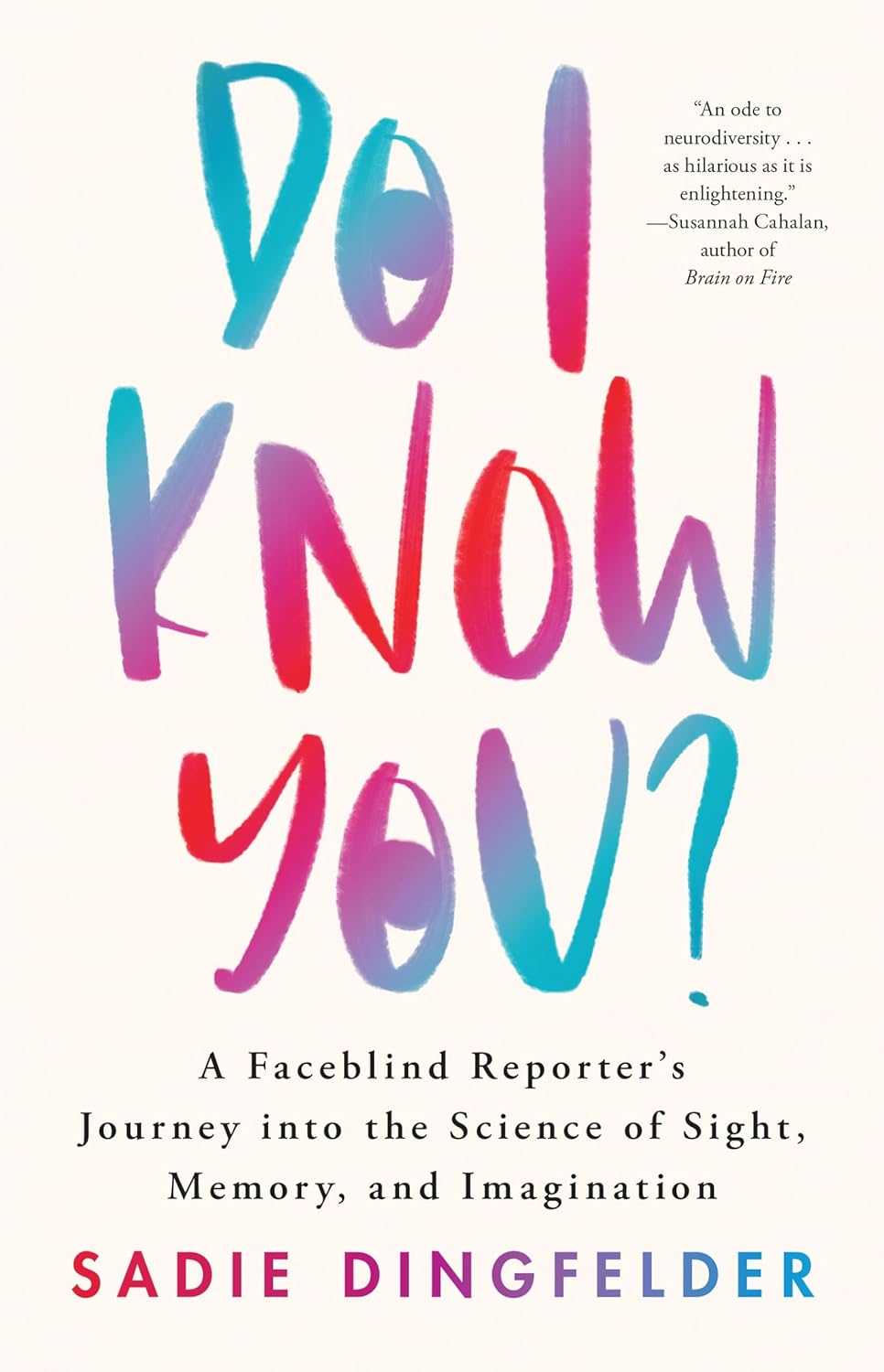
“Do I Know You?” by Sadie Dingfelder,is an eye-opening autobiography about a self-described “quirky” forty-year-old woman who recently discovered her inability to recognize faces, known as prosopagnosia. Throughout her life, Sadie felt her experiences were different from those around her. She always wondered why she had a hard time making friends, why she was never asked out on a date, and why she felt so lonely. Although recognizing the face of a loved one, a friend, or a stranger seems simple for most people, for Sadie it is like solving a new riddle with every new face. To her, interactions that normally would be defaulted on by intuitive memory, are moments for strategic planning and insight that take a massive amount of effort. For instance, to remember a woman named Sandy, Sadie would memorize her hair as being a sandy color, thereby remembering her name. Throughout her experiences, Sadie feels like sometimes all she does is talk to strangers.
Prosopagnosia is a neurological disorder in which one has an inability to recognize known faces, deriving from the Greek words prosopon, meaning face, and agnosia, meaning lack of knowledge (Rocha Cabrero & De Jesus, 2024). This condition can be acquired following an injury to the brain or inherited. Damage in the right or bilateral fusiform-lingual gyrus, where facial recognition and memory are processed, is thought to be the primary reason for acquired prosopagnosia. Whereas development of prosopagnosia seems to be caused by either a disconnection between anterior and posterior face networks, or reduced activation in regions of the brain responsible for facial recognition (Rocha Cabrero & De Jesus, 2024). Sadie, along with being diagnosed with prosopagnosia, has stereoblindness (inability to perceive in 3D), aphantasia (inability to visualize), and SDAM (severely deficient autobiographical memory).
Sadie first discovers her unknown condition after reading an article on prosopagnosia in The New Yorker, written by neurologist, Oliver Sacks. Quick to realize the similarities between this condition and her own, Sadie questioned, “Is that me?” Initially, Sadie tries to reject the notion that she has severe face blindness; being cast as an outsider from an ocean of neurotypical people is a hard reality to face. Sadie, however, puts her best foot forward while advocating for neurodiversity.
Sadie reinterprets her memories, and she begins to see the offbeat and out of kilter thread running through each storyline. After her uncomfortable epiphany in the grocery store while shopping with her husband Steve, Sadie describes her unfortunate mishap, noting that, “All at once, I see that this man is not my husband. He’s a Steve-shaped stranger who’s wearing almost the exact same coat. What a nasty trick!” (Dingfelder, 2024, p. 14). She later returned to her husband in the checkout line, embarrassed and shocked at the realization that this is not the kind of mistake other people make. Sadie begins researching her unknown condition, searching for answers to identify it. Sadie began communicating with Joe DeGutis, a Harvard neuroscientist who is conducting experiments on the topic of face blindness, and Sadie decides to take part in his research experiments. After flying to Boston to undergo those experiments and complete a training program and countless facial recognition tests, Sadie receives a formal diagnosis of severe prosopagnosia and begins to accept her new reality.
Sadie examines the vastly diverse ways in which people think and see the world. Her struggles of understanding and coping with her newly diagnosed neurological disorder led her to a refreshing realization about neurodiversity. With everything we know and do not know about the brain and its cognitive processes, many atypical ways of thinking are yet to be discovered. After reading this book, the question stands: Does a neurotypical person exist?
Despite the challenges posed by her condition, Sadie adeptly interweaves humor into her narrative, creating entertaining anecdotes of her awkward interactions that captivate and amuse her audience. This book illustrates an engaging and insightful story into Sadie’s life as she deals with the obstacles that prosopagnosia poses. Sadie offers an optimistic lens, leaving you to question the existence of the “typical” mind, while exploring new avenues of thinking. This refreshing story will captivate and entertain readers, shedding light on several less-known disorders and reconceptualizing the concept of neurodiversity.
References
Dingfelder, S. (2024). Do I Know You? United States: Little, Brown and Company
Rocha Cabrero, F., De Jesus, O. (2023). Prosopagnosia. Treasure Island (FL): StatPearls Publishing.https://www.ncbi.nlm.nih.gov/books/NBK559324/