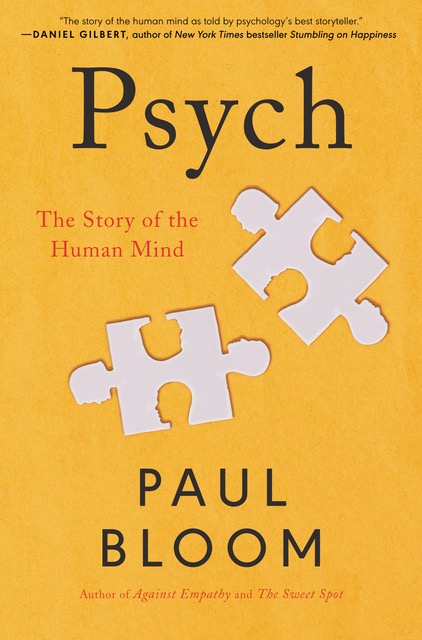
Author: Paul Bloom
Publisher: Ecco
Publication Date: February 2023
ISBN: ISBN 0063096358
While it may seem unlikely for a single book to provide an empirical and informative introduction to a field as expansive as psychology, in his new book Psych: The Story of the Human Mind, Paul Bloom masterfully discusses a wide range of topics, including child development, learning, language, memory, sensation and perception, motivation, prejudice, intelligence, mental illness, and much more. A professor of Psychology at the University of Toronto and Yale University, Dr Bloom teaches an open on-line Introduction to Psychology course that has been taken by over one million individuals.
Psych is organized into five distinct yet related sections: foundations, thinking, appetites, relations, and differences. Although these may seem unrelated, Bloom brilliantly connects these topics by infusing concepts, like cognitive dissonance, into multiple sections, demonstrating the interconnectedness of various sub-fields of psychology. The book can be read without prior knowledge of psychology or can enhance the understanding of an experienced psychology instructor with respect to content and also clarifications of complex concepts with clear, illustrative examples.
There are dozens, if not hundreds, of intellectual gems on a variety of topics, so only a few can be described here. These include the application of Karl Popper’s falsifiability criteria to a variety of theories such as those of Freud and Skinner, a consideration of humans’ ability to distinguish differences in the sounds of languages despite not knowing them, and an analysis of the relevance of biological predispositions for the following areas: learning, language, intelligence, the forming of phobias, and psychopathology. Additionally, the book describes the four laws of genetics to understand and explain human behaviors. Bloom also discusses current methodological concerns in psychological research, such as P-hacking and the typical overuse of participants who fit the WEIRD acronym (Western, Educated, Industrialized, Rich and Democratic).
Bloom offers insights into what is generally accepted by research psychologists and also highlights topics that are highly contentious or even somewhat dismissed by the academic community. There is, for example, an entire chapter devoted to the theories and ramifications of Sigmund Freud, despite his largely unfalsifiable claims. Bloom shows a great appreciation for the field’s history and the development of our current understandings by discussing the complexities of many unresolved debates. For example, he discusses the Whorf-Sapir hypothesis, regarding the relationship between language and thought, in great detail. Bloom does acknowledge and explain both the evidence and intricacies for proponents of the Whorf-Sapir hypothesis, as well as its skeptics and critics, as he does for many topics throughout the course of the book.
Bloom describes dozens of influential experiments and studies in psychology such as the Asch study of conformity, Milgram’s study of obedience, and Garcia’s and Breland’s research on learning. Each study is clearly explained with clarity and insight often revealing information that is not typically covered in introductory psychology textbooks. He also includes several theories proposed by the forerunners of modern psychology such as Charles Darwin, William James, and many others.
Despite the advancements in psychology described in Psych, Bloom makes it clear that psychology, like all branches of science, is simultaneously incomplete yet cumulative and progressive. We know, for example, that partial reinforcement leads to more resistant behaviors, tends to neglect base rates in problem-solving, and can change behaviors through systematic reinforcement and shaping. However, we still don’t fully comprehend all of the ways in which the brain influences our experiences, or how to eradicate disorders such as schizophrenia. Despite our advances, Bloom frequently acknowledges that there is still much to learn.
Bloom has written a masterful book that effectively covers a wide range of topics in a way that is easy to comprehend. Regardless of whether a reader intends to study psychology or is just looking for an introduction, Psych is an excellent resource for all.