Confronting Inequality
Available formats
Also available from
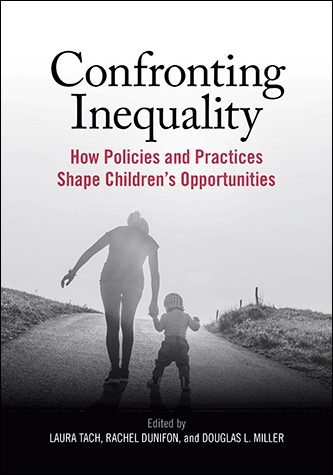
All children deserve the best possible future. But in this era of increasing economic and social inequality, more and more children are being denied their fair chance at life.
This book examines the impact of inequality on children’s health and education, and offers a blueprint for addressing the impact of inequality among children in economic, sociological, and psychological domains.
Chapters examine a wide range of studies including exposure to stress and its biological consequences; the impact of federal programs offering access to nutrition for mothers and children; the impact of parental decision-making and child support systems; the effects of poverty on child care and quality of education, parental engagement with schools, parent-child interactions, friendship networks, and more.
The book concludes with commentaries from leading scholars about the state of the field, and efforts to help mitigate the effects of inequality for children in the U.S. and throughout the world.
Contributors
Introduction. What Does it Take to Improve Equality of Opportunity for Children?
I. Health
- Reducing Stress Disparities: Pathways to Equity through the Study of Stress Biology
- Does the WIC Program Promote Equality of Opportunity in Early Life?
- How Do Early Life Health Experiences Affect Future Generations’ Equality of Opportunity?
II. Family
- Behavioral Insights and Parental Decision-Making
- “Whatever They Need”: Helping Poor Children Through In-Kind Support
III. Neighborhoods and Schools
- Promoting Equality of Opportunity by Investing Early: Recommendations for Longitudinal Research
- Does School Spending Matter? The New Literature on an Old Question
- How Parents and Children Adapt to New Neighborhoods: Considerations for Future Housing Mobility Programs
IV. Multidisciplinary Commentary
- Core Concepts from the Bioecological Model of Human Development
- Education and Equality of Opportunity
- Multigenerational Influences on Child Development
Conclusion
Laura Tach, PhD, is an associate professor of policy analysis and management and sociology (by courtesy) at Cornell University. Her research and teaching interests focus on poverty and social policy.
She co-directs Cornell Project 2Gen, an initiative of the Bronfenbrenner Center for Translational Research that serves as a hub for research, policy, and practice that supports vulnerable caregivers and children together.
Prior to joining the Department of Policy Analysis and Management at Cornell, Laura was a Robert Wood Johnson Foundation Postdoctoral Scholar at the University of Pennsylvania.
Rachel Dunifon, PhD, is interim dean of the College of Human Ecology and professor in the Department of Policy Analysis and Management at Cornell University.
Prior to joining Cornell as a faculty member in 2001 she was the recipient of an NIH-funded postdoctoral fellowship at the University of Michigan. Dunifon’s research focuses on child and family policy, examining the ways in which policies, programs and family settings influence the development of less-advantaged children.
Dunifon is co-director of Project 2GEN, which combines research, policy, and practice to address the needs of vulnerable children and their parents together.
Visit her page on the Cornell University College of Human Ecology websiteopens in new window.
Douglas L. Miller, PhD, is associate chair and professor of policy analysis and management at Cornell University. His research interests include applied econometrics, and social policy, with an emphasis on demographically and economically vulnerable populations as well as the relationship between the economic environment and health outcomes.
Prior to joining the Department of Policy Analysis and Management, he was a member of the Economics Department at UC Davis.