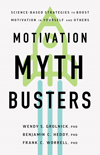
 Authors: Wendy S. Grolnick, PhD, Benjamin C. Heddy, PhD, and Frank C. Worrell, PhD
Publisher: American Psychological Association
Publication Date: 2024
ISBN: 978-1-4338-4167-5
Pages: 369
Price: $21.99 (paperback)
This book examines many assumed motivational factors and shares strategies for increasing motivation. This book also addresses some common beliefs that may harm motivation. For instance, some of the chapters include "Competition Can Actually Be Demotivating," "There Are More Effective Motivators than Competition," and "Telling People They Are Smart Can Backfire." The authors explain our often-flawed thinking and ask us to explore how factors like curiosity, intrinsic motivation, flow, grit, and structure can increase motivation.
The authors bring expertise and unique insights to this book. Wendy S. Grolnick, PhD, a professor of psychology at Clark University, is an expert on motivation, and a leading researcher on parenting. Benjamin C. Heddy, PhD, an associate professor of educational psychology at the University of Oklahoma, is the director of the school’s Motivation, Out-of-school, Value, and Engagement (MOVE) research lab. Frank C. Worrell, PhD, a professor in the School of Education at the University of California, Berkeley, studies adolescence, ethnic and racial identity, and talent development.
The authors’ writing engages all readers by highlighting a case story at the beginning and end of each chapter. Each case exemplifies a common motivational issue, such as how telling a student they are smart can decrease their performance. The authors attempt to “end the story” at the end of each chapter by asking questions, suggesting strategies, or following up with case subjects.
This book contains all the research of an academic journal without the academic jargon that often makes scientific research unattractive to the average reader. Each chapter is free-standing and can be understood without reading the other chapters. Motivation Myth Busters is well written, easy to understand, and gives simple suggestions on how to implement motivational strategies.
Motivation Myth Busters is a must-read for parents, teachers, coaches, and employers. This book uses empirical evidence to explain why motivation is as unique as a fingerprint and helps the reader understand how everyone is motivated to be productive. The key is to find ways to internalize motivation and be less reliant on extrinsic and short-term motivators. This publication helps us understand principles from cognitive, motivational, and social psychology.
Teachers could use this book to expand students’ understanding of their own motivation and cognition. The conclusion of the book invites the reader to put the science of motivation to use. The authors created a flow chart to help guide readers to evaluate their own thinking. The authors then provide scenarios of various individuals struggling with motivation and then an explanation of how the motivation flowchart could be used to find faulty thinking. Finally, the authors offer readers strategies for implementing solutions to the sample problems and ask readers to try it on their own. The last chapter could easily be used as a discussion or paper prompt in an introductory psychology course.
The authors do an excellent job of explaining past and current motivational theories as they are addressed in the book. Readers do not have to have a background in cognition or motivation to benefit from this book. Motivation Myth Busters does a great job of not only educating the reader but also explaining how the theories can be put into practice.