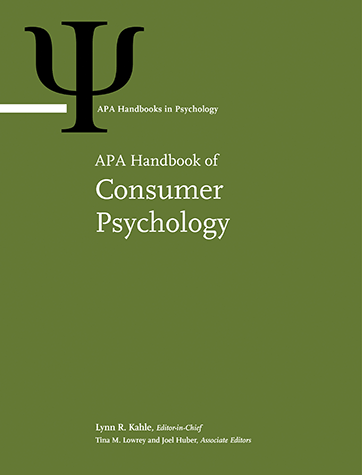
APA Handbook of Consumer Psychology
ISBN: 978-1-4338-3642-8Available formats
Part of the landmark APA Handbooks in Psychology® Series from APA
The APA Handbook of Consumer Psychology presents a comprehensive survey of the field, including its historical background and critical sources of information in both core and emerging literature.
This 33-chapter handbook is designed as a library reference that captures up-to-date content on consumer psychology, with insights offered by an outstanding roster of contributors. Broad coverage areas include perspectives on consumer psychology, consumer characteristics and contexts, use of psychology to communicate with consumers, consumer cognitions and affect, and use of psychology to carry out business functions.
Chapters pinpoint practical issues; probe unresolved and controversial topics in a balanced manner; and present future theoretical, research, and practice trends. The handbook provides a starting point for an examination of consumer psychology and ways to move the knowledge forward in this meaningful and vital area of human behavior.
Editorial Board
About the Editors
Contributors
A Note from the Publisher
Introduction
Part I. Perspectives on Consumer Psychology
- Chapter 1. Consumer Psychology: Evolving Goals and Research Orientations
Joel B. Cohen and William L. Wilkie - Chapter 2. The Activation and Use of Declarative and Procedural Knowledge
Robert S. Wyer, Jr. - Chapter 3. Consumer Psychology Knowledge
Gordon R. Foxall - Chapter 4. Structural Equation Models in Consumer Research: Exploring Intuitions and Deeper Meanings of SEMs
Richard P. Bagozzi - Chapter 5. Understanding the Changing Role and Functions of Marketing
Kevin Lane Keller
Part II. Consumers Have Demographic and Psychographic Characteristics
- Chapter 6. Poverty and Consumer Psychology
Ronald Paul Hill - Chapter 7. Children as Consumers: A Review of Fifty Years of Research in Marketing
Deborah Roedder John and Lan Nguyen Chaplin - Chapter 8. Gender Research in Marketing, Consumer Behavior, Advertising, and Beyond: Past, Present, and Future
Linda Tuncay Zayer and Kathrynn Pounders - Chapter 9. A Structural Versus Dynamic View of Personality in Consumer Behavior
Suresh Ramanathan - Chapter 10. Consumer Values
Eda Gurel-Atay - Chapter 11. Lifestyle and Sports: Emulation Marketing
Pierre Valette-Florence, Tony Meenaghan, and Lynn R. Kahle
Part III. Consumers Live in a Social Psychological World
- Chapter 12. Cultural Influences on Consumer Psychology
Carlos J. Torelli and Sharon Shavitt - Chapter 13. Attitude Change and Persuasion: Classic, Metacognitive, and Advocacy Perspectives
Zakary L. Tormala and Derek D. Rucker - Chapter 14. Social Relationships and Consumer Behavior
Kelley Wight, Peggy J. Liu, James R. Bettman, and Gavan J. Fitzsimons - Chapter 15. Sustainability: Understanding Consumer Behavior in a Circular Economy
Marius Claudy and Mark Peterson - Chapter 16. Marketing Ethics, Ethical Consumers, and Ethical Lapses
Ann-Marie Kennedy and Sommer Kapitan - Chapter 17. Time
Ashwani Monga, Ozum Zor, and Rafay A. Siddiqui - Chapter 18. Psychological Aspects of Economic Expectations
Richard Curtin
Part IV. Businesses Use Psychology to Communicate With Consumers
- Chapter 19. Language and Consumer Psychology
Ruth Pogacar, Alican Mecit, Fei Gao, L. J. Shrum, and Tina M. Lowrey - Chapter 20. The Consumer Psychology of Traditional Media
Esther Thorson - Chapter 21. Social Media: From Classic Psychological Theories to New Opportunities
Cait Lamberton and Ashlee Humphreys - Chapter 22. Celebrity Endorsements
Eda Gurel-Atay
Part V. Consumers Process Cognitions and Affect
- Chapter 23. Omission Neglect and Consumer Judgment and Inference Based on Limited Evidence
Frank R. Kardes, Steven S. Posavac, and Donald R. Gaffney - Chapter 24. Three Mechanisms of Mind-Body Influence: Feelings, Concepts, and Procedures
Spike W. S. Lee and Lorenzo Cecutti - Chapter 25. The Interplay of Affect and Cognition: A Review of How Feelings Guide Consumer Behavior
Rashmi Adaval and Maria Galli - Chapter 26. Consumer Involvement and Engagement: From Involvement’s Elaboration Likelihood to Engagement’s Investment Propensity
Linda D. Hollebeek and Rajendra K. Srivastava - Chapter 27. Neural Basis of Consumer Decision Making and Neuroforecasting
Alexander Genevsky and Carolyn Yoon - Chapter 28. Consuming for Happiness
Siok Kuan Tambyah and Soo Jiuan Tan
Part VI. Businesses Use Psychology to Carry Out Functions
- Chapter 29. Omnichannel Retailing: A Consumer Perspective
Peter C. Verhoef, Koert van Ittersum, P. K. Kannan, and Jeff Inman - Chapter 30. Pricing
Kent B. Monroe - Chapter 31. The Brand Property Strength Framework: Integrating Theory and Research on Brand Consumer Psychology
Joseph R. Priester, Monique A. Fleming, Leigh Anne Novak Donovan, and Chaumanix Dutton - Chapter 32. Innovation and Product Development
Doug Hall - Chapter 33. Human Factors Research and User-Centered Design
Robert W. Proctor, Leon Zeng, and Kim-Phuong L. Vu
Index
Editor-in-chief
Lynn R. Kahle, PhD, has always believed that consuming food contributes to happiness and sustaining health. He received his PhD in social psychology from the University of Nebraska (corn-fed beef) and subsequently worked as a postdoctoral fellow at the University of Michigan Institute for Social Research (Frankenmuth chicken).
He is emeritus professor of marketing and recipient of the 2014 Thomas Stewart Distinguished Professorship at the University of Oregon Lundquist College of Business (Dungeness crab, fresh strawberries). For many years he chaired the department of marketing there (Voodoo donuts, pinot wine). He served as founding director of the Warsaw Sports Marketing Center (craft beer, hazelnuts). He has also taught at Hanyang University in Seoul (kimchi), Pace University in New York (pizza), Griffith University in Australia (bbq’d prawns), Copenhagen Business School in Denmark (smørrebrød), and Singapore Management University (chili crab). He has enjoyed a study abroad program in Vienna, Austria (wienerschnitzel) and won a Fulbright scholarship to work in Phnom Penh, Cambodia (samlor korko).
He previously served as president of the Society for Consumer Psychology. He represented consumer psychology for two terms on the APA Council of Representatives and chaired the APA Membership Board. He advocated for human rights as the president of the City of Eugene Human Rights Presidents’ Council. Meetings of these groups often involved a tuna sandwich lunch.
He was honored with the Lifetime Achievement Award from the American Marketing Association Consumer Behavior SIG and the Distinguished Career Contributions to the Scientific Understanding of Sports Business from the American Marketing Association Sports SIG. He received the Stotlar Award for Education from the Sport Marketing Association. Champagne is nice on occasion.
Dr. Kahle helped develop the List of Values and has subsequently conducted research on values and lifestyles. His work has been published in such places as the Journal of Personality and Social Psychology, Journal of Consumer Psychology, Journal of Consumer Research, and Journal of Marketing. He has also studied consumption in relation to religion, to sport, and to sustainability. His 15 books include Marketplace Lifestyles in an Age of Social Media with Pierre Valette-Florence and Consumer Social Values, edited with Eda Gurel-Atay.
And for dessert he sometimes likes tiramisu, because it deliciously combines diverse layers into a substantial collection of integrated tastes.
Associate editors
Tina M. Lowrey, PhD, (University of Illinois) is professor of marketing at HEC Paris. Her research interests include children’s consumer behavior, materialism, the application of psycholinguistic theory to marketing communications, and gift-giving and ritualistic consumption. Her work has appeared in numerous journals, including Journal of Consumer Research, Journal of Consumer Psychology, Journal of Marketing, Journal of the Association for Consumer Research, International Journal of Research in Marketing, and Journal of Advertising.
She is currently serving on the JCR Policy Board, and is on the editorial review boards of the Journal of Consumer Psychology, International Journal of Research in Marketing, and Journal of Advertising. She edited Brick & Mortar Shopping in the 21st Century and Psycholinguistic Phenomena in Marketing Communications (both Erlbaum). She coedited The Routledge Companion to Consumer Behavior (with Mike Solomon).
She has chapters in Contemporary Consumption Rituals: A Research Anthology (which she coedited with Cele Otnes); Handbook of Research on Identity Theory in Marketing; The Psychology of Entertainment Media: Blurring the Lines Between Entertainment and Persuasion; The Sage Handbook of Persuasion: Developments in Theory and Practice; Handbook of Media Effects; Go Figure: New Directions in Advertising Rhetoric; Handbook of Qualitative Research Methods in Marketing; Marketing Communication: Emerging Trends and Developments; Gender Issues and Consumer Behavior; Gift Giving: A Research Anthology; and New Developments and Approaches in Consumer Behavior Research, among others.
She has served as ACR treasurer, cochaired the first-ever virtual ACR conference in 2020 (which was supposed to be in Paris), has cochaired three European and Latin American ACR conferences, and solo-chaired an SCP boutique conference and an APA Division 23 conference.
She received a BBA in finance from the University of Houston, an MS in advertising from the University of Illinois, and her PhD in communication and social psychology from the University of Illinois. She has taught at Rider University (New Jersey), the University of Texas at San Antonio, and is currently at HEC Paris (serving as PhD coordinator at the latter two institutions). She has visited at ESCP Paris, NYU, Tulane, University of Sydney, and Wharton.
She currently teaches two doctoral seminars at HEC: research methods to PhD students in all business disciplines, and consumer behavior to primarily marketing students. And, yes, she agrees with Lynn that champagne is always good, and has not yet found any cuisine that isn’t wonderful!
Joel Huber, PhD, is the Alan D. Schwartz Professor Emeritus at the Fuqua School of Business, Duke University. He received his undergraduate degree from Princeton and his MBA and PhD in 1974 from the Wharton School of the University of Pennsylvania. In addition to Fuqua, he has taught at the business schools at Penn, Columbia, and Purdue University. He was associate dean for the Daytime program at Fuqua from 1995–1999.
He is on the review boards for numerous journals and has been an associate editor for Journal of Consumer Research, Journal of Consumer Psychology, Marketing Science, and International Journal of Research in Marketing. From 2006–2009 he served as editor-in-chief for the Journal of Marketing Research, and from 2014–2020 was the inaugural editor-in-chief for the Journal of the Association for Consumer Research.
His research interest focuses on predicting and understanding market choice, with a continuing focus on ways to measure preference through choice-based conjoint analysis. He has worked for many years with Sawtooth Software and others to help develop new ways to determine the best ways to measure consumers’ product desires and beliefs.
A series of grants from the U.S. Environmental Protection Agency led to studies of the value of cleaner lakes and streams and healthier drinking water. That work later evolved into a number of studies with W. Kip Viscusi and Jason Bell exploring household recycling behavior from a large national sample of households between 2005 and 2015. Research with Martin Meissner and others has used eye tracking to reveal the way people process complex repeated choice tasks.
His published papers are available on his websiteopens in new window.