Psychology students are no strangers to randomness in data. Data around human behavior are usually loaded with unpredictability, so why would plans for after graduation be any different? If your students are considering where in the workforce to apply their newfound skills, there are free tools to help them explore their options.
Page, C. (2026, September 3). I have a bachelor’s degree in psychology… now what do I do? https://www.apa.org/ed/precollege/psychology-teacher-network/introductory-psychology/bachelor-degree

Is entering the workforce with a psychology bachelor’s degree worth it?
Many students may be wondering if starting their career with a bachelor’s is the right next step. Whether starting their career now is “worth it” is going to be a personal decision based on several factors. If they are looking to practice psychology in a professional and licensed capacity, that will require graduate education. But there are many other routes available to them, as well. Students with a four-year degree in psychology may wonder what careers are available to them, or what skills they should highlight in their resumes. The tools included below can help you guide them to these answers.
In fact, as of 2023, the majority (53%) of psychology bachelor’s degree holders have not gone on to obtain a graduate degree. This finding comes from the 2023 National Survey of College Graduatesopens in new window (NSCG), which connects degree completions to work outcomes. The same survey found that 80% of psychology bachelor’s degree holders who were just starting their professional careers were either very or somewhat satisfied with their current job. Therefore, your students can find meaningful and satisfying work right now.
Where can I work with a psychology bachelor’s degree?
A psychology degree is so versatile that it can be readily applied across business, human services, and education sectors, to name a few. As of 2023, the most common occupation categories for psychology bachelor’s degree holders were management (21%), social services (13%), administrative occupations (9%), sales and marketing (8%), and K-12 teachers (6%).
A four-year degree in psychology prepares graduates with marketable skills for many careers, from technological skills, like familiarity with statistical software or fluency in learning new programs, to cognitive skills, like analytical thinking and information management. The problem for recent graduates might be that they do not recognize the valuable skills they have developed or how to demonstrate these skills to employers. To this end, APA has developed a resource called The Skillful Psychology Student (PDF, 55KB)opens in new window, which, if shared with students, can help them identify and use these skills to get a job. You may want to highlight these skills if a student asks you for a recommendation letter.
For students exploring what jobs are available to them at any degree level, APA has published a free, online data tool called Careers in Psychology that can assist them. APA built this tool by filtering down the NSCG data to only include psychology graduates. The first view on the tool allows users to explore jobs by degree level and career stage, with larger job titles representing higher levels of employment in that role. Hovering over any of the job titles will display more information. And if students are interested in working in a particular sector and want to explore jobs related to that sector, they can select the sector in the bottom legend and the tool will highlight titles within that sector.
But what if I choose to attend graduate school?
For the 31% of psychology bachelor’s holders looking to earn a non-psychology graduate degree, APA's Degree Pathways in Psychology data tool, also built off NSCG data, can narrow the search. By pressing the visualization’s “show fields of non-psychology degrees” button, users can reveal a table showing the top non-psychology degree programs that psychology bachelor’s graduates go on to earn.
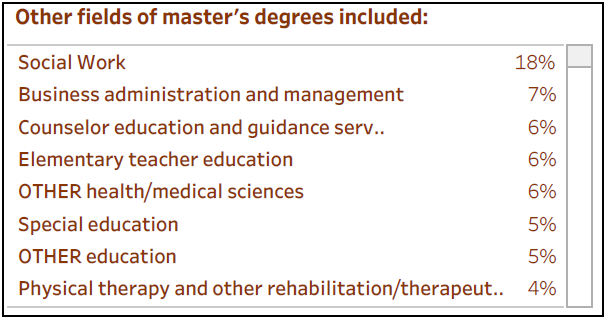
For students looking for a psychology graduate degree, another tool to consider is APA’s ‘Degrees in Psychology’ data tool. Data from this tool come from the Department of Education, specifically for annual degree completions across the country. The tabs titled “Master’s Degrees in Psychology” and “Doctorate Degrees in Psychology” include filters for field of degree and year. These tabs also include a heat map of where degrees are being conferred across the country and names of institutions awarding those degrees. For students with geographic constraints or those who are looking for lists of institutions awarding psychology graduate degrees, this tool allows them to easily explore those data.
About the author
 Cory Page is a senior research officer with the APA’s Psychology Team. His work centers on studying the psychological workforce, including its education, professional regulations, career pathways, and work experiences. He holds a master of public health and a master of public policy degree from the University of Michigan.