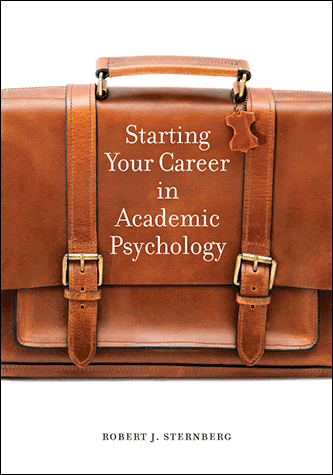
Starting Your Career in Academic Psychology
ISBN: 978-1-4338-2638-2You've earned your graduate degree in psychology, and maybe even landed your first academic job as a postdoc or faculty member.
How should you approach your new job and lay a solid foundation for tenure and promotion? How can you meet the many challenges of an academic career, which often requires skills that are not taught in graduate school?
This book provides a systematic guide for jump-starting your career in academic psychology — from applying and interviewing for academic positions, to settling in at your new job, to maximizing your success during the pre-tenure years.
The chapters cover all the key skills in which new faculty must become proficient: teaching, conducting and funding faculty-level research, serving your department and field, and "softer" activities such as networking and navigating university politics.
Given the ever-increasing demands and competition in the field, this guide is an essential roadmap for new academics.
Introduction
I. In the Beginning
- Before You Even Start
- Getting Going
II. Teaching
- Getting Started Teaching Your Courses
- Collaborating With Students
III. Research
- Forming Ideas for and Implementing Your Research
- Setting Up a Lab
- Forming Collaborations
- Getting a Grant
IV. Service
- Service to Your Department and University
- Service to Your Academic Field
V. Professional Advancement
- Networking
- Giving Talks and Lectures
- Writing Articles
- Departmental and University Politics
- Preparing for Tenure and Promotion
- Resolving Conflicts
- Twenty-One Common Mistakes Junior Faculty Make
Epilogue
References
Index
About the Author
Robert J. Sternberg, PhD, received his BA from Yale and his PhD from Stanford. He also is the recipient of 13 honorary doctorates.
He is a professor of human development at Cornell University and honorary professor of psychology at the University of Heidelberg, Germany. He previously served as a university dean, provost, and president. Earlier, he was IBM Professor of Psychology and Education in the Department of Psychology at Yale University and director of the Yale Center for the Psychology of Abilities, Competencies, and Expertise (PACE Center).
He was the 2003 president of APA and the 2012–2013 president of the Federation of Associations in Behavioral and Brain Sciences. He is editor of Perspectives on Psychological Science and previously was editor of The APA Review of Books: Contemporary Psychology and Psychological Bulletin.
He has won many awards, including the James McKeen Cattell (1999) and Williams James (2017) Awards of the Association for Psychological Science.
Dr. Sternberg is a member of the American Academy of Arts and Sciences and the National Academy of Education and a fellow of the APA, Association for Psychological Science, American Educational Research Association, and American Association for the Advancement of Science.
His work has been cited in the professional literature more than 115,000 times.
It is a valuable resource that will serve as a one-of-a-kind guidebook for graduate students, post-graduate trainees and new faculty within departments of psychology and related disciplines as well.
—New England Psychologist
Few psychologists can match that depth of experience…It would be difficult to find a psychologist more conspicuously qualified to take on questions as to how to succeed in academic psychology.
—PsycCRITIQUES
Given the demands and competition in the field, Starting Your Career in Academic Psychology is a comprehensive, thorough, and unreservedly recommended instructional guide that will prove to be an essential roadmap for new faculty.
—Midwest Book Review
Starting Your Career in Academic Psychology is a trove of insights and advice about launching an academic career — and keeping it going! Sternberg covers many issues that are seldom talked about, such as collaboration with students and departmental politics. What makes his advice less daunting than it might otherwise be is his self-effacing and nonthreatening tone, repeatedly pointing to his own mistakes. A wonderful read for any grad student aspiring to an academic career.
—Stephen J. Ceci, PhD
H. L. Carr Professor of Developmental Psychology, Cornell University, Ithaca, NY
I wish this book had been available when I was starting as a brand new assistant professor. Sternberg provides a valuable insider's guide to succeeding in academia. Even seasoned professionals will benefit from his helpful insights on everything from teaching and service to turning good ideas into a research career. It is a great gift for early career professionals, and the people who mentor them.
—Diane F. Halpern, PhD
Dean of Social Sciences, Emerita, Minerva Schools at KGI, San Francisco, CA; Professor of Psychology, Emerita, Claremont McKenna College, Claremont, CA
This stunningly comprehensive and accurate survival manual for those new to the psychology professoriat will also be of inestimable value to veteran members, and those in other areas of academe. With wit and wisdom, humor and humility, Sternberg — one of the most influential living psychologists — identifies the many quicksands, buzzsaws, bear traps, and other career-crippling hazards that lie in wait for the unsuspecting and tells how to avoid them — or extricate oneself if necessary. How I wish this book had been available to my students — not to mention myself!
—Ellen Berscheid, PhD
Regents' Professor of Psychology Emerita, University of Minnesota, Minneapolis
This is a must-read for graduate students and early career professionals of all fields. Sternberg covers all areas of interest in academia, from negotiating salaries to developing lectures to setting up research labs to addressing department and university politics. Graduate programs should consider developing a course using this book as its central text.
—Jeffery Scott Mio, PhD
California State Polytechnic University, Pomona