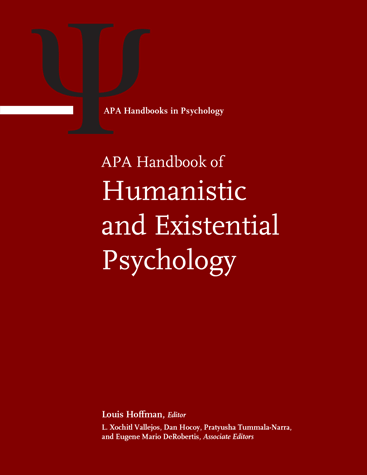
APA Handbook of Humanistic and Existential Psychology
Available formats
Part of the landmark APA Handbooks in Psychology® Series from APA
The 2-volume APA Handbook of Humanistic and Existential Psychology provides a comprehensive overview of the rich history, diverse theoretical perspectives, clinical and social applications, and important emerging issues and directions in the field.
The 61 chapters in this Handbook comprise a broad spectrum of coverage from the earliest foundations of humanistic and existential psychology to exciting future developments, including in-depth discussion of:
- important theorists upon whose work the field was built and developed
- aspects of human nature and existence, including creativity, freedom, social connectedness, authenticity, meaning making, and self-actualization
- the relationship of humanistic and existential psychology to other approaches, such as positive psychology, community psychology, and liberation psychology
- multiculturalism, diversity, and social justice in relation to practice, research, and theoretical development within humanistic and existential psychology
This Handbook is both a map of the current landscape of humanistic and existential psychology and a guide to where the field is headed. Researchers, practitioners, and students in psychology and related fields will learn how to incorporate a broad array of theoretical approaches; use quantitative, qualitative, and participatory methodologies; and apply the principles of humanistic and existential psychology to their practice, scholarship, and social advocacy.
Volume 1: History, Research, Philosophy, and Theory
Part I. History and Structure
- Chapter 1. A History of Humanistic and Existential Psychology: The Possibility and Cultural Contexts of Renewal in Science
Frederick J. Wertz - Chapter 2. Branches of Humanistic and Existential Psychology
Zenobia Morrill and José G. Luiggi-Hernández
Part II. Research
- Chapter 3. Qualitative Methods for Humanistic and Existential Research Grounded in Phenomenological, Hermeneutic, and Constructivist Paradigms
Scott D. Churchill and Amy Fisher-Smith - Chapter 4. Participatory and Relational Methodologies: Emergent Undercommons, Generative Refusals, and Fugitive Movements
Susan James and Helene Lorenz - Chapter 5. A Quantitative Review of Select Methods in Existential and Humanistic Psychology
Cathy R. Cox, Thomas B. Sease, and Francesca Gentea
Part III. Philosophy and Literature
- Chapter 6. Husserl, Heidegger, and Jaspers: Emergent Perspectives and Advancements
Susi Ferrarello and Francesca Brencio - Chapter 7. Kierkegaard and Nietzsche
Daniel Sullivan - Chapter 8. Sartre, de Beauvoir, and Merleau-Ponty: The French Existentialists
Claire Arnold-Baker, Simon Wharne, and F. Jak Icoz - Chapter 9. Frantz Fanon: Toward a New Humanism
Leswin Laubscher
Part IV. Psychological Theory
- Chapter 10. Conceptual and Historical Foundations of Human Science for Psychology
Christopher M. Aanstoos - Chapter 11. Otto Rank’s Original Contributions to Humanistic and Existential Psychology
Will Wadlington - Chapter 12. The Existential–Phenomenological Self: Perspectives and Insights
Fred J. Hanna and Joel Givens - Chapter 13. Existential Anxiety and Guilt
Claire S. LeBeau, Amanda B. Lowe, and Heather Macdonald - Chapter 14. Self-Actualization and Coactualization
Andrew M. Bland - Chapter 15. “A Little Stand-Offish”: Existential and Humanistic Diagnostic Perspectives
Anthony J. Pavlo - Chapter 16. The Psychology and Psychotherapy of Evil: Encountering the Daimonic
Stephen Arthur Diamond - Chapter 17. Terror Management Theory: Toward a Merger of Existential and Experimental Approaches to Understanding Human Behavior and Experience
Tom Pyszczynski and Moussa Diarra - Chapter 18. Contemporary Considerations of Freedom
Emmy van Deurzen - Chapter 19. Peak and Plateau Experiences and Our Higher Human Nature—With a Touch of Creativity
Ruth Richards and Stanley Krippner - Chapter 20. Myth and Existential Psychotherapy: Toward Inclusivity
Jason Dias and Justin J. Underwood - Chapter 21. Relationality, Isolation, and Alienation
Louis Hoffman and Sabah Islam - Chapter 22. Existential–Humanistic Developmental Psychology
Eugene Mario DeRobertis - Chapter 23. Authenticity and Genuineness
Todd DuBose - Chapter 24. Rethinking Individualism, Collectivism, and Conformity
Micah Ingle - Chapter 25. Critical Psychology
Oksana Yakushko - Chapter 26. An Existential Perspective on Positive Psychology: Toward a General Theory of Global Flourishing
Paul T. P. Wong - Chapter 27. A Contextualized Study of Zhi Mian and Its Critical View of Confucianism and Taoism: A Perspective of Humanism and Existentialism in Advocacy of Individualism
Xuefu Wang - Chapter 28. Liberation Psychologies and Decolonialities: Defecting From Environments of Domination to Build Spaces of Collective Agency, Prefigurative Politics, and Ecological Justice
Helene Lorenz and Susan James - Chapter 29. Reclaiming the Assimilation of Humanistic and Existential Psychology
Brent Dean Robbins
Index
Volume 2: Clinical and Social Applications
Part I. Psychotherapy
- Chapter 1. Foundations of Humanistic and Existential Therapy
Drake Spaeth - Chapter 2. Integrating Multicultural Perspectives
Makenna Berry Newton and Theopia Renee Jackson - Chapter 3. Collaborative Assessment
Hadas Pade and Alea Holman - Chapter 4. Coupling Existential–Humanistic and Systemic Paradigms
H. Luis Vargas and Lindsay L. Edwards - Chapter 5. Humanistic Child Therapy: Facilitating Healing Relationships
Dee C. Ray and Elizabeth V. Aguilar - Chapter 6. Contemporary Existential Group Psychotherapy: A Practice for Our Time
Francis Kaklauskas and Farooq Mohyuddin - Chapter 7. The Use of Research in Humanistic and Existential Psychotherapy
Hein Zegers and Siebrecht Vanhooren - Chapter 8. Expressive Arts Therapy
Sue Ann Herron - Chapter 9. Meaning Interventions: Working With Meaning in Life in Psychological Therapies
Pninit Russo-Netzer and Joel Vos - Chapter 10. Awe and Dread: An Existential Approach to Religion
Daryl R. Van Tongeren - Chapter 11. Existential–Humanistic Psychology’s Rightful Place in the Trauma Discourse
Theopia Renee Jackson and Marguerite Elise Pintauro - Chapter 12. LGBTQIA+ Applications in Humanistic and Existential Psychology
Madeline R. Stenersen and Sara K. Bridges - Chapter 13. Women and Humanistic Psychology
Vanessa F. Brown, Courtney D. Cabell, and Gina S. Belton - Chapter 14. Existential Sex Therapy
Shanae Adams - Chapter 15. Existential–Humanistic Animal-Assisted Psychotherapy
Betz King and Veronica Lac - Chapter 16. Somatic Psychotherapy
Eleanor Criswell Hanna - Chapter 17. Power Issues in Psychotherapy and How Contemporary Humanistic–Existential Approaches Address Them
Heidi M. Levitt and Zenobia Morrill - Chapter 18. Humanistic and Existential Therapies: An Integrative Perspective
Siebrecht Vanhooren and Kirk J. Schneider - Chapter 19. Emotion-Focused Therapy
Zoë Goldstein, Rhonda Goldman, and Danaë Rollet - Chapter 20. Gestalt Therapy
Samuel Kohlenberg and Ian Wickramasekera II - Chapter 21. A Brief Introduction to Constructivist Psychotherapy
Sara K. Bridges and Jonathan D. Raskin - Chapter 22. Contemporary Psychoanalysis and Existential Psychology
Rebecca Marcelina Gimeno - Chapter 23. Clinical Supervision Conducted From an Existential–Humanistic Perspective
Mark C. Yang and Xian Zhang
Part II. Social and Systemic Applications
- Chapter 24. Social Justice and Humanistic Psychology
L. Xochitl Vallejos and Nathaniel Granger, Jr. - Chapter 25. Meaning in Life and Society
Joel Vos - Chapter 26. Humanistic and Existential Approaches to Advocacy and Activism
Apryl A. Alexander, Hannah Klukoff, and Bronwyn Neal - Chapter 27. Polarization and the Experiential Democracy Dialogue
Kirk J. Schneider - Chapter 28. Ecopsychology and Humanistic Psychology: Critical Praxis for Justice Orientations
Derrick Sebree, Jr. and Gina S. Belton - Chapter 29. Deconstructing International Psychology
Sayyed Mohsen Fatemi - Chapter 30. Working With Organizational Systems
Gary S. Metcalf and Teresa A. Daniel - Chapter 31. Indigenous Psychology
Louise Sundararajan - Chapter 32. An Existential–Phenomenological Account of Community Psychology
Robert Garfield McInerney, Hannah Felix, Tea Johnson, Sam Merhaut, and Autumn Redcross
Index
Louis Hoffman, PhD, is executive director of the Rocky Mountain Humanistic Counseling and Psychological Associationopens in new window and a licensed psychologist in private practice. He serves on the editorial boards of the Journal of Humanistic Psychology, The Humanistic Psychologist, and the Journal of Constructivist Psychology. He has been recognized as a fellow of the American Psychological Association (APA) and is the 2020/2021 recipient of the Rollo May Award of the Society for Humanistic Psychology (APA Division 32). His interests include multicultural and social justice psychology, existential-humanistic therapy and evidence-based practice, and increasing access to psychotherapy and counseling. Visit him onlineopens in new window.