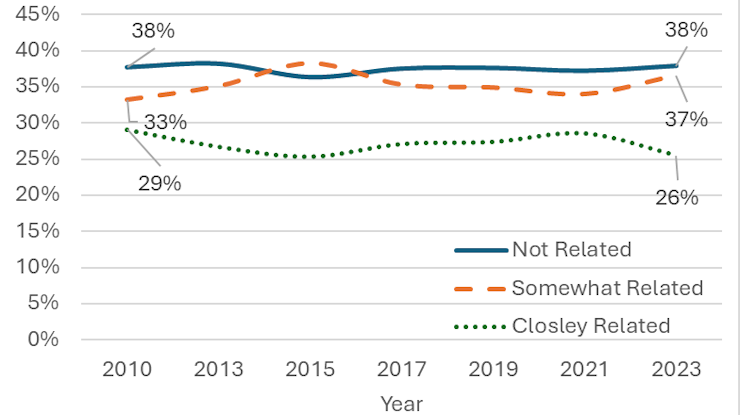
A wide variety of career pathways require the skills, abilities, and content knowledge learned as a psychology major, yet far too often psychology majors struggle to see how their academic background is related to and prepares them for their jobs. Only 26% of psychology majors indicated their jobs were closely related to psychology (National Science Foundation [NSF], 2025), and only one-third of psychology bachelor’s degree holders reported their jobs were somewhat related to psychology. These trends have held fairly steady since 2010 (NSF, select years). Importantly, about 38% of psychology bachelor’s degree holders reported their jobs were not related to psychology. This trend also did not change from 2010 to 2023. These findings suggest there is room for improvement in communicating and demonstrating the value of psychology in many career pathways.
Figure: Job relatedness to psychology for psychology bachelor’s degree holders
Psychology teachers are well-positioned to strengthen their students’ understanding of how the skills and content learned as psychology majors are foundational for many jobs, including market researchers, business intelligence analysts, and project managers. Students need to more clearly understand how psychology is crucial to the skills employers value, such as teamwork, leadership, communication, and problem solving.
How can psychology teachers more clearly connect psychology to a variety of career pathways? Here are some strategies to improve perceptions of the value of the psychology major at work.
- Facilitate student self-reflection and career exploration. Individual development plans (IDPs) can be helpful in exploring options, identifying goals, and creating a plan to achieve those goals. If you’re interested in a formal approach, check out APA’s IDP. This resource is aimed at graduate students and postdocs; however, with a little adaptation, it can be used by anyone at any career stage. Or try O*NET’s Interest Profileropens in new window, which can suggest occupations to consider. O*NET also has detailed profiles for occupations across the job markets, including skills, work activities, education, wages, and related occupations. Let’s say you had a student interested in analyzing data and communicating key findings. The student might look at the job requirements for market researchers, survey researchers, clinical data managers, business intelligence analysts, or additional occupations. Then they can compare their current skills and experiences to the job requirements. If their skills match the job requirements, then they can make a plan to apply for jobs. If their skills are missing something from the job requirements, then the student can figure out what they need to do (i.e. gain more work experience, pursue an advanced degree or certification) to be competitive for the jobs in which they are interested.
- Embed career information through psychology curricula, courses, and advising. The most recent APA Guidelines for the Undergraduate Major (2023) (PDF, 1MB)opens in new window emphasize connecting psychology education to careers and furthering students’ professional development. A Careers in Psychology course is a step in the right direction, but a large number of undergraduate programs do not offer a careers course (Norcross et al., 2016; Pfund et al., 2021). To more clearly connect skills to job opportunities, career information could be incorporated into courses across the curriculum (Conroy et al., 2022). The good news is you can start with your existing course syllabi, student learning outcomes, and assignments and be explicit about the skills students will develop in their psychology education. This will equip students with example language they can use in their resumes, cover letters, and job application materials.
- Help students know where to go for career resources. Give yourself some grace and recognize you do not have to have all the answers. Because of the breadth of career pathways, no one can be familiar with all of the pathways. Career services on your campus, APA, Society for the Teaching of Psychology (APA Division 2), O*NET, the National Association of Colleges and Employers (NACE), and related organizations can all fill this gap for information. See the resources at the bottom of this article for information you can share with your students.
By increasing awareness of the many career pathways from a psychology bachelor’s degree and the connection of the skills they learned in their major to those pathways, psychology majors will be better prepared for the possible future opportunities connected to their undergraduate education. As you communicate the connection between the psychology major and how psychology prepares students for a variety of career pathways, you might find more and more students continuing their study of psychology beyond the introductory course and declaring a psychology major.
About the authors
 Karen Stamm, PhD, is the senior director of the Center for Workforce Studies at the American Psychological Association. The mission of the APA Center for Workforce Studies is to collect, analyze, and disseminate information about the psychology workforce and education pathways. Karen has more than 15 years of experience in the field of psychology, both as an academic and with the APA. She is a quantitative psychologist who enjoys using data to tell compelling stories. Karen earned her PhD and MA in psychology from the University of Rhode Island and her BA in psychology and English from Boston College.
 Beth M. Schwartz, PhD, is the senior director of Precollege and Undergraduate Psychology Education at APA, supporting quality teaching and learning of psychology from high school through the undergraduate curriculum, fostering a community that exchanges pedagogical best practices, supports the needs of students and educators, advocates for the importance of education in psychology, and that promotes an understanding of the field’s breadth, skills developed, and the vast career opportunities. Beth has more than 30 years in the field of psychology, with much of her career as a faculty member and chief academic officer in higher education before joining the staff at APA. Beth earned her PhD and MA in experimental psychology from The State University of New York, Buffalo, and her BA in psychology from Colby College.
Resources
APA Individual Development Plan resource
The Skillful Psychology Student (PDF, 55KB)opens in new window
Guidelines for the Undergraduate Major 3.0 (PDF, 1 MB)opens in new window
Careers in Psychology data tool
O*NET’s Interest Profileropens in new window
National Association of College and Employers (NACE) Career Readinessopens in new window
References
Conroy, J. C., Stamm, K. E., Pfund, R. A., Christidis, P., Hailstorks, R., & Norcross, J. C. (2022). Career assistance from psychology programs and career services: Who is preparing psychology students? Teaching of Psychology, 49(2), 144-152. https://doi.org/10.1177/0098628320958695opens in new window
National Science Foundation, National Center for Science and Engineering Statistics. (select years). National Survey of College Graduates [data tables]. https://ncses.nsf.gov/surveys/national-survey-college-graduates/2023opens in new window
Norcross, J. C., Aiken, L. S., Hailstorks, R., Pfund, R. A., Stamm, K. E., & Christidis, P. (2016). Undergraduate study in psychology: Curriculum and assessment. American Psychologist, 71(2), 89-101. https://doi.org/10.1037/a0040095opens in new window
Pfund, R. A., Hailstorks, R., Stamm, K. E., Christidis, P., Conroy, J.C., & Norcross, J. C. (2021). Careers in psychology course: Prevalence, structure, and timing. Teaching of Psychology, 48(1), 63-68. https://doi.org/10.1177/0098628320959950opens in new window