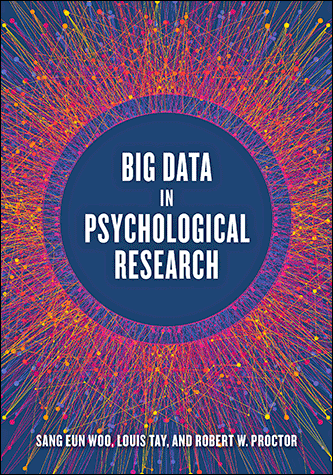
Big Data in Psychological Research
ISBN: 978-1-4338-3167-6Available formats
Also available from
Technological advances have led to an abundance of widely available data on every aspect of life today. Psychologists today have more information than ever before on human cognition, emotion, attitudes, and behavior.
Big Data in Psychological Research addresses the opportunities and challenges that this data presents to psychological researchers. This edited collection provides an overview of theoretical approaches to the utility and purpose of big data, approaches to research design and analysis, collection methods, applications, limitations, best practice recommendations, and key issues related to privacy, security, and ethical concerns that are essential to understand for anyone working with big data.
The book also discusses potential future research directions aimed at improving the quality and interpretation of big data projects, as well as the training and evaluation of psychological science teams that conduct research using big data.
I. Background and Overview
- Big Data Science: A Philosophy of Science Perspective
Brian D. Haig - Big Data: Challenges and Opportunities for Causal Inferences in the Experimental Tradition
Robert W. Proctor and Aiping Xiong - Big Data for Enhancing Measurement Quality
Sang Eun Woo, Louis Tay, Andrew T. Jebb, Michael T. Ford, and Margaret L. Kern
II. Innovations in Large-Scale Data Collection and Analysis Techniques
- Internet Search and Page View Behavior Scores: Validity and Usefulness as Indicators of Psychological States
Michael T. Ford - Observing Human Behavior through Worldwide Network Cameras***
Sara Aghajanzadeh, Andrew T. Jebb, Yifan Li, Yung-Hsiang Lu, and George K. Thiruvathukal - Wearable Cameras, Machine Vision, and Big Data Analytics: Insights into People and the Places They Go
Andrew B. Blake, Daniel I. Lee, Roberto De La Rosa, and Ryne A. Sherman - Human-Guided Visual Analytics for Big Data
Morteza Karimzadeh, Jieqiong Zhao, Guizhen Wang, Luke S. Snyder, and David S. Ebert - Text Mining: A Field of Opportunities
Padmini Srinivasan
III. Applications
- Big Data in the Science of Learning
Sidney K. D'Mello - Big Data in Social Psychology
Ivan Hernandez - Big Data in Health Care Delivery
Mohammad Adibuzzaman and Paul Griffin - The Continued Importance of Theory: Lessons from Big Data Approaches to Language and Cognition
Brendan T. Johns, Randall K. Jamieson, and Michael N. Jones - Big Data in Developmental Psychology
Kevin J. Grimm, Gabriela Stegmann, Ross Jacobucci, and Sarfaraz Serang - Big Data in the Workplace and Talent Analytics
Q. Chelsea Song, Mengqiao (MQ) Liu, Chen Tang, and Laura Long
IV. Best-Practice Recommendations for Responsible and Rigorous Use of Big Data
- The Belmont Report in the Age of Big Data: Ethics at the Intersection of Psychological Science and Data Science
Alexandra Paxton - Promoting Robust and Reliable Big Data Research in Psychology
Joshua A. Strauss and James A. Grand - Privacy and Cybersecurity Challenges, Opportunities, and Recommendations: Personnel Selection in an Era of Online Application Systems and Big Data
Talya N. Bauer, Donald M. Truxillo, Mark P. Jones, and Grant Brady - Privacy Enhancing Techniques for Security
Elisa Bertino - Future Research Agenda for Big Data Research in Psychology
Frederick Oswald
Sang Eun Woo, PhD, is an associate professor in the Department of Psychological Sciences at Purdue University. Her research focuses on industrial-organizational psychology, particularly personality and motivation, work attitudes, withdrawal behaviors, and interpersonal relationships in the workplace.
Louis Tay, PhD, is an associate professor in the Department of Psychological Sciences at Purdue University. His research focuses on industrial-organizational psychology, with a particular focus on issues related to methodology (i.e., measurement, continuum specification, latent class modeling, and big data/data science) and well-being (i.e., societal well-being, wellness programs, and work-leisure interface).
Robert W. Proctor, PhD, is a professor in the Department of Psychological Sciences at Purdue University. His research focuses on human performance, human-computer interaction, human factors issues related to information security and web design, and experimental research methods.
Below are the supplemental materials for Big Data in Psychological Research:
Chapter 7 Figures: “Human-Guided Visual Analytics for Big Data” (PDFopens in new window | DOCXopens in new window)
by Morteza Karimzadeh, Jieqiong Zhao, Guizhen Wang, Luke S. Snyder, and David S. Ebert