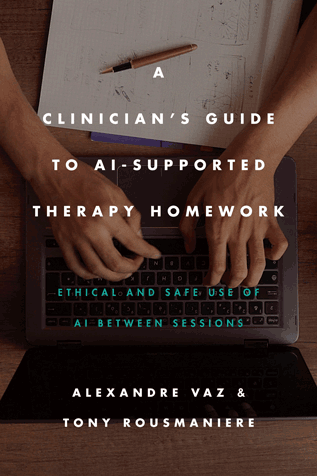
A Clinician's Guide to AI-Supported Therapy Homework
This guide outlines a step-by-step framework for helping clients use AI tools safely and effectively to enhance rather than replace therapy.
It reviews empirical research detailing how and why clients turn to AI chatbots for support and what they do and don't get out of it. These findings are translated into practical guidelines, including a set of overarching ethical principles, for leveraging artificial intelligence's benefits while mitigating its risks.
At the heart of this book are chapters that demonstrate how AI can be used to assist with between-session activities via three main roles: (a) reinforcing client motivation, (b) guiding clients through task completion, and (c) logging client activities and generating reports for review in the next session.
Each chapter breaks down the AI-integration process into five steps:
- Introduce AI as a potential homework partner, set boundaries to protect privacy and safety, and frame it within the context of therapy
- Codesign a simple, reusable AI prompt with optional variations based on the client's needs.
- Develop a clear plan for when and how to use AI.
- Encourage the client to engage in self-reflection after using AI.
- Review the results in the next session and integrate them into therapy.
Ethical guardrails that therapists can put in place to ensure client wellbeing are also reviewed, as are common challenges and how to respond. Case examples illustrate the entire AI-integration process with realistic clients. Therapist implementation checklists also outline key steps to take before and after assigning AI-assisted homework.
Foreword
Allen Frances
Preface
Part I. Context, Research, and Ethical Foundations
- Chapter 1. The Promise of AI for Between-Session Therapy Support
- Chapter 2. Digital Empathy: How AI Chatbots Work in Mental Health Contexts
- Chapter 3. What Are Therapy Clients Already Doing With AI? Emerging Research on AI in Mental Health
- Chapter 4. The Problem With Therapy Homework: Why Clients Struggle with Between-Session Work
- Chapter 5. A Clinical Framework for Safe AI-Assisted Between-Session Therapy Support
Part II. Diagnosis and Clinical Presentation-Focused Homework Assignments
- Chapter 6. Grounding and Emotional Regulation
- Chapter 7. Mood Tracking
- Chapter 8. Behavioral Activation and Daily Structure
- Chapter 9. Relationship and Communication Skills
- Chapter 10. Exposure and Avoidance Reduction
- Chapter 11. Self-Compassion Practice
- Chapter 12. Sleep Hygiene: Monitoring and Support
- Chapter 13. Perfectionism
- Chapter 14. Grief and Bereavement
- Chapter 15. Chronic Pain: Pacing and Acceptance
- Chapter 16. Addiction Recovery and Habit Change
- Chapter 17. Obsessive Compulsive Disorder: Exposure and Response Prevention Supports
- Chapter 18. Generalized Anxiety Disorder: Interrupting Worry and Rumination Loops
Part III. Population-Focused Homework Assignments
- Chapter 19. Couples Using AI Together
- Chapter 20. Chronic Disability
- Chapter 21. Autism and Neurodiversity: Social Communication Rehearsal
- Chapter 22. Caregivers and Family Burnout
- Chapter 23. Vocational Coaching
Appendix A. Clinician Checklist: Assessment of Client AI Use
Appendix B. Clinician Checklist: Appropriateness of AI Assistance Between Sessions
References
Index
About the Authors
Alexandre Vaz, PhD, is chief academic officer of Sentio University Marriage and Family Therapy (MFT) programopens in new window in California. This innovative online/hybrid California MFT degreeopens in new window was the first approved by the California BBS for MFT licensure to fully integrate deliberate practiceopens in new window and artificial intelligence (AI)opens in new window into its curriculum. He is also director of clinical training for the Sentio Counseling Centeropens in new window, which is Sentio MFT program’s guaranteed practicumopens in new window site. Dr. Vaz is the author/coeditor of many books on deliberate practice and psychotherapy training and is coeditor of APA’s Essentials of Deliberate Practice Series.
Tony Rousmaniere, PsyD, is president of Sentio University Marriage and Family Therapy (MFT) programopens in new window in California. He led the development of the online/hybrid Sentio MFT programopens in new window, the first MFT therapist training program approved by the California BBS for MFT licensure that integrates deliberate practiceopens in new window and artificial intelligence (AI) into its curriculum. Dr. Rousmaniere has authored/coedited many books on psychotherapy training and is coeditor of APA’s Essentials of Deliberate Practice Series. He is also executive director of the Sentio Counseling Centeropens in new window, which is the Sentio MFT program’s guaranteed practicumopens in new window site, and past president of the American Psychological Association’s Division 29.
Chances are many of our clients (with or without our knowledge) are consulting AI on their own to deal with their mental health issues between sessions. What should therapists do? This groundbreaking guide is essential reading for every practitioner, clinical supervisor, and trainee. It contains practical, step-by-step tools and thoughtful ethical guidelines to ensure we know how to help our clients use AI safely and in the context of a human-to-human relationship. This book will foster AI literacy—for clients and ourselves!
—Hanna Levenson, PhD, coauthor of Deliberate Practice in Psychodynamic Psychotherapy, Deliberate Practice in Emotionally Focused Couples Therapy, and Deliberate Practice in Accelerated Experiential Dynamic Psychotherapy
While many are hesitant to consider AI’s potential in clinical practice, this book leads the way in offering clear, practical tools and guidance for integrating AI into our work. It is also an invaluable resource for educators and supervisors who are supporting new clinicians to develop confidence and competence with AI. With this guide, we can all feel more prepared to apply AI thoughtfully and safely to enhance client outcomes, which is ultimately what matters most.
—Milena Esherick, PsyD, Associate Director, MS in Counseling, Kaiser Permanente School of Allied Health Sciences, Richmond, CA
Please see below to access the resources accompanying A Clinician’s Guide to AI-Supported Therapy Homework: Ethical and Safe Use of AI Between Sessions.
Note: These documents are offered for your personal use. If you reprint or adapt any of these resources for publication, permission is required from the publisher. Copyright 2026 by the Sentio Marriage and Family Therapy Programopens in new window. Reprinted with permission.