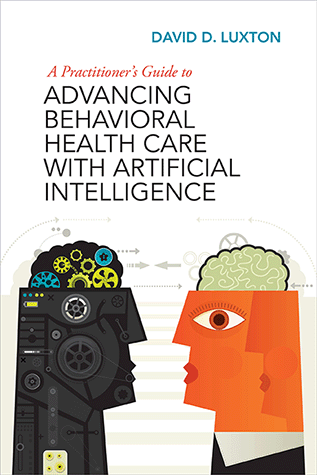
A Practitioner's Guide to Advancing Behavioral Health Care With Artificial Intelligence
ISBN: 978-1-4338-4451-5Available formats
Also available from
An essential, sensitive overview on the current and future use of artificial intelligence (AI) tools in the behavioral health care context.
Advances in AI are making possible more personalized, precise, efficient, predictive, and portable behavioral health care. This overview offers an important resource for practitioners who want to understand how AI can be used to improve their practice and help clients monitor their health.
AI is revolutionizing the delivery of behavioral health care for mental health care professionals and their clients. This handbook offers an accessible guide to this transformation. It explains the ways that AI tools are currently used in varied behavioral-health contexts, including office administration, research, assessment and diagnosis, and direct clinical care, and it identifies critical applications for future usage. The guide also presents the current and potential value of AI technology in professional training programs and patient self-care, suggesting important pathways to further development. Research grounds each chapter, bolstering the identification of the many opportunities for implementing AI to augment behavioral health, improve behavioral health outcomes, lower the costs of behavioral health care delivery, and benefit population health. Relevant ethical issues and safety concerns are sensitively discussed throughout.
Foreword
Nadine Kaslow, PhD
Introduction: Are You Ready for the AI Transformation?
- Chapter 1. Foundational Concepts and Definitions
- Chapter 2. AI Integration and Adoption Across Practice Settings
- Chapter 3. Risks, Safety, Ethics, and Legal Considerations
- Chapter 4. AI in Direct Clinical Care
- Chapter 5. AI in Psychological Assessment, Testing, Diagnostics, and Clinical Decision-Making
- Chapter 6. Intelligent Patient Monitoring, Management, and Self-Care
- Chapter 7. AI-Assisted Education, Training, and Supervision
- Chapter 8. Automated Workflow, Administrative, and Back-Office Assistance
- Chapter 9. Research and Program Evaluation Activities
- Chapter 10. Further Considerations and Opportunities
References
Glossary
Index
About the Author
David D. Luxton, PhD, MS, is an affiliate professor in the Department of Psychiatry and Behavioral Sciences at the University of Washington School of Medicine in Seattle. He has served as a research health scientist with the U.S. Navy and research psychologist and program manager with the U.S. Army. He has authored scientific and policy-level publications and books and has contributed to the U.S. Department of Defense, Department of Veterans Affairs, and Institute of Electrical and Electronics Engineers (IEEE), among others. He is a licensed clinical psychologist and U.S. Air Force veteran.
This engaging book helps clinical teams use artificial intelligence (AI) safely and effectively to streamline their work, offering more time for patient care. It provides practitioners without any technical background the right knowledge to navigate AI today and be ready for the AI of tomorrow.
—John Torous, MD, Associate Professor of Psychiatry, Harvard Medical School, Boston, MA, United States
This guide is an exceptional resource for practitioners, researchers, and behavioral health care administrators alike. Whether you’re an artificial intelligence (AI) novice or AI enthusiast, you’ll find Luxton’s clear writing and concrete examples to be accessible, informative, and practical.
—Dror Ben-Zeev, PhD, Professor of Psychiatry and Behavioral Sciences Director, University of Washington’s Behavioral Research in Technology and Engineering (BRiTE) Center, Seattle, WA, United States
Dr. Luxton connects us with practical ways artificial intelligence can assist, augment, and—on rare occasions—automate our work. We learn about the technology concepts, applications to clinical care, and safe, ethical, and legal practices. It promotes personalized care with culturally informed and equitable approaches. This is a must-read as part of education for trainees and professional development for those in practice—a trustworthy, transparent, and authoritative guide.
—R. Donald M. Hilty, MD, Professor at the UC Davis School of Medicine, Sacramento, CA, United States
Luxton cuts through artificial intelligence hype to deliver what practitioners actually need—a clear-eyed framework for integrating machine intelligence into behavioral health without losing sight of human dignity or clinical wisdom.
—Nell Watson, PhD, AI ethics expert; author of Taming the Machine: Ethically Harness the Power of AI and coauthor of Safer Agentic AI: Principles and Responsible Practices; President, European Responsible Artificial Intelligence Office (EURAIO), Leuven, Belgium
Luxton provides relevant, timely, and in-depth coverage of artificial intelligence in behavioral health care settings with the clinician in mind. The applications are practical, insightful, and easy to understand, even for readers with little or no background in technology. The text is useful and approachable, particularly for what at times can feel like a challenging topic. This is a must-read for clinicians and clinicians-in-training as we continue to practice in a technologically advancing culture.
—Jeremiah L. Peck, PhD, Chair, Graduate School of Counseling, George Fox University, Portland, OR, United States