A Practitioners Guide to Telemental Health
Available formats
Also available from
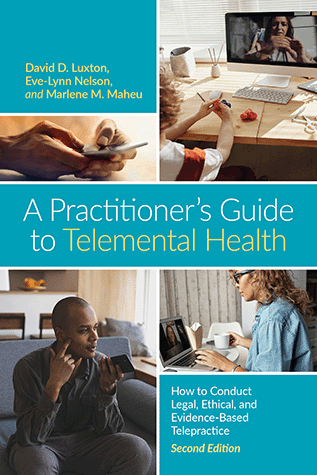
Now in its second edition, A Practitioner's Guide to Telemental Health is significantly updated with coverage of current best practices, evidence-based recommendations, and attention to nuanced refinements of telemental health in the face of recent accelerated growth in the field, due in part to the COVID-19 pandemic.
Telemental health, or TMH, has become integral to nearly all aspects of behavioral health service, including research and delivery of treatment, assessment, psychoeducation, training, supervision, and consultation. This has removed significant barriers to care access for many underserved groups; however, it also means that the field overall must build its capacity to provide TMH.
This book is for seasoned clinicians as well as new providers preparing to enter the mental and behavioral health care professions. Its chapters provide a guide for increasing TMH competencies, which require keeping up-to-date with the scientific evidence base and ongoing collegial discussion with informed leaders in the clinical, ethical, and legal realms.
Readers will benefit from the research presented, as well as the description of practical steps they can take to ensure they are providing rewarding, safe, and quality TMH care for their patients.
Foreword—Gerald P. Koocher
Acknowledgments
Introduction: Telemental Health Moves from the Margins Into the Mainstream
- Chapter 1. Concepts, Principles, and Benefits of Telemental Health
- Chapter 2. Overview of Telemental Health Technologies
- Chapter 3. Ethical, Legal, and Risk Management Considerations
- Chapter 4. Establishing a Telemental Health Practice
- Chapter 5. Safety and Emergency Planning and Management
- Chapter 6. Providing Direct Clinical Care
- Chapter 7. Conducting Psychological Assessments
- Chapter 8. Telesupervision and Training in Telepractice
- Chapter 9. Ethical Telepractice With Historically Underserved Populations
- Chapter 10. Optimizing Practitioner Skills and Resilience
- Chapter 11. Conclusion: A Call to Action and Telemental Health Leadership
References
Index
About the Authors
David D. Luxton, PhD, MS, is an affiliate professor in the Department of Psychiatry and Behavioral Sciences at the University of Washington School of Medicine, Seattle, and the founder of Luxton Labs LLC and Wayfarer Records LLC. Dr. Luxton's research and writing focus on the development and evaluation of innovative technologies in healthcare with specializations in artificial intelligence and ethics, telehealth, military and veterans’ health, and forensic psychology. He’s a licensed clinical psychologist and served in the United States Air Force.
Eve-Lynn Nelson, PhD, LP, FATA, is a professor of pediatrics and psychiatry at the University of Kansas. Securing over $40 million in federal funds over her career, Dr. Nelson’s research focuses on the evaluation of evidence-supported, patient-centered approaches in low-resource communities, including the evaluation of the array of telehealth technologies to deliver clinical and educational programming. She pioneered school-based telebehavioral health with her multi-state Telehealth ROCKS initiative (www.telehealthrocks.org) extending telebehavioral health best practices and social services support to set children up for success in the classroom and in life.
Marlene M. Maheu, PhD, is a telehealth consultant, author, publisher, trainer, and the founder of Telehealth.org, LLC. She has served on a dozen professional association committees and task forces related to telemental health, written five telehealth textbooks, 50+ book chapters, and journal articles, and trained more than 66,000 professionals in telehealth since 1994. She was the lead author of the first published competencies for telemental health and now serves as an expert witness in telehealth-related legal cases. Her 55 telehealth newsletters are read by more than 5,000,000 professionals annually. She founded the non-profit Coalition for Technology in Behavioral Science (ctibs.org) and its journal, the Journal for Technology in Behavioral Science.
Luxton, Nelson, and Maheu present an excellent overview of best practices for the telemental health professional. This text is incredibly timely, as the use of distance technologies is ever-changing in the professional clinical landscape. This is a must-read for both seasoned practitioners and practitioners in training.
—Jeremiah L. Peck, PhD, Western Seminary, Portland, OR
Written by a team synonymous with distinction in TMH care, this revised edition takes an interdisciplinary look at what has changed since the COVID years, including best practices, evidence-based recommendations, and artificial intelligence. It is hard to imagine a better book on TMH for practitioners, researchers, consultants, and mental-health related graduate students.
—Richard P. Long, Ph.D., Approved Supervisor and Clinical Fellow, American Association for Marriage and Family Therapy (AAMFT), Alexandria, VA
If you’re a health care professional, use this guide to discover the best ways to ensure accessible, quality, and safe telemental health care. It is easy to read, well-organized, and thoughtfully written by professionals who have clinical, educational, and research experience. They help us see virtual care from a 360-degree perspective. Trainees and early- and advanced career professionals will find it extremely useful.
—Donald M. Hilty, MD, MBA, Professor of Psychiatry and Behavioral Sciences, University of California (UC) Davis; Chief Medical Officer, Heritage Oaks Health System and Universal Health Services, Sacramento, CA; and Editor, Journal of Technology and Behavioral Science, Springer Nature