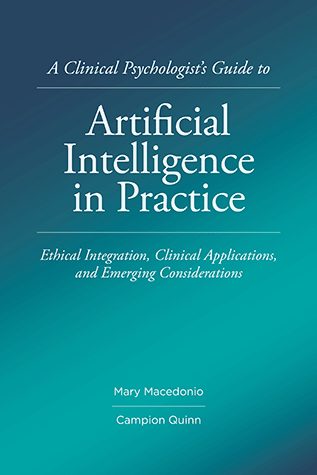
A Clinical Psychologist's Guide to Artificial Intelligence in Practice
Artificial intelligence now shapes assessment, documentation, triage, and digital therapy, yet most psychology programs offer little preparation for these tools. A Clinical Psychologist's Guide to Artificial Intelligence in Practicefills that gap for clinicians, trainees, and supervisors.
In clear and practical language, authors Macedonio and Quinn explain how AI systems work, how to use them responsibly, and how to evaluate risks such as bias and workflow disruption. Grounded in APA ethics policy and HIPAA compliance, AI systems are demystified and their utility to the full range of clinical concerns is explored. Relevant topics discussed include decision support, AI-driven psychometrics, tool selection, and potential risks to clients, including chatbot alliance. Ready-to-use tables provide practical guidance for vetting vendors and implementing and evaluating tools like ambient documentation and digital tracking devices. The material meets clinicians, trainees, and supervisors where they are, equipping them, and the students they train, for the technological revolution that's already here.
PART I: Foundations
- Chapter 1: The Clinical Problems AI Can Help Address
- Chapter 2: Ethical Foundations and HIPAA-Responsible Use
- Chapter 3: Evaluating and Choosing AI Tools
PART II: Clinical Applications
- Chapter 4: Ambient Documentation
- Chapter 5: Clinical Decision Support Systems
- Chapter 6: Therapeutic Chatbots and Digital Companions
- Chapter 7: AI-Enhanced Assessment
- Chapter 8: AI and Harm Prevention
PART III: Implementation and Professional Development
- Chapter 9: Data Protection and Vendor Management
- Chapter 10: Change Management in Clinical Settings
- Chapter 11: Training, Supervision, and Professional Competence
- Chapter 12: Research, Equity, and the Future of AI in Psychology
Campion Quinn, MD, FACP, MHA is a physician, educator, and medical author with over 25 years of experience across internal medicine, geriatrics, and emergency care. A fellow of the American College of Physicians, he has served in leadership roles in managed care and the pharmaceutical industry. Dr. Quinn has written extensively on clinical innovation and now focuses on how generative AI can reduce diagnostic error, streamline documentation, and improve patient outcomes. He brings a practical lens to this rapidly changing field, helping clinicians navigate the future of medical practice with confidence.
Mary Macedonio, PhD is a licensed psychologist, author, and certified professional coach with deep expertise across clinical, corporate, consulting, academic, and IT research domains. Her published work includes peer-reviewed studies on Virtual Reality and psychophysiology, as well as an upcoming book on navigating emotional health. With a background in AI-integrated therapy and precision health consulting, Dr. Macedonio bridges science, technology, and human insightmaking complex innovations like generative AI accessible to psychologists and wellness professionals alike.