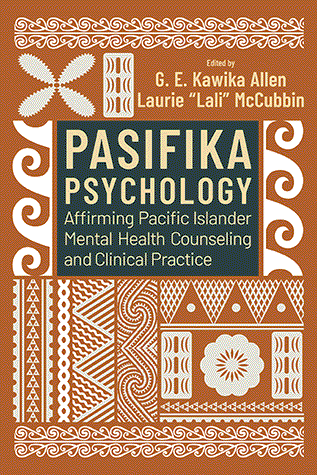
Pasifika Psychology
This volume provides a culturally grounded and scholarly examination of Pacific Islander psychology, integrating Indigenous knowledge, empirical research, and applied practice to advance ethical and effective mental health care for Pacific Islander communities.
The book provides an overview of Pasifika individuals and communities, including the unique challenges they face and their views of mental health and well-being. The term Pasifika refers to individuals with ancestry from the Pacific Islands of Melanesia, Micronesia, and Polynesia, inclusive of those who live in these regions as well as the diaspora in countries such as the United States. The book addresses a significant gap in the psychological literature by advancing scholarship situated within Indigenous frameworks while engaging contemporary research and professional practice. It integrates Indigenous, spiritual, clinical, and evidence-based approaches to mental health for Pacific Islander individuals, families, and communities across the United States and the South Pacific. In doing so, it provides a comprehensive foundation for culturally responsive psychological care.
Authored exclusively by Pacific Islander scholars, researchers, and clinicians, the volume presents Pacific Islanders as a diverse yet interconnected racial group with shared histories of indigeneity. The book serves as a critical resource for clinicians, educators, researchers, and training programs committed to ethical and culturally informed practice with Pasifika communities.
- Chapter 1. Pasifika Psychology: Wayfinding and Setting the Course
Laurie "Lali" McCubbin and G. E. Kawika Allen
Part I. Pacific Islands and the People: An Overview of Who We Are and Understanding Mental Health
- Chapter 2. Current Evidence-Based Research Regarding Pacific Islander Psychology and Mental Health Services
G. E. Kawika Allen and Sarah Wilde - Chapter 3. Weaving Wisdoms: Using the Mo'ohihia Model, Decolonialism, and Culture-as-Health in Therapeutic Settings for Pacific Islanders at Home and in Diaspora
Joanne Qina'au, Caleb Rivera, Lisa Nakamura, BS, V. Pauahi Souza, and A. Aukahi Austin Seabury - Chapter 4. Balancing Mana and Mental Health: Tongan Women's Well-Being in Cultural and Spiritual Contexts
Ofa Hafoka Kanuch, Sosaia F. Hafoka, and Halaevalu F. Ofahengaue Vakalahi - Chapter 5. Kainga Tuhono Indigenous Maori Attachments: From Politics, Categorization to Connection
Alayne Mikahere-Hall, Denise Wilson and Pita Perehama Pou
Part II. Pacific Islanders in Clinical Settings
- Chapter 6. Hoʻokāhuli: Transforming Culturally Responsive Behavioral Health Care With Kanaka ?Oiwi
Jillian M. N. Freitas, Robin E. S. Miyamoto, Momilani Awo, and Joseph Keawe'aimoku Kaholokula - Chapter 7. Beyond the Prison Walls: Integrating Samoan Cultural Values into Therapeutic Practice
Faafetai B. Faaleava - Chapter 8. Where Are You From? The Psychology of Pasifika Youth Talavou and Their Offending Behavior
Julia Ioane
Part III. Pacific Islanders and Well-Being
- Chapter 9. From Barriers to Belonging: Advancing Equity for Pacific Islander Students in Education and Mental Health
Melia Fonoimoana Garrett, Spencer Scanlan, and 'Inoke Hafoka - Chapter 10. Religiosity, Spirituality, and Pacific Islander Well-Being in Mental Health Practice
G. E. Kawika Allen, Elizabeth Cutrer-Párraga, Sarah Wilde, and Aigalesala Tauanu'u-Afalava - Chapter 11. Conclusion Chapter: Wayfinding—Future Directions
G. E. Kawika Allen and Laurie "Lali" McCubbin
G. E. Kawika Allen, PhD, is an associate professor of counseling psychology and special education at Brigham Young University. He is also the founder and director of the Polynesian Psychology Research Team at BYU, whose research efforts involve not only research on Polynesian and Pasifika psychology, but also research across all BIPOC and minoritized groups. His research areas involve spiritual, cultural, and Indigenous ways of healing in psychotherapy, including culturally appropriate psychotherapies and interventions for underserved populations.
Allen is the Hawaiian Pacific Island/Pacific Representative of the Society for the Psychological Study of Culture, Ethnicity, and Race (American Psychological Association Division 45) and has held editorial board and leadership positions in Divisions 17 and 36. He is a coeditor of the Handbook of Spiritually Integrated Psychotherapies.
Laurie "Lali" McCubbin, PhD, is a professor and chair in the Department of Educational, School, and Counseling Psychology at the University of Kentucky and an Indigenous/multiracial scholar. She is an associate editor for the journal Training and Education in Professional Psychology and editorial member for the Journal of Counseling Psychology and Asian American Journal of Psychology. She has served as past chair of the American Psychological Association's Committee on Children, Youth, and Families.