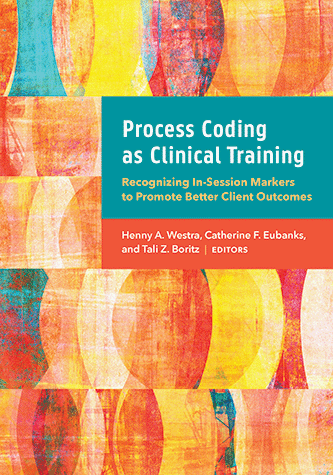
Process Coding as Clinical Training
Improve psychotherapy outcomes in real time by developing your attunement through process coding.
Traditional model-based approaches to psychotherapy training often leave clinicians without the tools to recognize and respond to what truly matters in-session. This groundbreaking volume is a compendium of current best practices in process coding—a research-backed method for observing, categorizing, and analyzing therapy as it unfolds. By watching therapy videos and coding transcripts to track subtle verbal and nonverbal signals, therapists and clinicians in training can identify alliance ruptures, engagement shifts, and other critical markers that predict outcomes—before it's too late.
Leading experts Henny Westra, Catherine F. Eubanks, and Tali Z. Boritz bring together validated coding systems, practical demonstrations, and video-based examples to show how process-centered training enhances responsiveness and complements any therapeutic model. Designed to be used either alone or in tandem with select APA therapy videos, the book shows clinicians and trainees how to do the right thing at the right time by improving their flexibility, attunement, and client outcomes.
Introduction
- Chapter 1. Leveraging Process Science to Develop Moment-by-Moment Observational Skills
Henny A. Westra, Tali Z. Boritz, and Catherine F. Eubanks
Part I. Coding Systems Focused on Dyadic Processes
- Chapter 2. Working Alliance Inventory Observer Version (WAI-O)
Timothy Anderson, Adam O. Horvath, and Mia Schmittenberg - Chapter 3. The Rupture Resolution Rating System (3RS)
Catherine F. Eubanks, Kaitlin M. Williams, and Dustin Phan - Chapter 4. The Motivational Interviewing Skills Code 1.1 and the Adapted Client Resistance Code (A-CRC)
Alyssa D. Bartolomeo and Henny A. Westra - Chapter 5. Therapeutic Collaboration Coding System (TCCS)
Eugénia Ribeiro and Dulce Pinto - Chapter 6. Structural Analysis of Social Behavior (SASB) Interpersonal Gestalt Coding
Kenneth L. Critchfield, Caroline Ball, Akiva Gornish, Nina L. J. Rose, Hallie R. Goldman, Eleanor G. Harrison, and Julia E. Mackaronis
Part II. Coding Systems Focused on Client and/or Therapist Processes
- Chapter 7. Multicultural Orientation Performance Task (MCO-PT)
Emma Freetly Porter and Jesse Owen - Chapter 8. The Experiencing Scale (EXP)
António Pazo Pires, Ana Daniela Barreto Aleixo, and Carolina Seybert - Chapter 9. Classification of Affective-Meaning States (CAMS)
Antonio Pascual-Leone and Florencia Cristoffanini - Chapter 10. Assimilation of Problematic Experiences Scale (APES)
Isabel Basto, Isabel Caro Gabalda, and William B. Stiles - Chapter 11. The Innovative Moments Coding System (IMCS)
Miguel M. Gonçalves, João Batista, and João Tiago Oliveira - Chapter 12. The Narrative-Emotion Process Coding System (NEPCS)
Tali Z. Boritz and Lynne Angus - Chapter 13. The Pausing Inventory Categorization System (PICS)
Heidi M. Levitt, Javier L. Rizo, and Nicholas A. Pierorazio - Chapter 14. Client and Therapist Vocal Quality Measures (CVQ & TVQ)
Jeanne C. Watson and Hadas Wiseman - Chapter 15. A Measure of Expressed Empathy (MEE)
Jeanne C. Watson and Signe Hjelen Stige - Chapter 16. Resource-Oriented Microprocess Analysis of Patients (ROMA-P)
Christoph Flückiger and Greta Probst
Part III. Conclusions and Future Directions
- Chapter 17. Integrating Process Coding into Clinical Training: Key Considerations and Training Suggestions
Tali Z. Boritz, Catherine F. Eubanks, and Henny A. Westra - Chapter 18. Conclusions and Future Directions
Catherine F. Eubanks, Henny A. Westra, and Tali Z. Boritz
Henny A. Westra, PhD, is professor emeritus in the Department of Psychology at York University in Toronto, Canada. She has held numerous positions over her 30-year career including professor, researcher, workshop presenter and teacher, frontline clinician, and program developer. She has written, published, and presented widely on ambivalence, resistance, anxiety, training and the development of expertise, motivational interviewing, and cognitive behavioral therapy. She is the author of the book Motivational Interviewing in the Treatment of Anxiety and is a principal developer of the Adapted Client Resistance Code (A-CRC), featured in this book alongside numerous other process coding schemes.
Catherine F. Eubanks, PhD, is a professor at the Gordon F. Derner School of Psychology at Adelphi University and codirector of the Center for Alliance-Focused Training. She is coauthor of Therapist Performance Under Pressure, and coeditor of Rupture and Repair in Psychotherapy. She was previously an associate editor on the Journal of Consulting and Clinical Psychology and is currently the managing editor of Psychotherapy Research.
Tali Z. Boritz, PhD, is an assistant professor in the Department of Psychology at York University in Toronto, Canada. She is a clinical psychologist, researcher, and educator. Her work focuses on psychotherapy process and outcomes, with an emphasis on translating research into practical training tools for clinicians and trainees. She has authored numerous peer-reviewed publications and is coauthor of the book Deliberate Practice in Dialectical Behavior Therapy. She is past president of the North American chapter of the Society for Psychotherapy Research.
"Rather than another conceptual book that predigests the nitty-gritty of therapeutic sessions into abstract principles, this one plunges the student experientially into the session, well-armed with pragmatic tools that provide a procedural map showing what to pay attention to, how to frame what one is observing, and how to plan next steps. Process Coding as Clinical Training: Recognizing In-Session Markers to Promote Better Client Outcomes emphasizes the importance of keenly observing microprocesses that the student can use on Day 1 with their first client. It represents the epitome of training geared to providing responsive, moment-to-moment personalized care." —Hanna Levenson, PhD, Professor Emerita, Wright Institute, Berkeley, CA, United States; Author of Brief Dynamic Therapy (3rd ed.)
"This is a wonderful book which brings the fruit of research to bear on improving clinical skills. It guides you in developing the much-needed perceptual skills that are difficult to acquire, but are essential for effective intervention. An invaluable tool to assist clinicians of all orientations in sharpening their clinical skills, it provides a comprehensive, up-to-date view of process research measures and how to use them." —Leslie S. Greenberg, PhD, Distinguished Research Professor Emeritus, Department of Psychology, York University, Toronto, ON, Canada
"With this book, three brilliant scholars, renowned researchers, and gifted therapists demonstrate how science and practice can be combined creatively and effectively. Trainees and experienced clinicians will be amazed to see how coding various aspects of therapy sessions can enhance their understanding of crucial moments in therapy, and improve the effectiveness of their interventions in responding to them—a way of learning that is distinct from, but complementary to, supervision and actual practice. " —Louis G. Castonguay, PhD, Liberal Arts Professor of Psychology, Pennsylvania State University, University Park, PA, United States
"This book is an excellent resource for trainers and supervisors who want to provide specific markers to help trainees learn to recognize good and poor examples of the psychotherapy process." —Clara E. Hill, PhD, Retired Professor of Psychology (Retired), University of Maryland, College Park, MD, United States
"A competent therapist is not only skilled in relevant therapeutic techniques but is also able to flexibly apply those skills to a given client, depending on the context, while recognizing what is happening in the room, moment by moment. This outstanding volume translates decades of psychotherapy process research into concrete, teachable skills, showing trainees, supervisors, and clinicians how to detect the subtle cues that turn an intervention into a competent and context-sensitive therapy tailored to a given client. This book provides a much-needed bridge between process research and better clinical practice." —Stefan G. Hofmann, PhD, codeveloper of Process-Based Therapy and Alexander von Humboldt Professor, Department of Psychology, Philipps-Universität Marburg, Hesse, Germany
"Much has been written about the need to close the gap between research and practice. This innovative and important volume approaches this issue by creatively proposing that coding systems used in process research can have an important place in clinical training. In doing so, it represents a significant breakthrough in enhancing effective therapy." —Marvin R. Goldfried, PhD, Distinguished Professor of Psychology (Retired), Stony Brook University, Stony Brook, NY, United States
Supplemental resources require an APA account and approval from APA to access. Please create or log in to your account and return to this page to download materials. Please note: After logging in, you may still need to be approved by APA staff to access secure content.