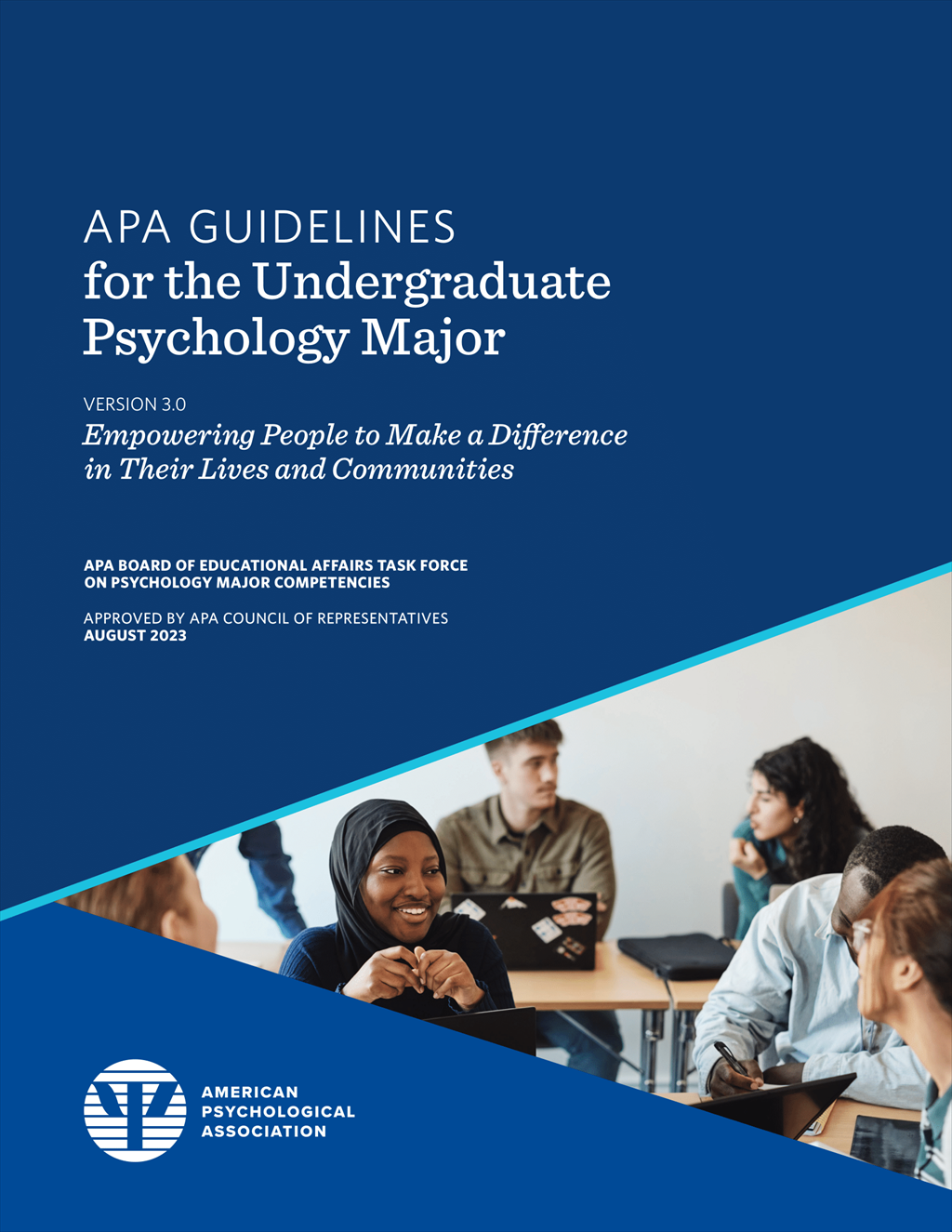
 At its August 2023 meeting, the APA Council of Representatives approved the revised APA Guidelines for the Undergraduate Psychology Major: Version 3.0. Guidelines 3.0 (PDF, 1MB)opens in new window captures a set of optimal expectations for performance by undergraduates engaged in the study of psychological science. Guidelines 3.0 specifies five broad educational goals and corresponding student learning outcomes that outline reasonable program expectations for the undergraduate psychology major across educational contexts. Indicators of progress on student learning outcomes represent two levels of development. “Foundation” indicators roughly represent progress that students may be expected to make midway through the major. As such, the outcomes may be helpful for psychological science programs at the two-year level or the psychology minor in a four-year program. “Baccalaureate” indicators represent an appropriate endpoint for the completion of the major. The progression describes expectations for how a student would undertake the journey of a novice in the discipline to the status of a reasonably informed and skilled undergraduate student on the completion of a four-year program.
Given that psychology programs face unprecedented demands in higher education today for accountability data to document high-quality educational programming, Guidelines 3.0 provides a solid foundation on which psychology educators may engage in effective curricular and assessment planning.