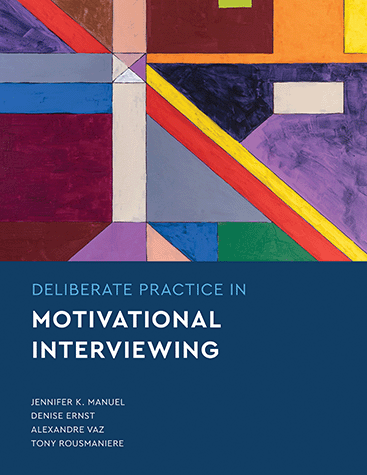
Deliberate Practice in Motivational Interviewing
ISBN: 978-1-4338-3618-3Deliberate practice exercises help clinicians develop competence in fundamental motivational interviewing skills to better assist clients with change goals, like quitting addictive behaviors and developing healthier habits and improving treatment engagement and retention.
These exercises present role-playing scenarios in which two trainees act as a client and a clinician, switching back and forth under the guidance of a supervisor. The clinician improvises appropriate and authentic responses to client statements organized into three difficulty levels—beginner, intermediate, and advanced—that reflect common client questions and concerns.
The first 12 exercises focus on specific skills, such as offering simple and complex reflections and affirmations, eliciting change talk, supporting client autonomy, and collaboratively mapping session agendas. These are followed by two comprehensive exercises—an annotated transcript and free-form mock therapy sessions—in which trainees integrate essential skills into one session.
Step-by-step instructions guide participants through the exercises, identify criteria for skill mastery, and explain how to monitor and adjust difficulty. Guidelines and forms to help trainers and trainees get the most out of training are also provided.
To demonstrate how deliberate practiceopens in new window can be fully integrated into a professional curriculum, this series features exercises developed and refined within the clinical training curriculum at the Sentio online marriage and family therapy (MFT) therapist training programopens in new window in California, which is where we started developing this series. These exercises, which have been tested at clinical training sites around the world, are used to enhance clinical outcomes within the firsthybrid MFT program approved by the California Board of Behavioral Sciencesopens in new window (BBS) to fully integrate deliberate practice into its entire curriculum. By integrating these models into its hybrid MFT program in California, Sentio University demonstrates that therapist training graduate programs can use deliberate practice to bridge the gap between theory and clinical mastery through repetitive, feedback-informed practice to support the development of modern, outcome-focused clinicians.
Series Preface
Tony Rousmaniere and Alexandre Vaz
Acknowledgments
Part I: Overview and Instructions
- Chapter 1: Introduction and Overview of Deliberate Practice and [Therapeutic Approach]
- Chapter 2: Instructions for the Motivational Interviewing Deliberate Practice Exercises
Part II: Deliberate Practice Exercises for Motivational Interviewing Skills
Exercises for Beginner Motivational Interviewing Skills
- Exercise 1: Simple Reflections
- Exercise 2: Complex Reflections, Part 1: Guesses at What the Client Means
- Exercise 3: Complex Reflections, Part 2: Guesses at Underlying Client Emotions or Values
- Exercise 4: Reflections and Open-Ended Questions
Exercises for Intermediate Motivational Interviewing Skills
- Exercise 5: Eliciting Change Talk
- Exercise 6: Reflections of Client Change Talk
- Exercise 7: Double-Sided Reflections
- Exercise 8: Dancing With Discord
Exercises for Advanced Motivational Interviewing Skills
- Exercise 9: Simple and Complex Affirmations
- Exercise 10: Autonomy Support
- Exercise 11: Agenda Mapping
- Exercise 12: Elicit–Provide–Elicit
Comprehensive Exercises
- Exercise 13: Annotated Motivational Interviewing Practice Session Transcript
- Exercise 14: Mock Motivational Interviewing Sessions
Part III: Strategies for Enhancing the Deliberate Practice Exercises
- Chapter 3: Additional Guidance for Trainers and Trainees: How to Get the Most Out of Deliberate Practice
Jennifer K. Manuel, PhD, is deputy director of psychology at the San Francisco Veterans Affairs Health Care System and an associate professor in the Department of Psychiatry and Behavioral Sciences at the University of California, San Francisco. She has been a member of the Motivational Interviewing Network of Trainers (MINT) since 2005. She conducts MI training and coding workshops throughout the world. She has coauthored multiple MI behavioral coding systems including the widely used Motivational Interviewing Treatment Integrity (MITI) coding manual. Dr. Manuel’s research expertise is in the implementation and evaluation of MI in front-line clinical settings.
Denise Ernst, PhD, is an adjunct professor at the School of Social Work, Portland State University. She has been a motivational interviewing (MI) consultant for over 25 years, providing training, evaluation, research and implementation support, and private coaching internationally. Dr. Ernst has helped develop and refine MI coding instruments, including the Motivational Interviewing Skill Code (MISC) and the Motivational Interviewing Treatment Integrity (MITI) coding system. She participated in research efforts to enhance training effects, providing structured feedback and coaching for many professions. Dr. Ernst has been a member of the Motivational Interviewing Network of Trainers (MINT) since 1997.
Alexandre Vaz, PhD, is chief academic officer of Sentio University marriage and family therapy (MFT) program in Californiaopens in new window. This innovative online/hybrid MFT programopens in new window was the first approved by the California Board of Behavioral Science for MFT licensure to fully integrate deliberate practiceopens in new window into its curriculum to ensure superior clinical outcomes. He is also director of clinical training for the Sentio Counseling Centeropens in new window which is Sentio MFT program’s guaranteed practicumopens in new window site where students provide low-cost online couples therapy in Californiaopens in new window. Dr. Vaz is the author/coeditor of many books on deliberate practice and psychotherapy training.
Tony Rousmaniere, PsyD, is president of Sentio University marriage and family therapy (MFT) program in Californiaopens in new window. He led the development of online/hybrid MFT programopens in new window, which is the first MFT therapist training program approved by the California Board of Behavioral Science for MFT licensure that fully integrates deliberate practiceopens in new window. Dr. Rousmaniere is the author/coeditor of many books on psychotherapy training. He is also the executive director of the Sentio Counseling Centeropens in new window, which is Sentio MFT program’s guaranteed practicumopens in new window site where students provide sliding-scale online therapy in Californiaopens in new window, and past president of the APA’s Division 29.
Like a sunburst on a cloudy day, this book clears the haze of motivational interviewing skill acquisition. It harnesses the wisdom of deliberate practice and provides sharp, direct, and stepwise instruction for trainers and learners alike. It is an essential traveling companion for anyone on the MI road.
—David B. Rosengren, PhD, President, Prevention Research Institute, Lexington, KY, United States; author of Building Motivational Interviewing Skills: A Practitioner Workbook
Here is a book that gathers decades of experience and here is the opportunity to reap the rewards. The book is well organized and opens the door to improving your practice. A wonderful contribution to the field.
—Stephen Rollnick, PhD, Honorary Distinguished Professor, School of Medicine, Cardiff University, Cardiff, Wales, United Kingdom
Congratulations to Jennifer Manuel and her colleagues on producing this sagely written, cutting-edge resource for sharpening clinical skills. Deliberate Practice is absolutely key in mastering motivational interviewing; indeed, there really is no other way to learn it. The well-crafted exercises help learners strengthen fundamental (though not easy) skills such as complex reflection then combine them in the clinical artistry of tasks like 'dancing with discord.' I recommend this book for helpers who are ready to take a next step in guiding their clients toward change and growth.
—William R. Miller, PhD, Emeritus Distinguished Professor of Psychology and Psychiatry, The University of New Mexico, Albuquerque, NM, United States
With its set of practical and easy-to-follow instructions for the trainer as well as for the trainees, this book will rapidly become a must in every motivational interviewing trainer’s library. Learners will appreciate the structured exercises and practice opportunities that respect their current level of competence and are especially tailored to guide them through to immediate progress. A truly impressive approach designed for trainers to help clinicians improve and consolidate their MI skills in a deeply affirming manner.
—Cristiana Fortini, MSc Psych, MINT certified MI trainer, Head Psychologist, Addiction Medicine, Centre Hospitalier Universitaire Vaudois (CHUV), Lausanne, Switzerland
Deliberate Practice in Motivational Interviewing offers an easy-to-follow road map for developing competency in core motivational interviewing skills. The authors inspire confidence through their effective method, comprehensive course plan, and exercises that can be adapted for beginning and seasoned clinicians. My favorite part is their clear guidelines for tailoring the exercises to the right difficulty level for the learner. This book is a must-have resource for knowledgeable MI trainers and for trainees who want to be able to guide challenging clinical conversations about change.
—Jennifer Frey, PhD, coauthor of Motivational Interviewing for Mental Health Clinicians: A Toolkit for Skills Enhancement
This book is part of the Essentials of Deliberate Practice series by Tony Rousmaniere and Alexandre Vaz. The materials on this page include a Deliberate Practice Reaction Form and a Deliberate Practice Diary Form that can be used with every book in this series, as well as volume-specific content.
These documents are offered for your personal use in clinical training or teaching courses. If you reprint or adapt them for publication, permission is required from the publisher.
Deliberate Practice Reaction Form
The Deliberate Practice Reaction Form can be used with any of the deliberate practice exercises throughout the series to measure how challenging it was for the trainees and to adjust the difficulty as needed. Appendix A includes a black-and-white version of the form with instructions for assessing and modifying an exercise’s difficulty. A color version of the Deliberate Practice Reaction Form is also available for individual download.
- Appendix A: Difficulty Assessments and Adjustmentsopens in new window (PDF)
- Deliberate Practice Reaction Formopens in new window (PDF)
Deliberate Practice Diary Form
The Deliberate Practice Diary Form is an optional form that trainees can complete during a training session’s final evaluation or between sessions to process their experiences with the activity, including what was and was not helpful and what they learned. Appendix B, which is the same across all books in the series, presents this form.
Volume-specific materials
The following content is unique to Deliberate Practice in Motivational Interviewing and includes a sample syllabus that integrates the deliberate practice exercises into a standard clinical course.
- Appendix C: Sample Motivational Interviewing Syllabus With Embedded Deliberate Practice Exercises (PDFopens in new window | Wordopens in new window)
Video demonstration
A YouTube series (Practice Time! with Amy DeSmidt and Jamie Manseropens in new window) highlights authentic deliberate practice sessions featuring exercises from this book and other releases in the Essentials of Deliberate Practice series.
Additional resources
- Deliberate Practice in Motivational Interviewing APA Books Webinaropens in new window
- Video resources are available to accompany this book.opens in new window
Supplemental resources for therapist training
Designed for faculty at graduate institutions, these supplemental resources provide a framework and clear examples for implementing deliberate practice within existing therapist training curricula. Sentio University is where we started to develop what would become the APA Essentials of Deliberate Practice series. We provide a comprehensive suite of free psychotherapy training resources based on the deliberate practice methodologyopens in new window. These materials are designed to supplement modern hybrid and online therapist training curricula and are used extensively within our own clinical programs.
- California MFT program integration: These materials are a core component of the Sentio hybrid MFT program in Californiaopens in new window, the first in the state to fully integrate DP into its entire curriculum and receive California Board of Behavioral Sciences approval for licensure.
- Free deliberate practice exercises: Access our library of therapist skill-building worksheetsopens in new window used to enhance the online California MFT degree through repetitive, feedback-informed practice.
- Deliberate practice video demonstrations: Visit our YouTube channel for free therapist training videosopens in new window to view clinical demonstrations from the APA Essentials of Deliberate Practice book series. These videos illustrate key skills used to enhance the online California MFT degree through repetitive, feedback-informed practice.
- AI and emerging therapy resources: Learn how deliberate practice can be used to safely and ethically integrate AI for therapist trainingopens in new window. Review our AI research programopens in new window and our clinical guidelines on using AIopens in new window to prepare for the modern landscape of digital mental health.