In the summer of 2017, while we were staying in Paris at La Maison Suger, an academic workplace and residence associated with Fondation Maison des Sciences de l’Homme (FMSH), my wife and colleague, Doris Vasconcellos, had an idea. She had taught psychology courses at La Sorbonne for many years prior to our marriage and thought it could be valuable for psychology faculty from around the world to convene in Paris to compare notes about how they teach. When I agreed, she said “Well, you organize teaching conferences, don’t you?” Then she looked at me in a way that left no doubt in my mind about what my future would hold. Before I knew it, I was planning a program, seeking grant support, publicizing the event, and working with Stephen Chew, chairman of the program committee at the National Institute on the Teaching of Psychology (NITOP), to create a website for what became the Biennial International Seminar on the Teaching of Psychological Scienceopens in new window (BISTOPS).
As described on that site, BISTOPS is an English language event designed to allow a small group of participants the opportunity to discuss existing research on the scholarship of teaching and learning (SoTL) in psychology, to exchange new research ideas, to create collaborative international research teams, and ultimately, to generate published empirical studies whose results will promote evidence-based recommendations for improving the teaching of psychological science on an international scale. To optimize interaction and focused discussion, registration is limited to those whose applications reflect the clearest evidence of involvement or interest in research on the teaching of psychology.
Participants attend one of the presentations delivered during BISTOPS 2024.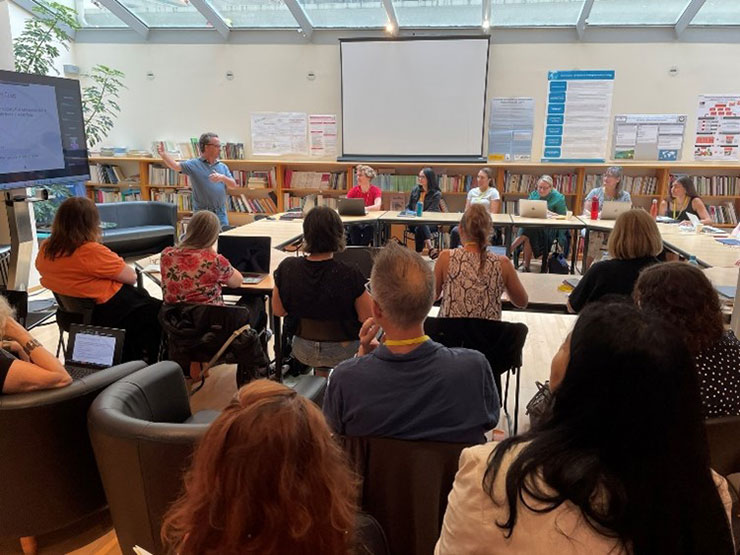
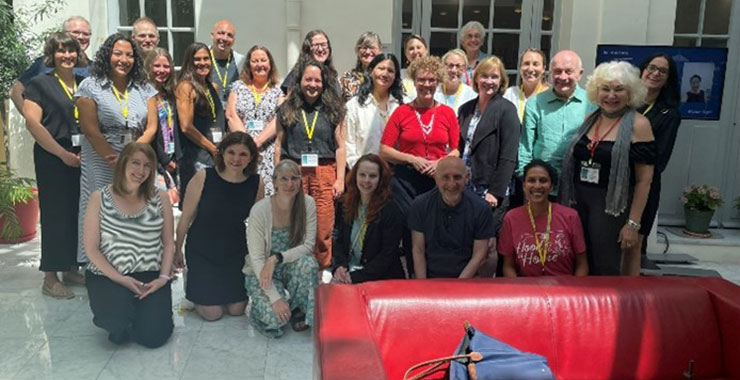
The inaugural BISTOPS took place in July 2018, at La Maison Suger, and was successful enough that it was followed by a second, COVID-delayed version in July 2022, and a third in July 2024. This time, BISTOPS brought together 30 teachers of psychology from nine countries, including the United States, Canada, Australia, New Zealand, the UK, the Netherlands, Italy, Germany, and Kazakhstan. They met for five days, beginning with an opening day self-introduction and poster session at which everyone could describe their teaching research interests, plans, and results. As described on the program page (PDF, 96KB)opens in new window of the BISTOPS website, there were also lengthy presentation, discussion, and brainstorming sessions led by invited speakers on days 1–4, and four 45-minute research presentations by selected participants on day five. The formal part of each day ended at 1:30 p.m. to allow participants and speakers to make new connections, discuss their current research, and launch international collaborations. There was a rumor that some people explored Paris, too.
And connect they did! I know that at least one group of BISTOPS 2024 participants has already formed a research team and its members have been exchanging ideas about topics and methods since leaving Paris. The same thing happened in 2018, when a small group of participants began discussing ideas for international research on the prevalence of psychological misconceptions among psychology students. That group, later joined by several others, published the results of its first studyopens in new window in 2023, and is currently preparing an article describing the results of a second, even more extensive one, while also analyzing data from yet a third study.
Participants networking during BISTOPS 2024.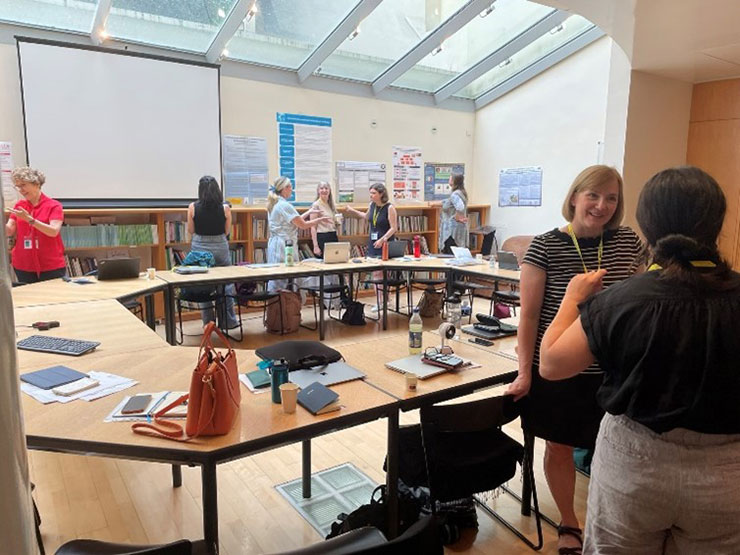
Participants’ comments on BISTOPS evaluation forms over the years have repeatedly mentioned that the most valuable aspect of the seminar is the opportunity to exchange information and ideas with fellow teachers from different countries and cultures. Here is a typical example: “I really enjoy the constant discussion with the other participants. I like the fact that the group is relatively small so that we have a chance to really interact with one another and to establish collaborative projects with one another. I do enjoy hearing about topics that can challenge my assumptions about how I teach and how academics should act in the world.”
If all goes well, the next BISTOPS will take place in July 2026, and I invite you to keep an eye on the BISTOPS website for announcements about the exact dates and the opening of the application process.
 Doug Bernstein received his bachelor's degree in psychology at the University of Pittsburgh in 1964, and his master’s and PhD degrees in clinical psychology at Northwestern University in 1966 and 1968, respectively. From 1968 to 1998, he was a member of the psychology faculty at the University of Illinois at Urbana-Champaign, where he served as Associate Department Head and Director of Introductory Psychology. He is currently professor emeritus at Illinois and courtesy professor of psychology at the University of South Florida. He founded the APS Preconvention Institute on the Teaching of Psychology, and in 2013, he stepped down after more than 30 years as chairman of the National Institute on the Teaching of Psychology. In 2018—along with his wife, Doris Vasconcellos—he founded BISTOPS. He has co-authored a book on the teaching of psychology, a compendium of examples for use in psychology courses, a manual for progressive relaxation training, and textbooks on criminal behavior as well as on introductory, clinical, and abnormal psychology.