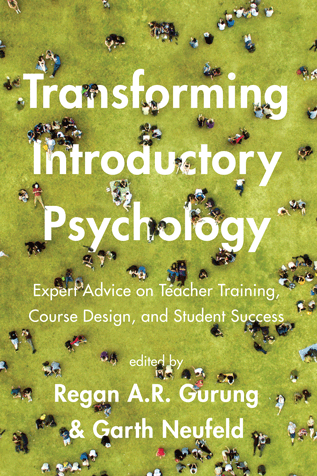
Transforming Introductory Psychology
Available formats
Also available from
Each year, well over a million undergraduate students take an introductory psychology course. This edited volume presents recommendations for designing and teaching this important course.
The book’s recommendations cover four key areas: course design, defining and assessing student learning goals and outcomes, teacher training and development, and student learning and transformation. Chapters illustrate how to implement the recommendations in various institutions, including public and private colleges and universities, research universities, liberal arts colleges, comprehensive universities, two-year colleges, and high school.
The recommendations stem from an initiative of the American Psychological Association, which seeks to make introductory psychology a transformational experience for students. While some students taking the course will become psychology majors or even psychologists, most will pursue other careers. Thus, successful introductory psychology courses help students grow personally, academically, and professionally with skills that will be valuable for the rest of their lives, regardless of career.
Given the diverse purposes served by the introductory psychology course, this work is a must-have for every psychology department and every person who teaches introductory psychology.
Contributors
Preface
Introduction: The Introductory Psychology Initiative
Regan A. R. Gurung and Garth Neufeld
I. Introductory Psychology Initiative Recommendations
- Why Introductory Psychology?
Stephen L. Chew, Karen Z. Naufel, Guy A. Boysen, Katherine Wickes, and Jerry Rudmann - Designing the Introductory Psychology Course: An Evidence-Informed Framework
Bridgette Martin Hard, Dana S. Dunn, Robin Musselman, Danae L. Hudson, and Aaron S. Richmond - Measuring Meaningful Learning in Introductory Psychology: The IPI Student Learning Outcomes
Jane S. Halonen, Jennifer L. W. Thompson, Kristin H. Whitlock, R. Eric Landrum, and Sue Frantz - Assessing Student Learning Outcomes in Introductory Psychology
Jane S. Halonen, Jennifer L. W. Thompson, Kristin H. Whitlock, R. Eric Landrum, and Sue Frantz - Navigating the Nuances of Teaching Introductory Psychology: A Roadmap for Implementing Evidence-Based Instructional Methods
Danae L. Hudson, Aaron S. Richmond, Bridgette Martin Hard, Dana S. Dunn, and Robin Musselman - The Successful Psychology Course: Transformative Skills in Introductory Psychology
Stephen L. Chew, Guy A. Boysen, Karen Z. Naufel, Katherine Wickes, and Jerry Rudmann - Changing the Paradigm: Support and Development for Teachers of Introductory Psychology
Melissa J. Beers, William S. Altman, Elizabeth Yost Hammer, Erin E. Hardin, and Jordan Troisi
- Teaching Introductory Psychology as a High School Elective: Davis High School
Kristin H. Whitlock - Teaching Introductory Psychology to Students of Varying Ages: Cascadia College
Garth Neufeld - Teaching Introductory Psychology With Revised Standards: Lehigh Carbon Community College
Robin Musselman - Teaching Introductory Psychology to Students With Varying Degrees of Readiness: Irvine Valley College
Jerry Rudmann, Kari Tucker, Michael Cassens, Benjamin Mis, and Yemmy Taylor - Teaching Introductory Psychology in a Small University: McKendree University
Guy A. Boysen - Teaching Introductory Psychology to a Homogenous Student Population: Samford University
Stephen L. Chew - Teaching Introductory Psychology in a Historically Black Liberal Arts College for Women: Spelman College
Shani N. Harris, Kai M. McCormack, Angela Farris-Watkins, Juanchella Grooms Francis, and Karen Brakke - Teaching Introductory Psychology When Classes Have Uneven Enrollment: The University of Tennessee
Erin E. Hardin - Teaching Introductory Psychology in Large Classes: Missouri State University
Danae L. Hudson - Teaching Introductory Psychology When the Department Is Growing: Oregon State University
Regan A. R. Gurung
Index
About the Editors
Regan A.R. Gurung, PhD, is professor of psychological science at Oregon State University and director of the general psychology program. His applied social cognition lab studies factors influencing teaching and learning.
A recipient of the APF Charles L. Brewer Distinguished Teacher of Psychology Award, he is author/coauthor/editor of 15 books and over 100 peer-reviewed articles.
He was founding coeditor of APA’s Scholarship of Teaching and Learning in Psychology and past president of both the Society for Teaching of Psychology (APA Division 2) and Psi Chi, the International Honors Society in Psychology.
Garth Neufeld, MA, is professor of psychology at Cascadia College, founder of Teaching Introductory Psychology Northwest and the Teaching of Psychology Incubator workshop, and cofounder of the PsychSessions podcast. He has served the national teaching of psychology community through the Society for the Teaching of Psychology, the AP Psychology Reading, and APA’s Education Directorate.
In 2018, Garth was awarded a Citizen Psychologist presidential citation from the APA for cofounding Shared Space For All, an organization that educates and mentors at-risk Thai children toward the prevention of prostitution.
He is also the recipient of the 2019 STP Wayne Weiten Teaching Excellence Award.
Introductory psychology is critical in explaining the importance of psychology to the general public—people who will vote, decide what and whom to believe, and make psychology-related decisions throughout their lives. Transforming Introductory Psychology is a treasure-trove of information for both seasoned and new instructors. Every chapter is written by well-known psychologists with a cumulative hundreds of years of experience. It is a must-read for faculty, curriculum committees, and everyone else who cares about quality teaching.
—Diane F. Halpern, PhD, Professor of Psychology Emerita, Claremont Mckenna College, Claremont, CA, and Past-President of the American Psychological Association
This remarkable collection of chapters should be required reading for all teachers of introductory psychology, especially those who are considering reshaping the course in line with recommendations of the APA’s Introductory Psychology Initiative. The authors are expert introductory psychology teachers whose insights and ideas will surely stimulate colleagues at every academic level to think more deeply about their teaching goals and assessment methods, as well as about how they might incorporate thematic innovations into their courses. Bravo!
—Douglas A. Bernstein, PhD, University of South Florida, Tampa