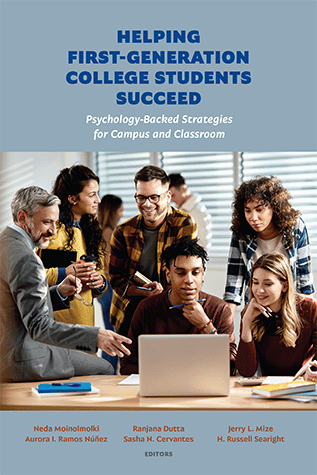
Helping First-Generation College Students Succeed
This timely edited volume offers a broad selection of psychologically grounded, classroom- and campus-tested strategies for transforming higher education to empower first-generation (FG) college students to succeed and thrive.
The book serves as an evidence-based, psychology-informed toolkit for faculty and administrators across varied institutions and disciplines to foster the successful integration of FG college students. The editors and chapter authors reimagine a higher education landscape where institutions move beyond deficit-based assumptions of engagement with FG students, acknowledging disadvantages and inequities while promoting strengths-based and institutionally responsive approaches. Chapters provide a nuanced interdisciplinary perspective on supporting FG students, focusing on students' lived experiences, cultural wealth, and identity development, recognizing them as central contributors whose presence drives innovation, relevance, and vitality across the academy.
The book integrates psychological frameworks with practical classroom and institutional strategies, highlighting practices that have succeeded across a wide range of higher education institutions and drawing on insights from those who have thoughtfully adapted these methods. A key strength of this volume is its presentation of concrete, evidence-informed pedagogical approaches that can be readily implemented across courses, departments, and programs. Chapters feature a user-friendly format, enabling faculty and academic leaders to incorporate the approaches quickly and efficiently into their teaching and curricular planning. Given the increasing demands on college instructors, this accessibility offers immediate value to institutions.
Each chapter includes a discussion of an activity or program, including its effectiveness and implementation recommendations. Robust supplementary resources to support college teachers and faculty are offered online.
Acknowledgments
Introduction: Leveraging First-Generation Strengths in the Classroom and on Campus
H. Russell Searight, Ranjana Dutta, Sasha Cervantes, Aurora Ramos-Núñez, Neda Moinolmolki, and Jerry L. Mize
Part I. Strategies for Use in the Classroom
- Chapter 1. Using Photovoice to Engage and Empower First-Generation Students
Lucy E. Napper, Margaret Munley Stone, Princess O. Neely, Laura C. Wolter, and Anthony Di Santo - Chapter 2. Creating Need-Supportive Online Classrooms: Motivational Approaches to First-Generation Student Engagement and Learning
Kathryn E. Frazier, Colleen J. Sullivan, Nicole M. Rosa, and Jacquelyn N. Raftery-Helmer - Chapter 3. Using Transformative Experience to Facilitate Perceived Usefulness and Personal Relevance Among First-Generation College Students
Jacqueline A. Goldman, Benjamin H. Heddy, and Alison C. Koenka - Chapter 4. First-Generation Student Success Starts With CARING: Compassionate, Approachable, Relational, Invested, iNviting, and Growth Mindset
Michelle M. Robbins and Han M. Tran - Chapter 5. Supporting First-Generation Student Success Through a Food Justice Service Learning Project
Bonnie I. Pepper and Joshua Abreu - Chapter 6. Learning as a Shared Responsibility: Using Ungrading to Leverage First-Generation Graduate Students Funds of Knowledge and Promote Self-Efficacy
Sonja Ardoin
Part II. Strategies for Use Beyond the Classroom
- Chapter 7. Using Culturally Responsive Approaches in Faculty Advising for First-Generation, Masters-Level Graduate Students
Avery B. Olson and Lindsay Sterk - Chapter 8. Institutionalizing First-Generation Student Feedback To Strengthen University Support
Giselle Laiduc, Ibette Valle, and Rebecca Covarrubias - Chapter 9. Changing the Narrative of "First-Gen" Through the Institutional Lens: Examples from a Student Success Program
Jennifer Stripe-Portillo, Breeda McGrath, and Felice Mayes - Chapter 10. Building Cultural Wealth for First-Generation College Students in STEM Using a Cohort Model
Amanda Ruiz, Jane Friedman, Carla Penha Vasconcelos, Drew Talley, Odesma Dalrymple, Paula Krist, and Perla Myers - Chapter 11. Cultivating Spaces for First-Generation Communication Sciences and Disorders Students: Coordinated Engagement Opportunities
Erica Ellis and Gabriela Simon-Cereijido - Chapter 12. Increasing Retention and Fostering a Sense of Belonging in First Year First-Generation College Students Through Peer Mentorship
Christine Smith and Myah Henderson - Chapter 13. Learning the Unwritten Rules: A Culturally Tailored Difference-Education Intervention for First-Generation College Students
Gerardo Ramirez, Leslie J. Remache, Giselle Laiduc, Matthew Jackson, Rebecca Covarrubias, and Ji Y. Son - Chapter 14. Coffee with a Professor: Building Relationships for First-Generation Success
Matt Daily and Randy Hetherington - Chapter 15. Inspiring and Empowering Students Through First-Generation Panelists
Ryan M. Pickering
Conclusion: Institutional Transformation to Support First-Generation College Students
Neda Moinolmolki, Ranjana Dutta, Sasha Cervantes, H. Russell Searight, Aurora Ramos-Núñez, and Jerry L. Mize
Index
About the Editors
Neda Moinolmolki, PhD, is an associate professor of psychology at Albertus Magnus College, committed to transformative pedagogy and equity-focused teaching. She integrates critical theory and research to promote resilience, social agency, and inclusive learning for diverse and at-risk students. Dr. Moinolmolki has mentored numerous student researchers, guiding them to present at conferences and publish in peer-reviewed journals. Her contributions to teaching, mentorship, and scholarship have been recognized with awards, including Advisor of the Year from the College of Coastal Georgia, the Early Career Research Award from the Southeastern Psychological Association, and the Distinguished Contribution to the Science of Psychology Award from the Connecticut Psychological Association.
Ranjana Dutta, PhD, is a professor of psychology at Saginaw Valley State University (SVSU). She routinely teaches many first-generation students in her courses (developmental psychology, research methods, cultural psychology) and supervises research. Dr. Dutta highlights the process and its challenges in her article, “From Consumers to Producers: Three Phases in the Research Journey With Undergraduates at a Regional University.” Her research on parenting and delay behaviors/procrastination informs her teaching philosophy. She emphasizes self-regulation, accountability, and peer connection for success. A recipient of multiple awards for teaching excellence at SVSU, she has experiences that align closely with this edited volume on first-generation college students.
Jerry L. Mize, MA, MEd, LPC, NCC, is an instructor and online undergraduate program coordinator in the Department of Psychology at George Mason University, where he teaches statistics, psychopathology, therapeutic communication, and stress and coping. He is a doctoral candidate in counselor education and supervision at the University of the Cumberlands and a Licensed Professional Counselor with a clinical focus on sexuality, relationships, identity development, and trauma. His scholarship examines counselor competence, clinician discomfort, and sexuality training in counseling, using quantitative methods to advance evidence-based practice. Mr. Mize publishes, presents nationally, and contributes to professional leadership and editorial service within counseling scholarship.
Aurora I. Ramos Núñez, PhD, is an associate professor of psychology and student success coordinator at the College of Coastal Georgia. She earned her doctorate in developmental psychology from the University of Houston and has published in leading journals, including Brain and Language and Journal of Cognitive Neuroscience. Dr. Ramos Nuñez is dedicated to mentoring first-generation students through high-impact practices such as service learning and undergraduate research, empowering them to present at conferences and publish scholarly work. Her commitment to equity and student success aligns with APA's mission to advance evidence-based strategies for supporting first-generation college students.
Sasha N. Cervantes, PhD, earned her doctorate in cognitive psychology with a minor in neurobiology from the University of Chicago. She is an associate professor of psychology at Governors State University. Her research interests include memory accuracy and false memory, normal cognitive aging, creativity, the scholarship of teaching and learning, as well as student cocurricular engagement and belonging. Dr. Cervantes has earned awards for excellence in undergraduate teaching and advising. Through her teaching, service, and research, she aims to increase student engagement, support student growth and belonging, improve first generation student graduation rates, and postgraduation outcomes for all her students.
H. Russell Searight, PhD, MPH, is professor of psychology at Lake Superior State University. He earned his PhD in clinical psychology and an MPH from Saint Louis University. He has held faculty positions at Saint Louis University, Southern Illinois University—Edwardsville, and Saint Louis University School of Medicine. He has received multiple awards for teaching including the 2011 Distinguished Teacher from Lake Superior State University. Dr. Searight has published 200 articles and chapters and authored or edited 10 books. His interests include medical ethics, educational assessment, social determinants of health, and first-generation university students.
First-generation students bring vital, unrecognized assets to college. The authors apply a strengths-based approach to reshape classroom and institutional practices, creating a welcoming and effective campus experience. This book delivers a transformative, useful framework and a critical road map for fostering student success.
—Amy Ballin, PhD, MSW, MST, Managing Director, Amy Ballin Consulting (ABc), Gloucester, MA
Helping First-Generation Students Succeed: Psychology-Backed Strategies for Campus and Classroom is an informative text for higher education faculty, staff, and administrators. The authors provide a comprehensive overview of a strengths-based model for first-generation (FG) students and the utility of applying this model to pedagogical approaches, programming, and services for FG students. The strategies and recommendations for supporting FG students are grounded in psychological theories and are clearly described, with useful implementation suggestions for a variety of higher education institutions.
—Jenna Silverman, PhD, Licensed Psychologist, Executive Director of Student Counseling and Educational Support, Student Counseling Center, University of Maryland, Baltimore
This book is full of creative, research-based ideas for how to engage and retain first-generation students. It takes a strengths-based approach to developing programming and policies, and everyone from new faculty to experienced administrators can benefit from reading it.
—Judith Danovitch, PhD, Professor and Director of Undergraduate Studies, Department of Psychological and Brain Sciences, University of Louisville, Louisville, KY
This manuscript is an exceptional resource for faculty members, student affairs practitioners, and college administrators. Each chapter offers clear, accessible guidance on effectively engaging first-generation college students with the aim of enhancing their collegiate experience and overall success, irrespective of race, ethnicity, or socioeconomic background. The practical strategies presented are grounded in research and reinforced by demonstrated outcomes that attest to the effectiveness of the interventions. I highly recommend this book to any college professional whose work centers on direct engagement with students. The authors are to be commended for their dedication to and advocacy for the first-generation college student population in our country.
—Zebulun R. Davenport, EdD, Vice President for University Advancement and External Affairs, West Chester University, Chester, PA