When an instructor has a course prepared and they decide to switch to a new textbook, you will sometimes hear the lament about the amount of effort that this particular course prep will take because of the “new” book — changing the examples used in the course, the reading assignments, becoming familiar with the new passages yourself — adding something new to your course does typically mean more work. For anyone who teaches APA writing style/format to the three-quarter million psychology majors in the U.S., adopting the 7th edition of the Publication Manual of the American Psychological Association (hereafter PM 7e) will mean more work. The goal of this PTN article is to reduce that amount of new/more work a little bit.
Of course, every teacher of writing will likely focus on different aspects of the writing process, and the good folks at APA were already kind enough to provide a summary of the changes about what’s new in the 7th edition, starting on p. xviii of PM 7e. As a teacher of writing who writes about writing and writes about teaching writing, I thought it might be useful to share my perspectives about what is different in PM 7e regarding student papers and the most important changes to emphasize to our students when first making the transition from 6e to 7e. Let’s acknowledge up front that your personal list is likely different from my personal list — so think of this as a launching point or discussion starter — neither absolute nor perfect. Or, think of it this way — when I have to make my own transition about how I grade the APA Style/format work of my students, what I am offering here are the top items I will be looking out for because for me, these are the key changes from 6e to 7e. Page numbers presented throughout refer to the page numbers in PM 7e.
Formatting
- A title page is required for all student papers (p. 30), with a sample provided on p. 32. The title of the paper is presented in bold font (p. 46). For a student paper, there is not a running head (p. 61).
- Font variability is now widely embraced (although the same font should be used throughout the paper — p. 44). In addition to the traditional Times New Roman 12 pt. font which was the standard in 6e, here are examples of what is now acceptable (because of how you are viewing this, the fonts may not be in their original [accurate] proportions):
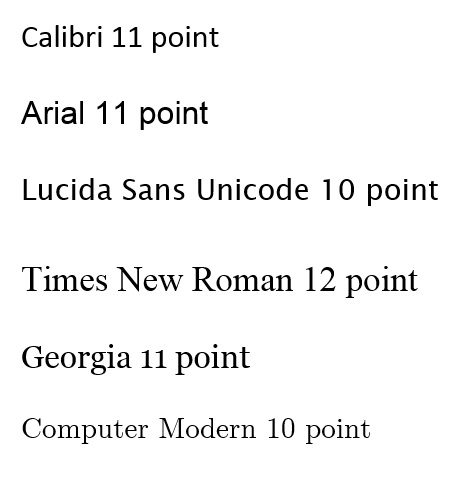
- Because of the variability in font choices/selection, it is probably better for instructors following PM 7e to make assignments based on word count rather than page length (p. 44).
- The PM 7e provides a very nice checklist regarding the preparation of tables on p. 207, and provides 23 different examples of table formats on pp. 210-224.
Style, including pronouns and punctuation
- Anthropomorphism / pathetic fallacy errors are directly addressed in PM 7e (p. 117). This is a pet peeve of mine. I think the PM 7e allows too much; for my thinking, inanimate objects cannot perform actions — a theory cannot conclude, but neither can results suggest, data provide, research contribute or a study find.
- The singular "they" is acceptable, and PM 7e provides examples on pp. 120-121.
- Avoid using "he" or "she" as a generic pronoun, avoid s/he, and try to avoid using "he or she." "They" is just the better choice in most cases when the gender of the subject of the sentence is unknown or irrelevant (p. 121).
- Although individual instructors may disagree, the PM 7e rule is that there shall be one space after a period at the end of a sentence (p. 154).
- If you have a complete sentence that appears within parentheses, the punctuation for that sentence is placed within the parentheses (p. 159).
- Exact p values can be reported to two or three decimal places (p. 180).
Citations
- When citing a direct quote in text and it comes from a source that does not have page numbers, providing a paragraph number as was done in 6e is no longer the only way to lead the reader to the source of the original material. On pp. 273-274, there are multiple techniques presented for the proper citation of directly quoted material from sources without pagination.
- The four basic building blocks of every reference (meaning the reference citation that appears at the end of a work) are the author, date, title and source. There are rule changes about different elements of the reference.
o Regarding the number of authors listed, under PM 7e, you list the first 20 authors; if there are 21 or more authors, you list the first 19 author names, then an ellipsis (...), and then the last author name (pp. 286-287).
o When providing author initials, one space between author initials (p. 286).
o Regarding the source, most online citations do not need a “Retrieved from” statement preceding the URL, especially if the webpage source is stable and the same page can be retrieved over time. The only instance where a “Retrieved January 27, 2020 from ...” is needed is when citing a website that is updated frequently (p. 290).
o Digital object identifiers (DOIs) should be included and are preferred over a URL. The DOI formatting rules have changed in PM 7e, and it is now appropriate to include URLs with hyperlinks, that is with the blue font and the underlining (although plain text is also acceptable). There are also now rules for DOI shorteners (pp. 298-300).
- In the source portion of a reference citation for a journal article, the issue number for that journal should now be inserted into the citation, in parentheses, following the volume number (the issue number is not italicized) (p. 294).
- When citing the publisher of a book or an edited book, it is no longer necessary to provide the city and state or city and country of the publisher (p. 295).
- When preparing a citation about a symposium presentation or poster presentation at a conference, the more details you can provide and links to materials, the better; multiple examples are provided on pp. 332-333.
Remember that instructors on their own reading of PM 7e will likely identify different aspects of writing style changes to emphasize with their students. Hopefully this will be a decent jumpstart for many faculty members who just have not had the time to carefully review the new Publication Manual page-by-page. I should point out there are a couple of errors in PM 7e; these are relatively minor. On p. 31, on the sample professional title page. the page number is in the wrong font (Times New Roman) as it does not match the rest of the paper (Calibri). On p. 57, the second sample page at the bottom, the page header is in the wrong font; the font switches to Times New Roman when it should have remained in Calibri. Although not really an error per se, the instructions about a reference citation for a book in a series (pp. 323-324), “for a series of conceptually related titles, the series title is not included in the reference” (p. 324) — the specific instruction to omit a detail which would provide a linkage seems odd to me.
Instructors, please remember that you do not have to allow yourselves to be limited by all of the new rules. It’s always important to remind students that even with the PM 7e, you have the right to change any rule you want, especially when you are assigning grades. It is just vital that you explain your expectations as early in the term as possible. If you prefer two spaces after a period because you think it improves sentence readability — go for it. The authors of PM 7e share this intent and advise writers to defer to their instructors and publishers (p. 154). If you think that a study cannot find, research cannot predict, and if data cannot conclude, then make your anthropomorphism rules more strict that PM 7e, but tell your students early (to minimize confusion) — and better yet, tell them why you have grading standards and rubrics slightly different from the Publication Manual. The ability to be flexible and adapt to changing conditions while also attending to details will be helpful to their future endeavors, whether they are interested in pursuing the psychology workforce, applying to a graduate or professional school outside of psychology, or plan to apply to a graduate program in psychology.
Reference
American Psychological Association. (2020). Publication manual of the American Psychological Association (7th ed.). https://doi.org/10.1037/0000165-000
About the author
 R. Eric Landrum, PhD, is a professor and chair in the department of psychological science at Boise State University, receiving his PhD in cognitive psychology from Southern Illinois University-Carbondale. He is a research generalist, broadly addressing the improvement of teaching and learning, including the long-term retention of introductory psychology content, skills assessment, improving help-seeking behavior, advising innovations, understanding student career paths, the psychology workforce, successful graduate school applications and more.
Eric has 425+ presentations, 23 books/textbooks and published 85 peer-reviewed journal articles. He has collaborated with 300+ research assistants and taught 18,000+ students in 28 years at Boise State. During Summer 2008, he led an American Psychological Association working group at the National Conference for Undergraduate Education in Psychology studying the desired results of an undergraduate psychology education, and at the 2014 APA Educational Leadership Conference, Eric was presented with a Presidential Citation for outstanding contributions to the teaching of psychology. With the 2015 launch of the Scholarship of Teaching and Learning in Psychology journal, he served as inaugural co-editor. He is a member of APA, a fellow of Div. 2 (Society for the Teaching of Psychology/STP), a fellow of Div. 1 (General Psychology), and served as STP president (2014). He is a charter member of the Association for Psychological Science (named fellow in 2018). During 2016-17, Eric was president of the Rocky Mountain Psychological Association and was president of Psi Chi, the International Honor Society in Psychology in 2017-18. In August 2019, he received the American Psychological Foundation’s Charles L. Brewer Distinguished Teaching of Psychology Award, the highest award given to teachers of psychology in America.