One of the most daunting tasks for instructors preparing to teach introductory psychology is trying to fit in all the content they believe they should be covering. For too long, content has driven course design and planning, and whether you teach a 14-16 week semester or a 10-week term, it is difficult to squeeze 16 chapters into your course. Doing it all is nearly impossible, and letting content go can feel irresponsible. So, what’s the solution?
Instructors can take solace in the newly proposed recommendations for teaching introductory psychology coming out of the APA Introductory Psychology Initiative (APA IPI n.d., Gurung and Neufeld, 2021). Most importantly, the recommendations move the onus from content to key themes in psychology.
The first step in course design is the selection of student learning outcomes (SLOs). The new recommended SLOs for the introductory psychology course (PDF, 40KB)opens in new window highlight key integrative themes in psychological science and underscore key elements of human behavior for students to master. Central to these SLOs is that any and all content in the course can be used to help students accomplish them. The complete work of the APA IPI also provides expert advice on how to use the SLOs, design the course, and shape assignments and classroom pedagogy, all with an eye toward student skills and transformation. So, then, what should you teach in your introductory course?
In terms of content selection, the APA IPI leaves the APA Board of Educational Affairs Working Group on Strengthening the Common Core of the Introductory Psychology Course (APA, 2014, Gurung et al., 2016) recommendations unchanged and suggests instructors cover at least two topics from each of five domains or pillars. The IPI emphasizes that “a central outcome of an introductory psychology course is a student’s ability to recognize and apply the kind of scientific thinking psychologists demonstrate” and purposely focuses on identifying the key skills that students should acquire as a result of taking this course, rather than identifying specific content that should be covered (Halonen et al., 2022, p. 67).
The previously recommended Pillar Model evokes an architectural plan similar to an ancient Greek structure. The base of the building represents the need to teach the foundational principles of scientific inquiry. Each pillar of the structure signifies the content of psychology divided into domains (biological, cognitive, development, social, and personality, and mental and physical health). A graphic incorporating the new a href="tcm:4-299207" target="_blank">IPI SLOs with seven integrative themes (PDF, 40KB), with the existing content selection Pillar Model is shown below.
The Pillar Model takes significant pressure off instructors who can now be supported in covering ten topics in a course, in addition to research methods. While instructors may also cover material from other chapters that fits their own department or university needs, the focus now is educating students on the seven integrative themes of psychology and ensuring that they get at least a basic exposure to the breadth of psychology through the five major domains of the field. While some instructors may decide to include more topics, the APA IPI work clearly notes the value of achieving outcomes by making strategic choices about content coverage that does not require exposing students to all of the available material. In alignment with this recommendation, the APA IPI also places a high value on developing students’ skills.
So, the next time you are planning your introductory psychology course, use the pillars as your guide to content selection. You and your students will benefit from this streamlined focus. In the five years since the model has been in use, some departments have even found it helpful for shaping the curriculum for the major and as a structure to guide assessment efforts. We hope that it helps you as well.
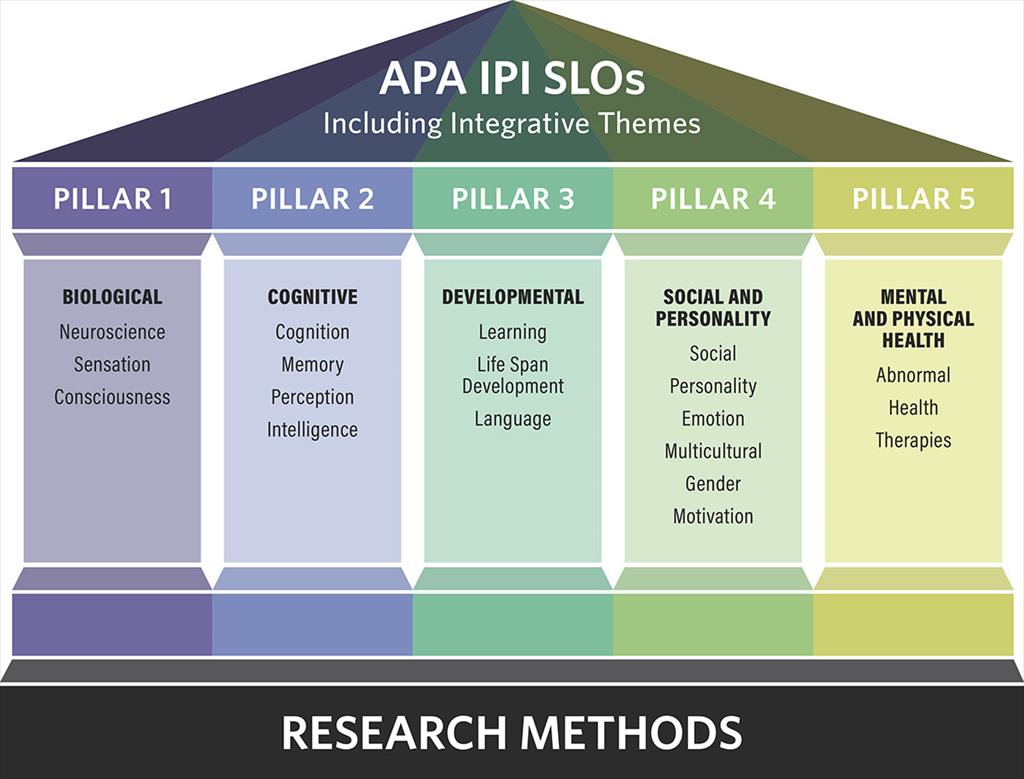
View full-sized infographic with full text description.
IPI looks forward to the publication of a new APA book entitled Transforming Introductory Psychology: Expert Advice on Teacher Training, Course Design, and Student Success in August.
 Regan Areesesh Raj Gurung is associate vice provost and executive director of the Center for Teaching and Learning at Oregon State University. founding coeditor of APA’s journal Scholarship of Teaching and Learning in Psychology, he cochairs the APA Introductory Psychology Initiative, and is currently past president of Psi Chi, the International Honor Society in Psychology. His research encompasses social and pedagogical psychology. He has had over 100 articles published in peer-reviewed journals and has coauthored/coedited 15 books.
 Garth Neufeld is professor of psychology at Cascadia College and faculty-in-residence of the college’s teaching and learning academy. He is the founder of Teaching Introductory Psychology Northwest and the Teaching of Psychology Incubator workshop, and cofounder of the PsychSessions podcast and The Psychology Network. He has served the national teaching of psychology community in various leadership roles through the Society for the Teaching of Psychology (STP), the AP Psychology Reading, and APA’s Education Directorate and is coeditor of the upcoming APA book, Transforming Introductory Psychology: Expert advice on teacher training, course design, and student success, along with Regan A. R. Gurung. In 2018, Garth was awarded a Citizen Psychologist presidential citation from the APA for cofounding Shared Space For All, an organization that educates and mentors at-risk Thai children toward the prevention of prostitution. He is also the recipient of the 2019 STP Wayne Weiten Teaching Excellence Award.