Psychology is a key contributor to creating a sustainable and environmentally just future (Amel et al., 2017a; Clayton & Manning, 2021; Manning & Amel, 2014). We have also found integrating sustainability and environmental justice into our psychology courses to be incredibly rewarding; students are increasingly worried about the future and psychology provides both an understanding of why it’s hard for people to change (see 2017b, for an annotated article for younger students) as well as a set of tools anyone can use to foster new ways of thinking and acting in the world.
We firmly believe that sustainability belongs in every course, psychology and otherwise. Yet, changing everything at once will likely feel overwhelming. Although we now include sustainability in all of our courses, our efforts were small at first and became more comprehensive as we gained more experience and confidence over time.
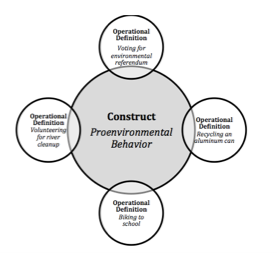
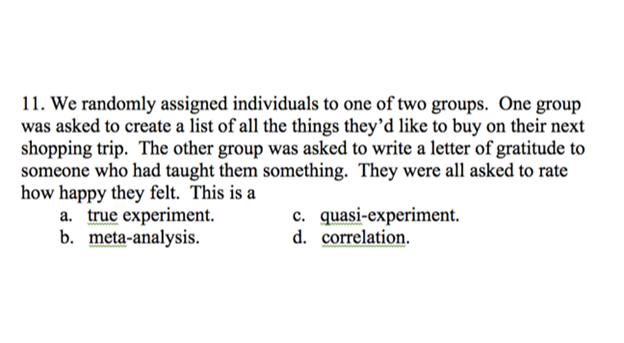
There are myriad ways to integrate sustainability into courses; they range in scope from stealthily introducing it to creating a whole course dedicated to the psychology of sustainability. In the stealth method, simply swap out examples, test questions, or assignment topics to include sustainability concepts. For instance, when teaching research methods students about constructs and operational definitions, you can use pro-environmental behavior as the example (fig 1). Likewise, test questions about true experiments can focus on IVs and DVs with a sustainability focus (fig 2). When helping students unpack how an empirical article is constructed, pick one that addresses some aspect of environmental justice.
More intensive integrations can range from dedicating a lecture, a guest speaker, an activity or project, or a whole unit to the topic. Lecture ideas can be found at Teachgreenpsych.com, in various instructor’s manuals (e.g., Koger et al, 2021), and resources such as webinars available through Division 34 of APA (e,g., Scott et al, 2021b). Every area of psychological study can address sustainability whether it is the impact of social norms, the mismatch between environmental problems and our cognitive abilities (hard to notice slow speed of change, many cues are invisible, etc.), how organizations drive individual behavior, or the impact of environmental degradation on our mental health. We encourage you to leverage what psychology educators have already developed and share your own innovations with your peers.
We’ve found the most rewarding forms of integration to be a theme that runs through an introductory psychology course (Manning et al, 2012) or a whole course dedicated to the psychology of sustainability (Scott et al, 2021). We’ve also enjoyed engaging students outside of psychology through interdisciplinary offerings such as honors and environmental studies, fine arts, or science capstone courses. Another way to help students build their skills is to collaborate with community partners to solve real sustainability problems. Every community needs to work on climate mitigation and adaptation, often with limited funds and personnel, so developing community engagement projects with organizations that focus on sustainability and environmental justice can be mutually beneficial to students and your region.
Off-campus excursions are yet another great way to show students that sustainability is not only possible but desirable. Although we are increasingly conflicted about the environmental costs of international travel, we’ve created study abroad courses that not only teach students what sustainability looks like, but also, through their structure and logistics (e.g., walking, riding bikes and taking public transit instead of tour buses; eating at vegetarian, locally-sourced restaurants and sleeping at organic hotels), provide a model to other faculty about how to make off-campus study courses and field trips more sustainable.
You might be wondering how to scaffold any of these approaches so here are some basic guidelines.
- While many young people are at the vanguard of environmental activism, many others have only a vague notion of the global scope and urgent nature of our environmental crises. We’ve found it essential to begin any series of discussions with an overview of the state of the planet. Yet often the tone of environmental writers is shrill and pessimistic, and students shut down and stop reading. Stating the facts is often enough to get students’ attention; in our experience it isn’t necessary to emphasize the seriousness of our global environmental situation, for most students arrive at a sense of urgency on their own. We also find that presenting the possibilities that exist for a hopeful, brighter future can help avoid despair and concomitant emotional shutdown.
- Students often don’t have a language for talking about sustainability, so we encourage an introduction to some of the fundamental concepts, drawn from the basic principles of ecology, that make or break whether actions are sustainable: all things are connected; small actions can have big consequences; life systems are circular; there are limits to growth and to nature’s capacity for regeneration; and diversity enhances resilience. These ecological principles not only provide a shared language, but they are also great heuristics for comparing the effectiveness of competing ideas that students encounter in readings, in discussion, and in the real world (Amel & Manning, 2012).
- Sustainability is about planetary flourishing for the long run, for everyone. In contrast, often the people who have contributed the least to environmental degradation are the most affected by it. Environmental racism exists in myriad forms from disproportionate exposure to toxicants to limited access to natural spaces. True sustainability addresses these injustices.
One thing we know—from psychology as well as from personal experience—is that changing individual behavior is slow and hard, so changing the underlying systems that drive behavior can get us farther faster. Importantly, if you can create systemic change, such as instituting a sustainability-focused shared reading across sections and faculty of general psychology, you can touch many more students, fuel their desire to learn more, and foster the next generation of sustainable psychologists.
 Christie Manning, PhD, (she/her) is the director of Sustainability and faculty member in Environmental Studies at Macalester College in Minnesota. Christie has a bachelor’s degree in Human Factors Engineering from Tufts University and a PhD in Cognitive and Biological Psychology from the University of Minnesota. Her recent co-authored publications include a report from the American Psychological Association and ecoAmerica, Mental Health and our Changing Climate, and a 2021 textbook, Psychology for Sustainability 5e. Her research focuses on how people respond to the climate crisis, and she is particularly interested in the psychological circumstances that motivate community-level action. In her personal life, Christie likes to ride her bike, learn about trees, and spend time with her two favorite climate justice activists—her daughters.
 Elise Amel, PhD, (she/her) earned her PhD in industrial-organizational psychology from Purdue University and has been teaching at the University of St. Thomas for over two decades. Amel is an award-winning professor of psychology; chair of the Department of Earth, Environment, & Society; past-president for the