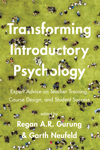
The Introductory Psychology Initiative Working Group (IPI, 2020) blazed a path for educators looking to transform their introductory psychology course by developing specific recommendations on teacher training, course design, and student success (Gurung & Neufeld, 2021) and crafting a set of student learning outcomesopens in new window (SLOs) that were approved by APA’s Council of Representatives in 2021. (For more information check out the APA IPI webpage).
These advancements set off a wave of enthusiasm among educators, particularly for those who see the incredible potential of this course taken by over 1.5 million students each year. A high-quality and accessible introductory psychology course can elevate the public’s understanding of psychology, increase scientific literacy, and draw students into the field, diversifying and strengthening the workforce. Notable recommendations include emphasizing psychology’s integrative themesopens in new window, helping students to cultivate and apply skills to improve their lives, and taming the tyranny of content to be covered by using the pillar model as a guide.
On the other hand, revamping a course is a formidable challenge in the best of times. And, unfortunately, this is not the best of times for educators. Resources are tightening in response to the demographic cliff, students are in a mental health crisis, ChatGPT and other AI products are disrupting the educational landscape, and educators are facing increasing political attacks on their academic freedom.
Like all guidelines developed and disseminated by APA, the IPI recommendations and SLOs are meant to be aspirational rather than prescriptive. They are designed to promote reflection and inspire innovation. And they present an opportunity for individual educators to join a larger community united in their passion for changing students’ lives. APA staff working on the precollege and college education portfolios, in partnership with many dedicated educators who are committed to the dissemination and implementation of the IPI recommendations, have designed some resources and opportunities to support educators in the transformation of their introductory psychology course.
In addition to developing the handouts and resources that can be found on the APA IPI webpage, we’ve hosted “book circles” that created small communities for educators to discuss the recommendations and share implementation tips. We’ve also offered a free virtual multi-session summer course design institute to give educators some space and support to redesign their course (if you missed this, be sure to check out the video recordings of those sessionsopens in new window on YouTube).
Most recently, with funding from the National Science Foundation, a working group of APA staff and educators1 designed and hosted an APA IPI Early Adopters conference to learn how educators are using the recommendations across institutional contexts, and what they might need to deepen and sustain their adoption. Forty-seven educators who had tried incorporating some or all of the recommendations from community colleges (32%), baccalaureate colleges (40%), and master’s and doctoral-granting institutions (28%) participated. Before the conference, they shared their reflections on how they did (or did not) attempt to integrate each of the recommendations into their class, along with a syllabus and sample assignment. During the conference, they engaged in small breakout and larger all-participant discussions where they shared examples of how they adopted the recommendations, discussed factors that facilitated and hindered their adoption, and identified some of the specific resources and supports they felt were needed to help maintain or expand adoptions.
One clear takeaway from the conference is that some recommendations and SLOs seem to be easier to implement than others. For example, almost all participants used the pillar model, integrated student skill building into their courses, introduced students to the integrative themes, and described goals and assignments aimed at helping students to evaluate and interpret research findings. In contrast, fewer instructors described opportunities for students to design or conduct research and some struggled with ways to explicitly promote diversity, inclusion, and belonginess in their classes. Almost all participants were using some evidence-based teaching strategies in their class, although some educators found it challenging to fully integrate backward course design into their course planning.
Educators at the early adopter conference communicated a need for more examples of sample syllabi and assignments and underscored the need for resources to be stored in a centralized, accessible location. Another consistent message was that communities of practice and other opportunities for peer-mentoring would be appreciated. We are currently exploring opportunities to help provide these needed supports.
We will try our best to keep the psychology educator community up to date on new IPI resources and professional development opportunities as they arise. And, if you have a syllabus or resource you’d like to share with the community, please reach out to me.
 Sue Orsillo is the senior director of psychology education and training at APA. Her current areas of focus include supporting educators in their implementation of the Introductory Psychology Initiative SLOs, Principles for Quality Undergraduate Education in Psychology, and APA Guidelines for the Undergraduate Psychology Major, broadening representation of educators and students in APA, strengthening pathways into the discipline, and supporting students in their career exploration and professional development. Before joining APA, Sue taught, supervised, and mentored undergraduate students, doctoral students in clinical psychology, interns, and postdoctoral fellows for close to 25 years. Her clinical research focused on using acceptance-based behavioral therapy to prevent and treat anxiety and related disorders.