 This year Brain Awareness Weekopens in new window will take place March 13-19, 2017. The Dana Foundationopens in new window supports activities to promote education of neuroscience, psychology and biology. What a perfect opportunity to gather nearby psychology teachers and hold an event.
Psychology teachers often come from a history/social science background and have little experience with biology and neuroscience. Using Brain Awareness Week as a theme, the Greater Philadelphia Area Teachers of Psychology in Secondary Schools (PhiTOPSS) met last year with Brian Balin, PhD, a professor and neuropathologist at the Philadelphia College of Osteopathic Medicine. The meeting was held at Penn Manor High School on March 19, 2016. PhiTOPSS was started through a grant provided by the American Psychological Foundationopens in new window (APF), and grant funding allowed the local group of teachers to provide Balin with a modest honorarium.
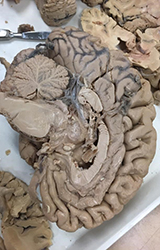
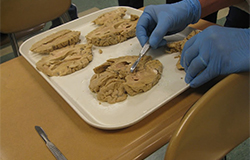
In addition to sharing recent research on Alzheimer’s disease, Balin dissected a human brain at the PhiTOPSS meeting. This felt like a once-in-a-lifetime experience. Each teacher had the opportunity to hold a human brain and see the essential structures typically taught in introductory psychological science. Teachers physically experienced the grandeur of structures like the cerebellum, which Balin described as having “more cells than the rest of the cortex — just more compact.”
Balin’s research has posited that pathogens might invade the brain through the nasal passageway and initiate the development of amyloid plaques, typical of Alzheimer’s disease. Balin and colleagues (2004), infected a mouse’s olfactory cells with chlamydia pneumoniae. After three months, the infection remained in the nasal passageways, but it also progressed to the brain. Over time, greater deposits of amyloid plaques were detected.
With financial support from the APF Outreach grant, PhiTOPSS has gathered for three meetings since the winter of 2016. Past guest speakers have included Frank Farley, PhD, former president of the American Psychological Association. The network gives teachers a forum to grow professionally, academically and personally. Teachers who have typically functioned in isolation are now working together to promote psychological science. John Mohl, one of the PhiTOPSS co-organizers, hosted a regional review with over 100 students from ten different schools. Teachers have reviewed various topics for students and then a practice exam was administered. Students and teachers are looking forward to the next Regional Review on April 22, 2017 at Cheltenham High School. Anyone in the Pennsylvania, Maryland, Delaware, New Jersey area can join us. For information, contact John Mohl via email.
Would you like to start a network of psychology teachers in your region? Consider applying for an APF High School Psychology Outreach grant by April 15, 2017.
Reference
Little, C.S., Hammond, C.J., MacIntyre, A., Balin, B., & Appelt, D.M. (2004). Chlamydia pneumoniae induced Alzheimer-like amyloid plaques in brains of BALB/c mice. Neurobiology of Aging. 25(4), 419-429.
About the author
 Maria Vita is a social studies and psychology teacher at Penn Manor High School in Millersville, Pennsylvania, where she started the Advanced Placement Psychology program. She maintains a laboratory with live rats for ethical research in learning and has expanded the program, requiring additional staff. She is also a recipient of the APA TOPSS Excellence in Teaching Award (2012) and currently serves on the TOPSS Committee as chair-elect.