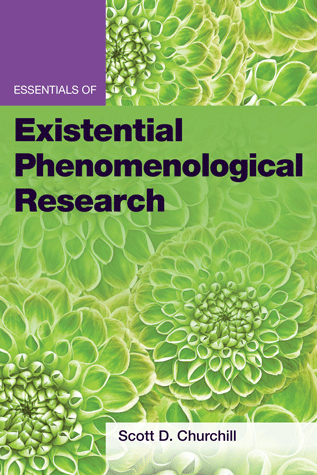
Essentials of Existential Phenomenological Research
ISBN: 978-1-4338-3571-1The brief, practical texts in the Essentials of Qualitative Methods series introduce social science and psychology researchers to key approaches to qualitative methods, offering exciting opportunities to gather in-depth qualitative data and to develop rich and useful findings.
In this book, Scott D. Churchill introduces readers to existential phenomenological research, an approach that seeks an in-depth, embodied understanding of subjective human existence that reflects a person’s values, purposes, ideals, intentions, emotions, and relationships. This method helps researchers understand the lives and needs of others by helping identify and set aside theoretical and ideological prejudgments.
About the Essentials of Qualitative Methods book series
Even for experienced researchers, selecting and correctly applying the right method can be challenging. In this groundbreaking series, leading experts in qualitative methods provide clear, crisp, and comprehensive descriptions of their approach, including its methodological integrity, and its benefits and limitations.
Each book includes numerous examples to enable readers to quickly and thoroughly grasp how to leverage these valuable methods.
Series Foreword—Clara E. Hill and Sarah Knox
1. Conceptual Foundations of Existential Phenomenological Research
- The “Human Science” Approach as a Way of Seeing
- What Is the Key Insight of Existential Phenomenology?
- Summary
2. Getting Started: Selecting an Experience to Study
- Formulating a Research Question
- Summary
3. Collecting the Data
- Attending to Ethical Considerations
- Selecting Participants
- Developing an Experiential “Approach” to Data Collection
- Data-Generating Activities
4. First Phase of Data Analysis: Focusing on Moments Within the Whole
- Doing Psychology Phenomenologically
- Mentoring EPR in the Classroom: Training the Research Team
- Summary
5. Second Phase of Data Analysis: Comprehensive Synthesis
- Individual Structural Description: A Comprehensive Synthesis
- General Structural Description: The Intuition of Essential Meaning
- Summary
6. Writing the Research Report
- Introduction Section
- Method Section
- Results Section
- Discussion Section
- Summary
7. Conclusions
- The Place of Phenomenology Within the Qualitative Tradition
- Achieving Methodological Integrity
- Strengths, Limitations, and Future Directions
Appendix: Exemplar Studies
References
Index
About the Author
About the Series Editors
Scott D. Churchill, PhD, began studying existential phenomenology in 1969 at Bucknell University and continued his studies at Duquesne University, where he earned his doctorate in “clinical phenomenological psychology” in 1984. He began his professional career at the University of Dallas in 1981, where he currently holds the position of professor, having earlier served as department chair and founding director of the master’s programs in psychology.
A fellow of the APA, he has served as editor-in-chief of The Humanistic Psychologist since 2006 and is currently president of APA’s Society for Theoretical and Philosophical Psychology. He has also served on the APA Council of Representatives and as president of the Society for Humanistic Psychology (APA Division 32), as well as editor of Methods: A Journal for Human Science, while also participating on numerous editorial boards both here and abroad. He is a founding member of the International Human Science Research Conference, the Society for Qualitative Inquiry in Psychology, and the Interdisciplinary Coalition of North American Phenomenologists.
Dr. Churchill has presented papers, workshops, and invited addresses at professional conferences around the world, including Italy, Norway, Sweden, Denmark, Germany, Taiwan, Malaysia, Canada, England, India, and Australia. He has authored numerous articles and book chapters in the fields of phenomenological research methodology, empathy studies, human–bonobo communication, and second-person perspectivity. He has developed and taught well over 100 courses in phenomenological psychology, hermeneutics, depth psychology, projective techniques, ecopsychology, primate studies, and cinema studies.
Dr. Churchill was awarded the Mike Arons and E. Mark Stern Award for Outstanding Lifetime Service to the Society for Humanistic Psychology and the Charlotte and Karl Bühler Award for Outstanding and Lasting Contribution to Humanistic Psychology from APA Division 32 (Society for Humanistic Psychology) and the Steve Harrist Distinguished Service Award from Division 24 (Society for Theoretical and Philosophical Psychology). He was also named a Minnie Stevens Piper Professor for excellence in teaching.
Locally, Dr. Churchill is a fellow of the Dallas Institute of Humanities and Culture and senior film and performing arts critic for the Irving Community Television Network.