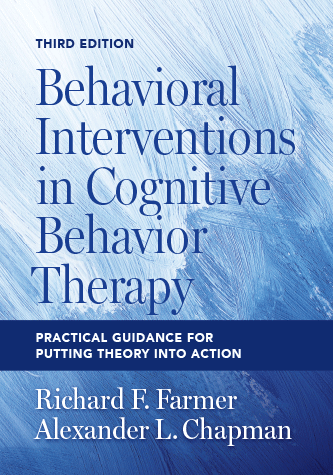
Behavioral Interventions in Cognitive Behavior Therapy
Available formats
Also available from
- Is particularly good because it shows how a behavioral perspective and specific interventions can be useful within cognitive behavior therapy. It looks at theory and practice. The authors are experts in the field. This third edition justifies replacing the second because it contains new information, updated chapters, and new research findings...It contains so much useful information for students, and clinicians in practice can benefit from this information as well.
—Doody's Reviews
An authoritative introduction to behavior therapy as well as a comprehensive resource for those with a firm background in this area.
This book clearly and methodically introduces the behavioral perspective to readers new to cognitive-behavioral therapy, while also applying a fresh lens for connecting theory, research, and practice for more experienced practitioners. Instead of matching interventions with client populations or diagnoses, the authors emphasize a framework and set of principles that are broadly applicable to adult clients. Readers will learn how therapists use a behavioral perspective to conceptualize their clients, their problem areas, and the therapeutic process. The chapters facilitate systematic, coherent, and flexible thinking about people and their behavior, and they offer guidance for addressing both common and novel clinical problems not addressed in standard therapy manuals.
This third edition includes:
- New chapters on problem‑solving therapies, self‑management interventions, and contemporary ethical and professional issues.
- A renewed focus on interventions for strengthening mindfulness and acceptance skills.
- Expanded discussions of behavioral case formulation and treatment planning.
- Extensive updates in clinical research.
Preface to the Third Edition
- Chapter 1. Historical and Conceptual Overview of Behavior and Cognitive Therapies
Part I. Conceptual Foundations of Behavioral Assessment
- Chapter 2. Principles, Goals, and Structure of Initial Assessment Sessions
- Chapter 3. Behavioral Case Formulation
- Chapter 4. Treatment Planning and Implementation
Part II. Interventions with Broad Applicability
- Chapter 5. Changing Behavior by Changing the Environment
- Chapter 6. Altering the Context that Supports Maladaptive Thinking
- Chapter 7. Developing and Strengthening New Behaviors and Skills
- Chapter 8. Reducing Distress and Avoidance Through Exposure-Based Interventions
Part III. Interventions for Promoting Change in Specific Areas
- Chapter 9. Fostering Mindfulness and Acceptance
- Chapter 10. Enhancing Emotion Regulation
- Chapter 11. Promoting Behavioral Activation
- Chapter 12. Improving Problem Solving
- Chapter 13. Increasing Interpersonal Effectiveness
- Chapter 14. Strengthening Self-Management Skills
Part IV. Therapy Process and Practice Considerations
- Chapter 15. Guiding Ethical and Professional Considerations When Using Behavioral Interventions
- Chapter 16. Navigating Therapeutic Challenges
- Chapter 17. Bringing Therapy to a Close and Aftercare
References
Richard F. Farmer is a licensed psychologist and research scientist affiliated with Oregon Research Institute in Springfield, Oregon. After earning a doctoral degree in clinical psychology from the University of North Carolina at Greensboro following an internship at Duke University Medical Center, he served as an associate professor of psychology at Idaho State University and East Carolina University, and as a senior lecturer in psychology at the University of Canterbury in Christchurch, New Zealand. His main areas of research and clinical interest include behavioral assessment and therapy, emotional and behavioral disorders over the lifespan, personality disorders, impulsivity, and substance misuse.
Alexander L. Chapman is a professor, registered psychologist, and director of clinical training in the Department of Psychology at Simon Fraser University as well as the president of the Dialectical Behaviour Therapy Centre of Vancouver. He received his BA from the University of British Columbia and his MS and PhD in clinical psychology from Idaho State University following an internship at Duke University Medical Center. Dr. Chapman completed a post-doctoral fellowship with Dr. Marsha Linehan at the University of Washington. Dr. Chapman’s research focuses on complex mental health concerns such as borderline personality disorder.
The third edition of Behavioral Interventions in Cognitive Behavior Therapy reflects a comprehensive, inclusive, and thoughtful approach to scaffolding essential competencies for learners of cognitive behavior therapies. Farmer and Chapman illustrate the behavioral science framework, teach functional analyses, and facilitate a conceptual understanding of common components of cognitive behavior therapies for flexible, individually tailored application in an approachable and highly readable manner. These foundations, the broad range of assessment and intervention techniques, and related sociocultural and ethical considerations are invaluable for those already practicing evidence-based cognitive behavior therapies as well as learners of modular, process-based therapy.
—Claudia Drossel, PhD, PhD, Associate Professor, Department of Psychology, Eastern Michigan University, Ypsilanti, MI, United States
This third edition of Farmer and Chapman’s exceptional text is up-to-date and filled with overviews of theory, research, and many guidelines for competent application of the behavioral strategies in cognitive behavior therapy. Encompassing a range of topics, from cultural humility to balancing functional approaches with traditional categorical diagnoses, the book will be a highly valued reference for students and new cognitive behavioral therapists. It is an excellent reminder for those who have been in the field for some time, and an informative and enjoyable "nerd" read for the seasoned expert.
—Christopher Martell, PhD, ABPP, Professor of Practice and Clinic Director, Psychological Services Center, Department of Psychological and Brain Sciences, University of Massachusetts Amherst, Amherst, MA, United States