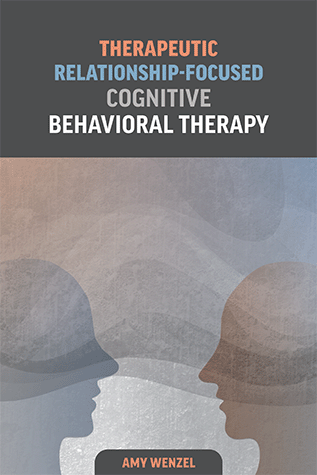
Therapeutic Relationship-Focused Cognitive Behavioral Therapy
ISBN: 978-1-4338-3596-4Available formats
Also available from
This book describes a relationship-focused approach to the conduct of cognitive behavioral therapy (CBT) called therapeutic relationship-focused CBT, offering readers a broad conceptualization of the therapeutic relationship by integrating literature that cuts across theoretical frameworks, and applies this conceptualization to illustrate how the therapeutic relationship can be used as both a facilitator of change as well as a central agent of change within the cognitive behavioral framework.
In addition to acknowledging important theoretical and empirical scholarship on the therapeutic relationship that has been advanced by renowned CBT scholars, the book highlights and integrates important insights from scholars who operate outside of the cognitive behavioral framework. In addition, it provides clinical guidance for developing, maintaining, and enhancing the therapeutic relationship throughout the course of CBT, and provides case illustrations to support the notion that some of the very best CBT occurs in the context of an issue happening in real time, in session, within the therapeutic relationship. Chapters emphasize that the incorporation of a focus on the therapeutic relationship in CBT has the potential to enhance outcomes and promote treatment engagement for clients.
The volume is divided into two parts. The first part on contextual foundations describes theory, discourse, empirical research, and some clinical applications of general aspects of the therapeutic relationship. Part two of the book summarizes clinical guidance for the implementation of therapeutic relationship-focused CBT, showing how the therapeutic relationship can facilitate CBT techniques like cognitive restructuring, social problem solving, exposure, and schema modification. The author discusses how to address sensitive issues that may not typically be addressed in the CBT literature, such as negative client reactions to therapists and vice versa. Guidance for repairing ruptures in the working alliance and ending therapy is also provided. Together, the volume presents a vivid description of a therapeutic relationship-focused CBT that brings together key scholarly advancements on the therapeutic relationship, translates them into clinical guidance, and establishes a foundation for future empirical research and clinical practice.
Preface
Introduction: The Therapeutic Relationship and Its Relevance to Cognitive Behavioral Therapy
Part I. Contextual Foundations
- Chapter 1. The Therapeutic Relationship:Definitions and Components
- Chapter 2. Common Therapeutic Relationship-Facilitating Aspects of Psychotherapy
- Chapter 3. Specific Therapeutic Relationship-Enhancing Aspects of Cognitive Behavioral Therapy
Part II. Clinical Guidance for Therapeutic Relationship-Focused Cognitive Behavioral Therapy
- Chapter 4. Establishing the Therapeutic Relationship in the First Contacts With a Client
- Chapter 5. Cognitive Restructuring and the Therapeutic Relationship
- Chapter 6. Social Problem Solving and the Therapeutic Relationship
- Chapter 7. Exposure and the Therapeutic Relationship
- Chapter 8. Schema Modification and the Therapeutic Relationship
- Chapter 9. The Ending of Treatment and the Therapeutic Relationship
Conclusion: A Fresh Perspective on the Therapeutic Relationship and Cognitive Behavioral Therapy
References
Index
About the Author
Amy Wenzel, PhD, ABPP, is a clinical psychologist who specializes in cognitive behavioral therapy (CBT). She founded the Main Line Center for Evidence-Based Psychotherapy, is a trainer-consultant with the Academy of Cognitive Therapy, and is an affiliated faculty member of the Beck Institute for Cognitive Behavior Therapy.
Dr. Wenzel is author or editor of over 25 books and has authored more than 100 peer-reviewed articles and book chapters. She has trained and supervised over 1,000 clinicians, lectures internationally, has been featured in CBT video demonstrations, and is on the editorial boards of three journals.
This groundbreaking book makes the implicit explicit: Cognitive behavior therapy is grounded in a strong, respectful, and caring therapeutic relationship. The research is clear and compelling: Attention to the therapeutic relationship improves treatment outcome and decreases therapy drop out. If doubts linger, Dr. Wenzel’s clinical experience and wisdom will convince you. And once convinced, you’ll find in this book skills, strategies, and guidance that will add both power and compassion to the cognitive behavior therapy you provide.
—Michael A. Tompkins, PhD, ABPP, codirector, San Francisco Bay Area Center for Cognitive Therapy, Oakland, CA; faculty, Beck Institute for Cognitive Behavior Therapy, Bala Cynwyd, PA, United States
Dr. Amy Wenzel, a leading expert in cognitive behavior therapy, delivers a compelling and comprehensive guide for clinicians on therapeutic relationship processes in CBT, including those unique to the modality. Rich in theoretical concepts and empirical research synthesis, this guide offers clinicians practical insights they can immediately apply in their sessions.
—Nikolaos Kazantzis, PhD, Cognitive Behavior Therapy Research Unit, Melbourne, Australia, and author of The Therapeutic Relationship in Cognitive-Behavioral Therapy: A Clinician’s Guide
Presents a refreshing and necessary paradigm shift for the therapeutic relationship… The book powerfully illustrates how the most impactful CBT often emerges when relational impasses are skillfully navigated using CBT principles, offering profound learning and generalization… Highly recommended. Graduate students, faculty, and professionals.
—Choice, American Library Association