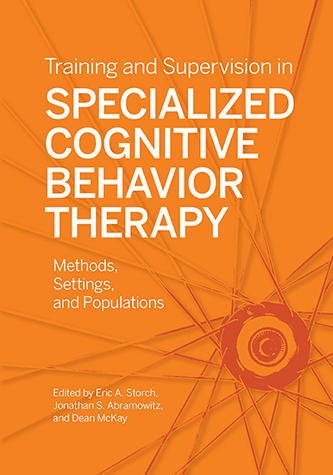
Training and Supervision in Specialized Cognitive Behavior Therapy
Available formats
Also available from
This book describes training, supervision, and consultation with specialized cognitive behavior therapy (CBT) approaches, to ensure proper implementation across a variety of clinical contexts.
Although CBT is sometimes portrayed as a single treatment method, the expert contributors in this volume describe a diverse collection of cognitive behavioral theories and techniques, such as exposure therapy, acceptance and commitment therapy, dialectical behavior therapy, and child behavior management.
Contributors also review application guidelines for a variety of settings, including public schools, inpatient and outpatient medical settings, and diverse client populations representing different religious and spiritual beliefs, cultural and ethnic backgrounds, and sexual and gender minorities.
For each approach and setting, contributors describe key concepts and techniques, explain the characteristics of good and bad training cases, survey common trainee mistakes and supervision obstacles, and also address common ethical issues.
This book is intended for CBT trainees and practitioners who seek training in specialized areas, and those trained in other theoretical orientations who seek to adapt CBT techniques to their practice.
Contributors
Introduction to Training and Supervision in Cognitive Behavior Therapy
Eric A. Storch, Jonathan S. Abramowitz, and Dean McKay
Part I. Techniques of Cognitive Behavior Therapy
- Chapter 1. The Supervision of Exposure Therapy
Jonathan S. Abramowitz, Eric A. Storch, and Dean McKay - Chapter 2. Cognitive Therapy Supervision
Robert L. Leahy - Chapter 3. Supervision and Training in Rational Emotive Behavior Therapy
Kristene A. Doyle, Michael Hickey, and Raymond DiGiuseppe - Chapter 4. Training and Supervision in Acceptance and Commitment Therapy
Michael P. Twohig, Jennifer Krafft, Julie M. Petersen, and Carter H. Davis - Chapter 5. Supervision in Dialectical Behavior Therapy
Elizabeth Raposa - Chapter 6. Functional Analytic Psychotherapy: Supervision and Therapist Self-Development
Mavis Tsai, Robert J. Kohlenberg, Emerson Hardebeck, Sarah Sullivan-Singh, and Mary Plummer Loudon - Chapter 7. Supervising Delivery of Comprehensive Behavior Intervention for Tics
Christopher A. Flessner, Theresa R. Gladstone, and Emily P. Wilton - Chapter 8. Supervision in Behavioral Activation
Stacey B. Daughters, Catherine E. Paquette, and Elizabeth D. Reese - Chapter 9. Supervising Child Behavior Management
Deborah J. Jones, Rex Forehand, Nicholas Long, and Robert J. McMahon
Part II. Special Settings and Populations
- Chapter 10. Supervising the Delivery of Cognitive Behavioral Therapy in Community Clinics
Alison Salloum and Brian E. Bunnell - Chapter 11. Supervising Delivery of Cognitive Behavioral Therapy in College Counseling Centers
Michael Rogers and Jonathan Mitchell - Chapter 12. Cognitive Behavior Therapy Consultation With Independent Practitioners
Dean McKay - Chapter 13. Supervising Delivery of Cognitive Behavior Therapy in Medical Settings
Livia Guadagnoli, Jason J. Washburn, and Zeeshan Butt - Chapter 14. Supervising Delivery of Cognitive Behavior Therapy in School Settings
Kristin A. Gansle and George H. Noell - Chapter 15. Cognitive Behavior Therapy Supervision of Multidisciplinary Teams in Intensive Levels of Care
Bradley C. Riemann, Nicholas R. Farrell, and Rachel C. Leonard - Chapter 16. Supervising Delivery of Cognitive Behavior Therapy for Children and Adolescents
Amanda Palo - Chapter 17. Supervising Cognitive Behavior Therapy Delivery With Spiritual and Religious Patients
Moses Appel and David H. Rosmarin - Chapter 18. Clinical Supervision in Delivering Cognitive Behavior Therapy Across Race, Ethnicity, and Culture
Monnica T. Williams and Joseph La Torre - Chapter 19. Supervision and Consultation in Delivery of Cognitive Behavior Therapy to LGBTQ Individuals
Audrey Harkness and John E. Pachankis - Chapter 20. Training and Supervision of Cognitive Behavioral Couple Therapy
Danielle M. Weber and Donald H. Baucom - Chapter 21. Supervision of Cognitive Behavioral Therapy for Substance Use Disorders
Paige Morrison, Jessica Spofford, and Mercedes Carswell
Index
About the Editors
Eric A. Storch, PhD, is professor and McIngvale Presidential Endowed chair in the Department of Psychiatry and Behavioral Sciences, Baylor College of Medicine (BCM). He serves as vice chair and head of psychology and codirects the obsessive compulsive disorder program at BCM.
Dr. Storch specializes in the nature, assessment and treatment of childhood and adult obsessive-compulsive disorder, anxiety disorders, and anxiety among youth with autism.
He has received multiple grants from NIH to investigate treatment efficacy, mechanisms of action, genetics, neuroethics, and how to enhance outcomes for those struggling with these conditions.
Jonathan (Jon) S. Abramowitz, PhD, is a professor and clinical psychologist in the Department of Psychology and Neuroscience, University of North Carolina at Chapel Hill.
His research and clinical work focus on obsessive-compulsive disorder (OCD) and anxiety disorders, including fears and phobias, health anxiety, and panic attacks.
He has authored over 300 scientific publications and 20 books, which have been translated into several languages.
He served as president of the Association for Behavioral and Cognitive Therapies and as editor or associate editor of several academic journals.
Jon Abramowitz lives in Chapel Hill, NC.
Dean McKay, PhD, ABPP is professor at the Department of Psychology, Fordham University, past president (2018) of the Society for a Science of Clinical Psychology, and past-president (2013-2014) of the Association for Behavioral and Cognitive Therapies.
He has edited or coedited 21 books and published over 300 journal articles and book chapters.
He is also a member of the Psychology of Pandemics Workgroup. Dr. McKay’s research has focused on anxiety disorders and obsessive-compulsive disorders, the role of disgust in psychopathology, and misophonia (selective sound sensitivity), as well as professional issues in the delivery of evidence-based interventions.