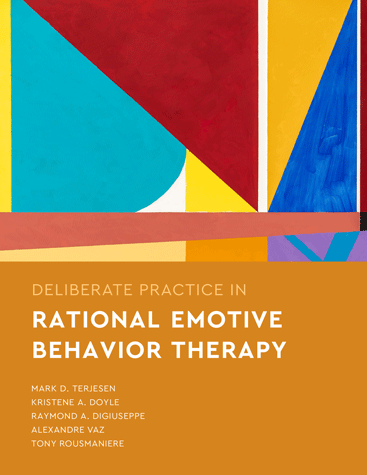
Deliberate Practice in Rational Emotive Behavior Therapy
ISBN: 978-1-4338-3835-4Deliberate practice exercises provide trainees and students an opportunity to build competence in essential rational emotive behavior therapy (REBT) skills while developing their own personal therapeutic style.
These exercises present role-playing scenarios in which two trainees act as a client and a clinician, switching back and forth under the guidance of a supervisor. The clinician improvises appropriate and authentic responses to client statements organized into three difficulty levels—beginner, intermediate, and advanced—that reflect common client questions and concerns.
Each of the first 12 exercises focuses on a single skill, such as psychoeducation, assessing and disputing irrational beliefs, helping clients differentiate maladaptive vs. adaptive behaviors and emotions, teaching clients the ABC model, and developing homework assignments. Two comprehensive exercises follow in which trainees integrate these essential skills into a single REBT session.
Step-by-step instructions guide participants through the exercises, identify criteria for mastering each skill, and explain how to monitor and adjust difficulty. Guidelines to help trainers and trainees get the most out of training are also provided.
To demonstrate how deliberate practiceopens in new window can be fully integrated into a professional curriculum, this series features exercises developed and refined within the clinical training curriculum at the Sentio online/hybrid marriage and family therapy (MFT) therapist training programopens in new window in California, which is where we started developing this series. These exercises, which have been tested at clinical training sites around the world, are used to enhance clinical outcomes within the first hybrid MFT program approved by the California Board of Behavioral Sciencesopens in new window to fully integrate deliberate practice into its entire curriculum. By integrating these models into its hybrid MFT program in California, Sentio University demonstrates that therapist training graduate programs can use deliberate practice to bridge the gap between theory and clinical mastery through repetitive, feedback-informed practice to support the development of modern, outcome-focused clinicians.
Series Preface
Tony Rousmaniere and Alexandre Vaz
Acknowledgments
Part I. Overview and Instructions
- Chapter 1. Introduction and Overview of Deliberate Practice and Rational Emotive Behavior Therapy
- Chapter 2. Instructions for the Rational Emotive Behavior Therapy Deliberate Practice Exercises
Part II. Deliberate Practice Exercises for Rational Emotive Behavior Therapy Skills
Exercises for Beginner Rational Emotive Behavior Therapy Skills
- Exercise 1. Psychoeducation About Rational Emotive Behavior Therapy’s ABC Model
- Exercise 2. Psychoeducation About Dysfunctional Versus Functional Negative Emotions and Behaviors
- Exercise 3. Agreement on the Session Goals
- Exercise 4. Clarifying Inferences From Irrational Beliefs
Exercises for Intermediate Rational Emotive Behavior Therapy Skills
- Exercise 5. Assessing the Irrational Beliefs About the Activating Event
- Exercise 6. Prioritizing Which Irrational Beliefs to Target for Change
- Exercise 7. Teaching the Belief–Consequence Connection
- Exercise 8. Functional Disputation of Irrational Beliefs
Exercises for Advanced Rational Emotive Behavior Therapy Skills
- Exercise 9. Empirical Disputation of Irrational Beliefs
- Exercise 10. Semantic Disputation of Irrational Beliefs
- Exercise 11. Constructing Full Rational Alternative Beliefs to Replace Irrational Beliefs
- Exercise 12. Collaborative Homework Development
Comprehensive Exercises
- Exercise 13. Annotated Rational Emotive Behavior Therapy Practice Session Transcript
- Exercise 14. Mock Rational Emotive Behavior Therapy Sessions
Part III. Strategies for Enhancing the Deliberate Practice Exercises
- Chapter 3. Additional Guidance for Trainers and Trainees: How to Get the Most Out of Deliberate Practice
Appendix A. Difficulty Assessments and Adjustments
Appendix B. Deliberate Practice Diary Form
Appendix C. Sample Rational Emotive Behavior Therapy Syllabus With Embedded Deliberate Practice Exercises
References
Index
About the Authors
Mark Terjesen, PhD, is professor of psychology at St. John's University and a core member of the school psychology programs, previously serving as director. He was the Child and Family Service Coordinator for the Albert Ellis Institute for Rational Emotive Behavior Therapy in Manhattan and was President of the School Division of the New York State Psychological Association (NYSPA) and of APA’s Division 52 (International Psychology). Dr. Terjesen has studied and published on diverse topics, including rational emotive behavior therapy, cognitive behavior therapy, the assessment and treatment of ADHD and anger in children, school psychology, and international psychology.
Kristene A. Doyle, PhD, ScD, is the director of the Albert Ellis Institute (AEI) and director of Clinical Services and a licensed staff psychologist at AEI. Her clinical and research interests include eating disorder treatment, ADHD, and treating children and adolescents. Dr. Doyle is coauthor of The Practitioner's Guide to Rational Emotive Behavior Therapy, 3rd Edition, coeditor of The Journal of Rational-Emotive & Cognitive-Behavior Therapy, and has published in numerous scientific journals, including the Journal of Social Behavior and Personality. She is also the external examiner for the MSc in rational emotive behavior therapy at Goldsmiths, University of London.
Raymond A. DiGiuseppe, PhD, ABPP, is professor of psychology and chair of the Institutional Review Board at St. John's College of Liberal Arts and Sciences. He has promoted the recognition of anger as a form of psychopathology and studies the diagnosis, assessment, and treatment of anger problems. Dr. DiGiuseppe has published two psychological tests assessing dysfunctional anger: the anger disorders scale (ADS) for adults and the anger regulation and expression scale (ARES) for children and adolescents. He works on the development of the theory, practice, and empirical research support of rational emotive behavior therapy and cognitive behavior therapies.
Alexandre Vaz, PhD, is chief academic officer of Sentio University marriage and family therapy (MFT) program in Californiaopens in new window. This innovative online/hybrid MFT programopens in new window was the first approved by the California Board of Behavioral Science for MFT licensure to fully integrate deliberate practiceopens in new window into its curriculum to ensure superior clinical outcomes. He is also director of clinical training for the Sentio Counseling Centeropens in new window which is Sentio MFT program’s guaranteed practicumopens in new window site where students provide low-cost online couples therapy in Californiaopens in new window. Dr. Vaz is the author/coeditor of many books on deliberate practice and psychotherapy training.
Tony Rousmaniere, PsyD, is president of Sentio University marriage and family therapy (MFT) program in Californiaopens in new window. He led the development of online/hybrid MFT programopens in new window, which is the first MFT therapist training program approved by the California Board of Behavioral Science for MFT licensure that fully integrates deliberate practiceopens in new window. Dr. Rousmaniere is the author/coeditor of many books on psychotherapy training. He is also the executive director of the Sentio Counseling Centeropens in new window, which is Sentio MFT program’s guaranteed practicumopens in new window site where students provide sliding-scale online therapy in Californiaopens in new window, and past president of the APA’s Division 29.
This book is the fundamental reference guide for the deliberative practice of rational emotive behavior therapy. Written by key leaders in the field, it should be in the portfolio of any trainee and trainer interested to learn and apply REBT efficiently. The book and its approach is a very relevant and important development in the whole REBT/cognitive behavior therapy field!
—Daniel David, PhD, Professor, International Institute of Psychotherapy, Member of the Romanian Academy and of the Academia Europaea (the Academy of Europe)
Deliberate practice is at the heart of a revolution in clinical training and supervision. This volume, by leading experts in rational emotive behavior therapy, brings the structure of deliberate practice to bear in helping students as well as more experienced therapists identify and master the component skills crucial to becoming an effective and flexible rational emotive behavior therapy practitioner.
—David A. F. Haaga, PhD, Professor of Psychology and Director of Clinical Training, American University, Washington, DC, United States
Deliberate practice is a purposeful, positive, and goal-directed approach to learning, and this volume demonstrates exceptionally well how to apply this approach to rational emotive behavior therapy. Written by a group of experts in highly accessible language, this volume is replete with skills that practitioners at all levels of training and experience can incorporate into their practice. This is really a “must” book for anyone who wants to know and use rational emotive behavior therapy.
—Keith S. Dobson, PhD, Faculty Professor Emeritus, Clinical Psychology, University of Calgary, Calgary, AB, Canada, and President, World Confederation of Cognitive and Behavioural Therapies
In theory-driven empirical science and practice the significance of theory is of course paramount, but in an applied science one has to move from the abstract to actual operations. For it is what therapists do that affects our patients, and this volume concentrates on the doing, the actual operations that cognitive behavior therapists following the rational emotive behavior therapy model engage in to implement concepts and empirical findings. In experimental terms, this well-written book specifies the independent variable, something often found vague in conversations about “doing cognitive restructuring” or “doing cognitive behavior therapy.” This well-organized and clearly written gem will be invaluable in graduate education as well as in the continuing education of researchers, practicing professionals, and university instructors.
—Gerald C. Davison, PhD, Professor of Psychology, University of Southern California, Los Angeles, CA, United States
This book is part of the Essentials of Deliberate Practice series by Tony Rousmaniere and Alexandre Vaz. The clinician and practitioner resources on this page include a Deliberate Practice Reaction Form and a Deliberate Practice Diary Form that can be used with every book in this series, as well as volume-specific content.
These documents are offered for your personal use in clinical training or teaching courses. If you reprint or adapt them for publication, permission is required from the publisher.
Deliberate Practice Reaction Form
The Deliberate Practice Reaction Form can be used with any of the deliberate practice exercises throughout the series to measure how challenging it was for the trainees and to adjust the difficulty as needed. Appendix A includes a black-and-white version of the form with instructions for assessing and modifying an exercise’s difficulty. A color version of the Deliberate Practice Reaction Form is also available for individual download.
- Appendix A: Difficulty Assessments and Adjustmentsopens in new window (PDF)
- Deliberate Practice Reaction Formopens in new window (PDF)
Deliberate Practice Diary Form
The Deliberate Practice Diary Form is an optional form that trainees can complete during a training session’s final evaluation or between sessions to process their experiences with the activity, including what was and was not helpful and what they learned. Appendix B, which is the same across all books in the series, presents this form.
Volume-specific materials
The following content is unique to Deliberate Practice in Rational Emotive Behavior Therapy and includes a sample syllabus that integrates the deliberate practice exercises into a standard clinical course.
- Appendix C: Sample Rational Emotive Behavior Therapy Syllabus With Embedded Deliberate Practice Exercises (PDFopens in new window | Wordopens in new window)
Video demonstration
A YouTube series (Practice Time! with Amy DeSmidt and Jamie Manseropens in new window) highlights authentic deliberate practice sessions featuring exercises from this book and other releases in the Essentials of Deliberate Practice series.
Supplemental resources for therapist training
Designed for faculty at graduate institutions, these supplemental resources provide a framework and clear examples for implementing deliberate practice within existing therapist training curricula. Sentio University is where we started to develop what would become the APA Essentials of Deliberate Practice series. We provide a comprehensive suite of free psychotherapy training resources based on the deliberate practice methodologyopens in new window. These materials are designed to supplement modern hybrid and online therapist training curricula and are used extensively within our own clinical programs.
- California MFT program integration: These materials are a core component of the Sentio hybrid MFT program in Californiaopens in new window, the first in the state to fully integrate DP into its entire curriculum and receive California Board of Behavioral Sciences approval for licensure.
- Free deliberate practice exercises: Access our library of therapist skill-building worksheetsopens in new window used to enhance the online California MFT degree through repetitive, feedback-informed practice.
- Deliberate practice video demonstrations: Visit our YouTube channel for free therapist training videosopens in new window to view clinical demonstrations from the APA Essentials of Deliberate Practice book series. These videos illustrate key skills used to enhance the online California MFT degree through repetitive, feedback-informed practice.
- AI and emerging therapy resources: Learn how deliberate practice can be used to safely and ethically integrate AI for therapist trainingopens in new window. Review our AI research programopens in new window and our clinical guidelines on using AIopens in new window to prepare for the modern landscape of digital mental health.