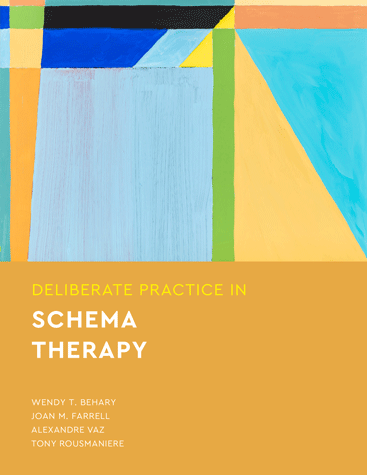
Deliberate Practice in Schema Therapy
ISBN: 978-1-4338-3602-2Deliberate practice exercises allow students and trainees to rehearse foundational schema therapy skills so that they can build competence and hone their own personal therapeutic styles.
Each book in the Essentials of Deliberate Practice series contains customized role-playing exercises in which two trainees act as a client and a therapist, switching back and forth under a supervisor's guidance. The trainee playing the therapist improvises appropriate and authentic responses to client statements organized into three difficulty levels—beginner, intermediate, and advanced—reflecting common issues encountered by schema therapists.
The first 12 exercises focus on skills derived from schema therapy’s three stages—bonding and emotional regulation, mode change, and autonomy—and include limited reparenting, psychoeducation about schema modes, and empathic confrontation. Following these are two comprehensive exercises—an annotated transcript and free-form mock therapy sessions—in which trainees integrate essential skills into a single session.
Step-by-step instructions guide participants through the exercises, identify criteria for mastering each skill, and explain how to monitor and adjust difficulty. Guidelines to help trainers and trainees get the most out of training are also provided.
To demonstrate how deliberate practiceopens in new window can be fully integrated into a professional curriculum, this series features exercises developed and refined within the clinical training curriculum at the Sentio online marriage and family therapy (MFT) therapist training programopens in new window in California, which is where we started developing this series. These exercises, which have been tested at clinical training sites around the world, are used to enhance clinical outcomes within the firsthybrid MFT program approved by the California Board of Behavioral Sciencesopens in new window (BBS) to fully integrate deliberate practice into its entire curriculum. By integrating these models into its hybrid MFT program in California, Sentio University demonstrates that therapist training graduate programs can use deliberate practice to bridge the gap between theory and clinical mastery through repetitive, feedback-informed practice to support the development of modern, outcome-focused clinicians.
Series Preface
Tony Rousmaniere and Alexandre Vaz
Acknowledgments
Part I. Overview and Instructions
- Chapter 1. Introduction and Overview of Deliberate Practice and Schema Therapy
- Chapter 2. Instructions for the Schema Therapy Deliberate Practice Exercises
Part II. Deliberate Practice Exercises for Schema Therapy Skills
Exercises for Beginner Schema Therapy Skills
- Exercise 1. Understanding and Attunement
- Exercise 2. Supporting and Strengthening the Healthy Adult Mode
- Exercise 3. Schema Education: Beginning to Understand Current Problems in Schema Therapy Terms
- Exercise 4. Linking Unmet Needs, Schema, and Presenting Problem
Exercises for Intermediate Schema Therapy Skills
- Exercise 5. Education About Maladaptive Schema Modes
- Exercise 6. Recognizing the Mode Shifts of the Maladaptive Coping Modes
- Exercise 7. Identifying the Presence of the Demanding/Punitive Inner Critic Mode
- Exercise 8. Identifying the Presence of the Angry and Vulnerable Child Modes
Exercises for Advanced Schema Therapy Skills
- Exercise 9. Limited Reparenting for the Angry and Vulnerable Child Modes
- Exercise 10. Limited Reparenting for the Demanding/Punitive Inner Critic Mode
- Exercise 11. Limited Reparenting for the Maladaptive Coping Modes: Empathic Confrontation
- Exercise 12. Implementing Behavioral Pattern Breaking Through Homework Assignments
Comprehensive Exercises
- Exercise 13. Annotated Schema Therapy Practice Session Transcript
- Exercise 14. Mock Schema Therapy Sessions
Part III: Strategies for Enhancing the Deliberate Practice Exercises
- Chapter 3. How to Get the Most Out of Deliberate Practice: Additional Guidance for Trainers and Trainees
Appendix A. Difficulty Assessments and Adjustments
Appendix B. Deliberate Practice Diary Form
Appendix C. Overview of Schema Therapy Concepts
Appendix D. Sample Schema Therapy Syllabus With Embedded Deliberate Practice Exercises
References
Index
About the Authors
Wendy T. Behary, MSW, LCSW, is the founder and director of The Cognitive Therapy Center of New Jersey and The Schema Therapy Institutes of NJ-NYC-DC. She was also the President of the International Society of Schema Therapy (ISST) from 2010–2014. She is the author of Disarming the Narcissist: Surviving and Thriving with the Self-Absorbed (New Harbinger Publications). She has been treating narcissist clients, their partners and associates, and couples experiencing relationship problems; training professionals; and supervising psychotherapists for over 20 years. She lectures internationally to professional and general audiences on schema therapy and on narcissism and relationships.
Joan M. Farrell, PhD, is a clinical psychologist and Adjunct Professor of Psychology and Research Director of the Center for Borderline Personality Disorder Treatment and Research at Indiana University-Purdue University Indianapolis. She directs the Schema Therapy Institute Midwest—Indianapolis. She has been training psychologists and psychotherapists internationally for 40 years. She developed a group model of schema therapy with Ida Shaw, and they wrote two books on this model for borderline and other personality disorders (Wiley Blackwell). Their latest book is Experiencing Schema Therapy From the Inside-Out: A Self-Practice/Self-Reflection Workbook for Therapists (Guilford Press). Visit Schema Therapy Institute Midwest-Indyopens in new window.
Alexandre Vaz, PhD, is chief academic officer of Sentio University marriage and family therapy (MFT) program in Californiaopens in new window. This innovative online/hybrid MFT programopens in new window was the first approved by the California Board of Behavioral Science for MFT licensure to fully integrate deliberate practiceopens in new window into its curriculum to ensure superior clinical outcomes. He is also director of clinical training for the Sentio Counseling Centeropens in new window which is Sentio MFT program’s guaranteed practicumopens in new window site where students provide low-cost online couples therapy in Californiaopens in new window. Dr. Vaz is the author/coeditor of many books on deliberate practice and psychotherapy training.
Tony Rousmaniere, PsyD, is president of Sentio University marriage and family therapy (MFT) program in Californiaopens in new window. He led the development of online/hybrid MFT programopens in new window, which is the first MFT therapist training program approved by the California Board of Behavioral Science for MFT licensure that fully integrates deliberate practiceopens in new window. Dr. Rousmaniere is the author/coeditor of many books on psychotherapy training. He is also the executive director of the Sentio Counseling Centeropens in new window, which is Sentio MFT program’s guaranteed practicumopens in new window site where students provide sliding-scale online therapy in Californiaopens in new window, and past president of the APA’s Division 29.
In Deliberate Practice in Schema Therapy, Wendy Behary and Joan Farrell deliver a groundbreaking contribution to schema therapy training and the development of clinical competence and mastery. Along with the thoughtful and meticulous framework provided by Tony Rousmaniere and Alexandre Vaz, this body of work will be a truly inspiring and helpful resource for anyone new to clinical practice as well as the proficiently experienced clinician. This revolutionary approach to learning, applied to schema therapy, will make the model more accessible in graduate school settings as well as in parts of the world where certified schema therapy trainers are scarce or unavailable.
—Jeffrey E. Young, PhD, Founder of Schema Therapy
Deliberate Practice in Schema Therapy provides a practical guide to learning how to conceptualize clients who have had traumatic childhoods. It teaches the clinician how and when to use schema therapy to help clients understand and then change their unhelpful reactions. Practical exercises aid the therapist in using standard and advanced schema therapy techniques.
—Judith S. Beck, PhD, Beck Institute for Cognitive Behavior Therapy, and Clinical Professor of Psychology in Psychiatry, University of Pennsylvania, Philadelphia, PA
This book is part of the Essentials of Deliberate Practice series by Tony Rousmaniere and Alexandre Vaz. The clinician and practitioner resources on this page include a Deliberate Practice Reaction Form and a Deliberate Practice Diary Form that can be used with every book in this series, as well as volume-specific content.
These documents are offered for your personal use in clinical training or teaching courses. If you reprint or adapt them for publication, permission is required from the publisher.
Deliberate Practice Reaction Form
The Deliberate Practice Reaction Form can be used with any of the deliberate practice exercises throughout the series to measure how challenging it was for the trainees and to adjust the difficulty as needed. Appendix A includes a black-and-white version of the form with instructions for assessing and modifying an exercise’s difficulty. A color version of the Deliberate Practice Reaction Form is also available for individual download.
- Appendix A: Difficulty Assessments and Adjustmentsopens in new window (PDF)
- Deliberate Practice Reaction Formopens in new window (PDF)
Deliberate Practice Diary Form
The Deliberate Practice Diary Form is an optional form that trainees can complete during a training session’s final evaluation or between sessions to process their experiences with the activity, including what was and was not helpful and what they learned. Appendix B, which is the same across all books in the series, presents this form.
Volume-specific materials
The following content is unique to Deliberate Practice in Schema Therapy, including an overview of schema therapy concepts and a sample syllabus that integrates the deliberate practice exercises into a standard clinical course.
- Appendix C: Overview of Schema Therapy Conceptsopens in new window (PDF)
- Appendix D: Sample Schema Therapy Syllabus With Embedded Deliberate Practice Exercises (PDFopens in new window | Wordopens in new window)
Video demonstration
A YouTube series (Practice Time! with Amy DeSmidt and Jamie Manseropens in new window) highlights authentic deliberate practice sessions featuring exercises from this book and other volumes in the Essentials of Deliberate Practice series.
Supplemental resources for therapist training
Designed for faculty at graduate institutions, these supplemental resources provide a framework and clear examples for implementing deliberate practice within existing therapist training curricula. Sentio University is where we started to develop what would become the APA Essentials of Deliberate Practice series. We provide a comprehensive suite of free psychotherapy training resources based on the deliberate practice methodologyopens in new window. These materials are designed to supplement modern hybrid and online therapist training curricula and are used extensively within our own clinical programs.
- California MFT program integration: These materials are a core component of the Sentio hybrid MFT program in Californiaopens in new window, the first in the state to fully integrate DP into its entire curriculum and receive California Board of Behavioral Sciences approval for licensure.
- Free deliberate practice exercises: Access our library of therapist skill-building worksheetsopens in new window used to enhance the online California MFT degree through repetitive, feedback-informed practice.
- Deliberate practice video demonstrations: Visit our YouTube channel for free therapist training videosopens in new window to view clinical demonstrations from the APA Essentials of Deliberate Practice book series. These videos illustrate key skills used to enhance the online California MFT degree through repetitive, feedback-informed practice.
- AI and emerging therapy resources: Learn how deliberate practice can be used to safely and ethically integrate AI for therapist trainingopens in new window. Review our AI research programopens in new window and our clinical guidelines on using AIopens in new window to prepare for the modern landscape of digital mental health.