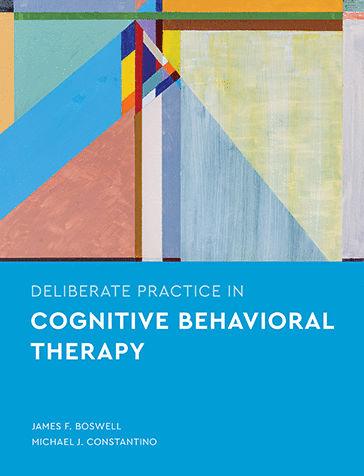
Deliberate Practice in Cognitive Behavioral Therapy
ISBN: 978-1-4338-3555-1Deliberate practice exercises help students and trainees rehearse fundamental cognitive-behavioral therapy (CBT) skills to develop basic competence and hone their own personal therapeutic style.
Each book in the Essentials of Deliberate Practice series contains customized exercises consisting of role-playing scenarios in which two trainees act as a client and a therapist, switching back and forth under the guidance of a supervisor. The trainee playing the therapist improvises appropriate and authentic responses to a series of client statements organized into three difficulty levels—beginner, intermediate, and advanced—that reflect common problems and concerns encountered by CBT practitioners.
The first 10 exercises each focus on a single skill, such as establishing goals for treatment; assigning and reviewing between-session exercises; working with various client cognitions, behaviors, and emotions; and addressing relationship ruptures and client resistance. These are followed by two comprehensive exercises—an annotated transcript and free-form mock therapy sessions—in which trainees integrate these essential skills into a single CBT session.
Step-by-step instructions guide participants through the exercises, identify criteria for mastering each skill, and explain how to monitor and adjust difficulty. Guidelines to help trainers and trainees get the most out of training are also provided.
To demonstrate how deliberate practiceopens in new window can be fully integrated into a professional curriculum, this series features exercises developed and refined within the clinical training curriculum at the Sentio online marriage and family therapy (MFT) therapist training programopens in new window in California, which is where we started developing this series. These exercises, which have been tested at clinical training sites around the world, are used to enhance clinical outcomes within the first hybrid MFT program approved by the California Board of Behavioral Sciencesopens in new window (BBS) to fully integrate deliberate practice into its entire curriculum. By integrating these models into its hybrid MFT program in California, Sentio University demonstrates that therapist training graduate programs can use deliberate practice to bridge the gap between theory and clinical mastery through repetitive, feedback-informed practice to support the development of modern, outcome-focused clinicians.
Series Preface
Tony Rousmaniere and Alexandre Vaz
Acknowledgments
Part I: Overview and Instructions
- Chapter 1: Introduction and Overview of Deliberate Practice and Cognitive-Behavioral Therapy
- Chapter 2: Instructions for the CBT Deliberate Practice Exercises
Part II: Deliberate Practice Exercises for Cognitive-Behavioral Therapy Skills
Exercises for Beginner CBT Skills
- Exercise 1: Explaining the Treatment Rationale for CBT
- Exercise 2: Establishing Goals
- Exercise 3: Negotiating a Session Agenda
- Exercise 4: Assigning and Reviewing Between Session Activities
Exercises for Intermediate CBT Skills
- Exercise 5: Working With Cognitions
- Exercise 6: Working With Behaviors
- Exercise 7: Working With Emotions
Exercises for Advanced CBT Skills
- Exercise 8: Adherence Flexibility
- Exercise 9: Responding to Therapeutic Alliance Ruptures
- Exercise 10: Responding to Client Resistance
Comprehensive Exercises
- Exercise 11: Annotated CBT Practice Session Transcript
- Exercise 12: Mock CBT Sessions
Part III: Strategies for Enhancing the Deliberate Practice Exercises
- Chapter 3: Additional Guidance for Trainers and Trainees: How to Get the Most Out of Deliberate Practice
- Appendix A: Difficulty Assessments and Adjustments
- Appendix B: Sample CBT Syllabus With Embedded Deliberate Practice Exercises
References
About the Authors
Index
James F. Boswell, PhD, is an associate professor of clinical psychology at the University at Albany, State University of New York. He is also an associate of the Center for the Elimination of Minority Health Disparities. He received his PhD in clinical psychology from The Pennsylvania State University.
Dr. Boswell has received the Early Career Award from the American Psychological Foundation/APA Division 29, the Outstanding Early Career Achievement Award from the Society for Psychotherapy Research, the David Shakow Early Career Award for Distinguished Scientific Contributions to Clinical Psychology, the Dissertation and Marvin R. Goldfried New Researcher Awards from the Society for the Exploration of Psychotherapy Integration, and a Rising Star designation from the Association for Psychological Science. He is also a Fellow of APA and serves as president of the North American Society for Psychotherapy Research.
Dr. Boswell has published extensively in the areas of psychotherapy process and outcome, measurement-based care, and practice-oriented research. His work has been funded by the Patient-Centered Outcomes Research Institute, National Institute of Mental Health, Robert Wood Johnson Foundation, and APA. He is also a member of the Advisory Committee to the APA Mental and Behavioral Health Data Registry.
In addition, he served as a technical expert panelist on the government-sponsored white paper prepared for the U.S. Department of Health and Human Service and the Office of the Assistant Secretary for Planning and Evaluation on Strategies for Measuring the Quality of Psychotherapy.
Dr. Boswell is on the editorial board of the Journal of Consulting and Clinical Psychology, Behaviour Research and Therapy, Behavior Therapy, Psychotherapy Research, Psychotherapy, and the Journal of Clinical Psychology.
Michael J. Constantino, PhD, received his BA in psychology from SUNY Buffalo, and his MS and PhD from The Pennsylvania State University. He completed a predoctoral clinical internship at SUNY Upstate Medical University and a postdoctoral fellowship at the Stanford University Medical Center.
Dr. Constantino is now professor of psychological and brain sciences at the University of Massachusetts Amherst, where he directs the Psychotherapy Research Lab and serves as graduate program director. His professional and research interests center on patient, therapist, and dyadic factors in psychosocial treatments; pantheoretical principles of clinical change; and measurement-based care.
He has published more than 150 articles and chapters in leading journals and books in the field, and he has received extramural grant and contract support for his research, including from the Patient-Centered Outcomes Research Institute, National Institute of Mental Health, Robert Wood Johnson Foundation, and APA. He is also coeditor of the book Principles of Change: How Psychotherapists Implement Research Findings in Practice (Oxford University Press) and the in-preparation Handbook of Psychotherapy, to be published by APA.
Dr. Constantino has received several early- and mid-career research awards, including from the International Society for Psychotherapy Research, the Society for the Advancement of Psychotherapy (APA Division 29), and the Society for the Exploration of Psychotherapy Integration. Dr. Constantino is also an APA Fellow.
Among other professional positions, he is associate editor for Psychotherapy and past-president of both APA Division 29 and the North American Society for Psychotherapy Research.
Deliberate practice, as presented by Boswell and Constantino, takes training to a new level by providing an actual tool for developing the various components of competent CBT. This accessible book should be considered a basic resource for training clinics, supervisors, and instructors. Seasoned therapists will also find this book useful in refining skills or recalibrating to avoid “therapist drift.” This is a most welcomed advancement.
—Christopher R. Martell, PhD, ABPP, Clinic Director and Lecturer, Psychological Services Center, Department of Psychological and Brain Sciences, University of Massachusetts Amherst, Amherst, MA, United States
Practice makes perfect! Clinical training typically lacks opportunities for students to rehearse specific skills repeatedly until they become second nature. Deliberate Practice in Cognitive Behavioral Therapy aims to fill this gap so that trainees can put into action what they learn in their classes, workshops, readings, and clinical placements. This book is filled with practical exercises to develop skills across 10 core components of CBT. It will absolutely change the way I train my own students.
—Martin M. Antony, PhD, Professor of Psychology, Department of Psychology, Ryerson University, Toronto, ON, Canada, and coauthor of the Shyness and Social Anxiety Workbook and The Anti-Anxiety Program
This volume is sure to become a staple on every clinician’s bookshelf. The authors integrate cutting edge science on expertise with specific and engaging exercises focused on key clinical skills. This book represents a major advance in clinical training by providing tools to empower clinicians and supervisors to “up their game” and improve client outcomes.
—Henny Westra, PhD, Department of Psychology, York University, Toronto, ON, Canada
This important clinical book makes a valuable contribution to the CBT practice literature; it skillfully conveys how treatment processes are nested within an in-session relational process.
—Nikolaos Kazantzis, PhD, Founder and Director of the Cognitive Behavior Therapy Research Unit, Melbourne, Australia, and faculty member of the Beck Institute for Cognitive Behavior Therapy and Research
This book is part of the Essentials of Deliberate Practice series by Tony Rousmaniere and Alexandre Vaz. The materials on this page include a Deliberate Practice Reaction Form and a Deliberate Practice Diary Form that can be used with every book in this series, as well as volume-specific content.
These documents are offered for your personal use in clinical training or teaching courses. If you reprint or adapt them for publication, permission is required from the publisher.
Deliberate Practice Reaction Form
The Deliberate Practice Reaction Form can be used with any of the deliberate practice exercises throughout the series to measure how challenging it was for the trainees and to adjust the difficulty as needed. Appendix A includes a black-and-white version of the form with instructions for assessing and modifying an exercise’s difficulty. A color version of the Deliberate Practice Reaction Form is also available for individual download.
- Appendix A: Difficulty Assessments and Adjustmentsopens in new window (PDF)
- Deliberate Practice Reaction Formopens in new window (PDF)
Deliberate Practice Diary Form
The Deliberate Practice Diary Form is an optional form that trainees can complete during a training session’s final evaluation or between sessions to process their experiences with the activity, including what was and was not helpful and what they learned. Appendix B, which is the same across all books in the series, presents this form.
Volume-specific materials
The following content is unique to Deliberate Practice in Cognitive Behavioral Therapy and includes a sample syllabus that integrates the deliberate practice exercises into a standard clinical course.
- Appendix C: Sample Cognitive Behavioral Therapy Syllabus With Embedded Deliberate Practice Exercises (PDFopens in new window | Wordopens in new window)
Video demonstration
A YouTube series (Practice Time! with Amy DeSmidt and Jamie Manseropens in new window) highlights authentic deliberate practice sessions featuring exercises from this book and other releases in the Essentials of Deliberate Practice series.
Additional resources
Video resources are available to accompany this book.opens in new window
Supplemental resources for therapist training
Designed for faculty at graduate institutions, these supplemental resources provide a framework and clear examples for implementing deliberate practice within existing therapist training curricula. Sentio University is where we started to develop what would become the APA Essentials of Deliberate Practice series. We provide a comprehensive suite of free psychotherapy training resources based on the deliberate practice methodologyopens in new window. These materials are designed to supplement modern hybrid and online therapist training curricula and are used extensively within our own clinical programs.
- California MFT program integration: These materials are a core component of the Sentio hybrid MFT program in Californiaopens in new window, the first in the state to fully integrate DP into its entire curriculum and receive California Board of Behavioral Sciences approval for licensure.
- Free deliberate practice exercises: Access our library of therapist skill-building worksheetsopens in new window used to enhance the online California MFT degree through repetitive, feedback-informed practice.
- Deliberate practice video demonstrations: Visit our YouTube channel for free therapist training videosopens in new window to view clinical demonstrations from the APA Essentials of Deliberate Practice book series. These videos illustrate key skills used to enhance the online California MFT degree through repetitive, feedback-informed practice.
- AI and emerging therapy resources: Learn how deliberate practice can be used to safely and ethically integrate AI for therapist trainingopens in new window. Review our AI research programopens in new window and our clinical guidelines on using AIopens in new window to prepare for the modern landscape of digital mental health.