Clinical Depression
Available formats
Also available from
- PROSE Award Finalist -Biological and Life Sciences: Clinical Psychology and Psychiatry
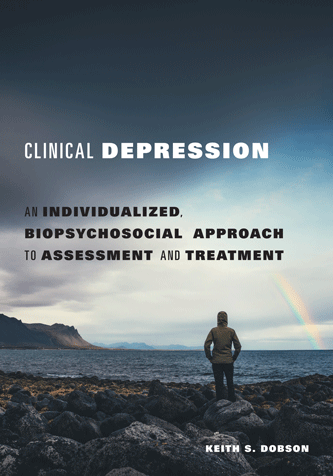
This book offers integrative treatments for clinical depression based on the biopsychosocial model.
Keith Dobson synthesizes decades of research and professional experience in this comprehensive guide that follows the therapy process from beginning to end. He starts with a theoretical overview of depression, including its associated features, risk and resiliency factors, and offers a comparative evaluation of various models of depression.
Clinical chapters review the intake process, from the initial interview, to formulating an early case conceptualization and ensuring the client’s involvement. Dobson then presents an organizational model to determine which issues to focus on in therapy, and the optimal interventions to address them. He also describes common strategies to target problematic behaviors and cognitions, develop problem-solving skills, and modify maladaptive thoughts and schemas. Guidelines for ending therapy and preventing relapse are also provided, as are considerations related to comorbid disorders, clients’ relationships with significant others, and in-person vs. distance treatment.
Recurring case examples with two hypothetical clients help to demonstrate the entire process for assessing, conceptualizing, and treating clinical depression.
Acknowledgments
Introduction: Developing Multifaceted Models and Interventions for Depression
Part I. Understanding Depression and Its Treatment
- Chapter 1. The Nature of Depression
- Chapter 2. Risk and Resiliency for Depression
- Chapter 3. Evolving Models of Clinical Depression
Part II. Beginning Therapy and Treatment Planning
- Chapter 4. The Intake Assessment: Developing a Case-Specific Treatment Model
- Chapter 5. Optimizing Client Engagement in Treatment
- Chapter 6. An Organizational Model for the Treatment of Depression
Part III. Common Strategies for Treating Depression
- Chapter 7. Behavioral Activation: Addressing Risk Factors for Depression
- Chapter 8. Cognitive Restructuring in the Treatment of Depression
- Chapter 9. Problem-Solving Therapy Applied to Depression
- Chapter 10. Modifying Core Beliefs and Schemas Associated With Depression
Part IV. Ending Treatment and Other Considerations
- Chapter 11. Ending Therapy and Relapse Prevention
- Chapter 12. Other Considerations in the Treatment of Depression
Part V. Future Directions in Understanding and Treating Depression
- Chapter 13. The Next Steps in Evidence-Based Psychotherapy for Depression
References
Index
About the Author
Keith S. Dobson, PhD, is professor emeritus of clinical psychology at the University of Calgary where he served as director of the clinical psychology program and head of the Department of Psychology. His research focuses on depression models and treatments, particularly cognitive behavioral therapies. His books include the Handbook of Cognitive-Behavioral Therapies, Fourth Edition; Law, Standards and Ethics in the Practice of Psychology, Fourth Edition; The Stigma of Mental Illness; and Treatment of Psychosocial Risk Factors in Depression. He has received numerous awards, including the Canadian Psychological Association Gold Medal for Lifetime Contributions to Psychology and the Order of Canada.
Professor Keith Dobson’s Clinical Depression: An Individualized, Biopsychosocial Approach to Assessment and Treatment is an excellent resource for clinicians at all levels of experience and training. Dobson, who has been at the forefront of research on depression for several decades and is a world leader in the field, has provided the reader with a balance of scholarly research and practical clinical guidance. This superb book will help the reader understand the complex nature of depression, the antecedence and vulnerabilities, the underlying risk for depression, and the debilitating consequences of depression. Rather than focus on one approach, Dobson reviews and gives examples of the major models of intervention that have empirical validation. Throughout the book, there are clear clinical examples of application, so the reader will come away with an expanded knowledge of the latest work in the field and a sophisticated practical resource for conducting therapy. Written in an accessible and humane voice, this is a book that I will recommend and I will personally refer to in my own work. Bravo!
—Robert L. Leahy, PhD, Director, American Institute for Cognitive Therapy, New York, NY, United States
This book brings a biopsychosocial model of depression to life in a way that is comprehensive and yet clinically accessible. From cognition to exercise, if substantial data exists in support of a method for addressing depression, it finds its place in this volume as part of a coherent, step-by-step, personalized approach that will be appealing to students and practitioners from a variety of evidence-based orientations. A clear step forward for the field from one of the masters.
—Steven C. Hayes, PhD, Foundation Professor of Psychology Emeritus, University of Nevada, Reno, Reno, NV, United States
Written by one of the foremost experts on depression, Dr. Keith Dobson surveys the contemporary literature on the nature and treatment of depression with a particular focus on cognitive behavioral therapy. This is an excellent and well-written book that should be part of every clinician’s library. Individuals suffering from this debilitating and common condition will equally benefit. I highly recommend it.
—Stefan G. Hofmann, PhD, Alexander von Humboldt Professor, Philipps University of Marburg, Marburg, Germany
Dobson’s long and broad immersion in research on depression and its treatment has resulted in an engaging guide for trainees and experienced clinicians alike. His accessible and personal writing style comprehensively describes the many presentations of clinically significant depression, multifaceted risk factors and models, and diverse psychotherapy treatments. He makes the case that today’s therapists need to understand how each client’s depression is different and illustrates how diverse empirically supported treatment models and interventions may contribute useful components.
—Constance Hammen, PhD, Distinguished Research Professor Emeritus, Department of Psychology, University of California, Los Angeles, Los Angeles, CA, United States
This is without question one of the best clinician handbooks ever written on depression and its treatment. If there was only one professional book my graduate student trainees could read on depression, this is the book I would highly recommend. My unbridled enthusiasm for this book is based on its many strengths.
—David A. Clark, PhD, Professor Emeritus, Clinical Psychology, University of New Brunswick, Fredericton, NB, Canada