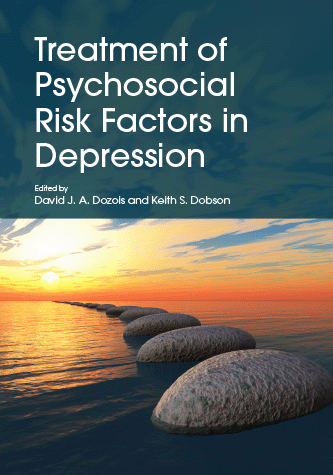
Treatment of Psychosocial Risk Factors in Depression
ISBN: 978-1-4338-3406-6Available formats
Also available from
This innovative book explores a range of well-established risk factors for clinical depression and links them to targeted, evidence-based treatments.
Clinical depression is the single leading cause of mental health disease in the world, and the need for effective treatments has never been greater. In recent years, the volume of theory and research on a range of psychosocial risk factors for depression has grown dramatically. Fortunately, many of these risk factors are modifiable, making them ideal targets for treatment. Unlike other books that focus on intervention from a specific conceptual vantage point, such as cognitive-behavioral or acceptance and commitment therapy, this book’s innovative approach targets the client’s underlying vulnerability or risk factor and links it to specific, evidence-based treatment.
In each chapter, leading authorities on a particular risk factor evaluate the literature, discuss implications for treatment, and present a case example to demonstrate how therapists can use the techniques with clients.
Contributors
Acknowledgments
- Introduction: Treatment of Psychosocial Risk Factors in Depression
David J.A. Dozois & Keith S. Dobson - Chapter 1: Models of Psychosocial Risk in Depression
Keith S. Dobson & David J. A. Dozois - Chapter 2: Parental Psychopathology and Parenting
Abigail E. Pine & Judy Garber - Chapter 3: Low Social Support and Relational Regulation
Brian Lakey - Chapter 4: Interpersonal Risk Factors
Jami F. Young, Molly Davis & Laura Mufson - Chapter 5: Childhood Adversity, Stressful Life Events, and Trauma
Kate L. Harkness - Chapter 6: Dependency and Excessive Reassurance Seeking
Lisa R. Starr, Angela C. Santee & Meghan Huang - Chapter 7: Marriage and Relationship Issues
Mark A. Whisman & Anna L. Gilmour - Chapter 8: Emotion Dysregulation
Natasha H. Bailen & Renee J. Thompson - Chapter 9: Negative Thinking: Cognitive Products and Schema Structures
David J. A. Dozois & Aaron T. Beck - Chapter 10: Negative Information Processing
Wisteria Deng & Jutta Joormann - Chapter 11: Optimism and Pessimism
Max Genecov & Martin E. P. Seligman - Chapter 12: Perfectionism
Paul L. Hewitt, Martin M. Smith, Sabrina Ge, Marcia Mössler, Gordon L. Flett & Samuel F. Mikail - Chapter 13: Rumination
Ed Watkins - Chapter 14: Ineffective Social Problem Solving
Arthur M. Nezu, Christine Maguth Nezu, Jenna L. Damico & Holly R. Gerber - Chapter 15: Cognitive and Behavioral Avoidance
Christopher R. Martell & Ajeng J. Puspitasari - Chapter 16: Metacognition and Mental Regulation
Adrian Wells & Henrik Nordahl - Chapter 17: Investigating and Treating Psychosocial Risk Factors in Depression: An Integrative Summary
David J. A. Dozois & Keith S. Dobson Index
About the Editors
David J. A. Dozois, PhD, is a professor of psychology and psychiatry, and director of the clinical psychology graduate program at the University of Western Ontario. Dr. Dozois is a fellow of the Association for Behavioral and Cognitive Therapies, the Canadian Association of Cognitive and Behavioural Therapies, the Academy of Cognitive Therapy, and the Canadian Psychological Association.
Dr. Dozois’ research focuses on cognitive vulnerability to depression and cognitive-behavioral theory/therapy. He has published 196 scientific articles, book chapters and books, and 89 non-peer reviewed papers, and has presented over 360 research presentations at national and international conferences.
Find him on Twitteropens in new window or learn more from his websiteopens in new window.
Keith S. Dobson, PhD, is a professor of clinical psychology at the University of Calgary, where has served in roles such as the director of the clinical psychology program, and head of the department of psychology.
His research has focused on both models and the treatment of depression, particularly using cognitive-behavioral therapies. Further, he has written about developments in professional psychology and ethics, and has been actively involved in organized psychology in Canada, including a term as president of the Canadian Psychological Association.
Dr. Dobson’s research has resulted in over 320 published articles and 80 chapters, 17 books, and conference and workshop presentations in many countries.
Spanning their career-length engagement with both basic and clinical studies of depression, Dozois and Dobson deliver on the promise of risk research—effective interventions for people both in and out of episode. Their blueprint for designing treatments that engage and modulate risk factors will guide the field for years to come.
—Zindel V. Segal, PhD, CPsych, Distinguished Professor of Psychology in Mood Disorders, University of Toronto Scarborough, Toronto, ON, Canada
Depression is the most prevalent of the psychological disorders, and many children enter adolescence at elevated risk. To reduce the likelihood of onset or recurrence, this treatise takes the novel approach of addressing those processes that contribute to risk. It should make a major contribution to the field.
—Steven D. Hollon, PhD, Gertrude Conaway Vanderbilt Professor of Psychology, Vanderbilt University, Nashville, TN, United States