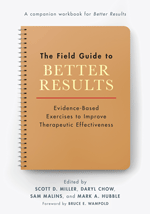
Better Results
Available formats
Also available from
Deliberate practice is a systematic approach for improving psychotherapy outcomes one clinician at a time. This step-by-step guide to deliberate practice demonstrates how to collect and use client outcome data to create an individualized professional development plan to improve the quality of your service.
Your goal is to help more of your psychotherapy clients get better. For those who do realize gains, your goal is to help them experience a greater degree of improvement as a result of working with you.
In this book you will learn how to conduct routine outcome measurements to gather data from your own practice. Detailed instructions and examples walk you through the process of determining your baseline performance, identifying and addressing your strengths and deficits as a practitioner, and assessing your progress.
Richly-drawn case studies and stories from the business world and popular culture illustrate how research from the field of expert performance offers a different paradigm for professional development that departs from the field’s traditional emphasis on learning therapy models and techniques.
Dedication
Foreword
Acknowledgments
Introduction
I. The State of Our Art
- What Therapists Will Say, Can’t Say, and Won’t Say
- What Do We Really Know About Psychotherapy, After All?
II. Expertise and Expert Performance: The Evidence Base
- Learning from the Experts on Expertise
- What is (and is not) Deliberate Practice?
III. Getting Started: What To Do First to Achieve Better Results
- Your Baseline Matters
- How to Find Your Baseline
- Making Sense of Your Baseline
IV. Moving Forward: Identifying What to Deliberately Practice
- Mining Your Data for Better Results
- Why Average Isn’t All That Bad
- How Being Bad Can Make You Better
- What Matters Most for Better Results
- A Study in Deliberate Practice
V. How to Deliberately Practice
- The Process of Deliberate Practice
- Designing a System of Deliberate Practice
- Still Feel Self-Doubt? You’re Probably on the Right Track
Appendix A. Reliable and Clinically Significant Change Chart
Appendix B. Calculating a Standard Deviation
Appendix C. Taxonomy of Deliberate Practice (TDPA)
Appendix D. Troubleshooting Tips
References
Index
About the Authors
Scott D. Miller, PhD, is the founder of the International Center for Clinical Excellence — a consortium of clinicians, researchers, and educators dedicated to promoting excellence in behavioral health services.
He conducts workshops and training, helping hundreds of organizations worldwide to achieve superior results. He writes and edits books and professional articles on the curative factors of psychotherapy and the development of expert performance.
Scott’s work on routine outcome management led to the development of Feedback Informed Treatment, now listed on SAMHSA’s National Registry of Evidence-based Programs and Practice.
He lives in Chicago, Illinois.
Visit his websiteopens in new window and follow @TheICCE.
Mark A. Hubble, PhD, is a founding member and senior advisor at the International Center for Clinical Excellence.
He is the co-author and co-editor of many professional papers and several books — including the award winning first edition of The Heart and Soul of Change: What Works in Therapy. He also served on the editorial review board for the Journal of Systemic Therapies.
His most recent work has focused on expert performance, deliberate practice, and the history and role of “magick” in psychotherapy.
Mark is also a professional bass player. He lives in Danbury, Connecticut.
Daryl Chow, PhD, is a senior associate of the International Center for Clinical Excellence.
He conducts research and workshops on the development of expertise and highly effective psychotherapists, and ways practitioners can accelerate learning.
He is the co-author of many articles and co-editor and contributing author of The Write to Recovery: Personal Stories and Lessons About Recovery From Mental Health Concern.
Currently, Daryl maintains a private practice and continues to serve as a senior psychologist at the Institute of Mental Health, Singapore.
He lives in Perth, Western Australia.
Better Results clearly shows that a given clinician’s performance is not the result of some inherent, immutable limit on their ability to succeed but is a function of the methods they use to train and develop. Most important of all, it provides therapists with the means for delivering more effective care.
—From the Foreword; K. Anders Ericsson, PhD
Conradi Eminent Scholar and Professor of Psychology, Florida State University, Tallahassee
Improving treatment effectiveness: That’s the goal to which all clinicians aspire and to which Miller, Hubble, and Chow devote this extraordinarily stimulating and eminently practical book. Learn how to leverage deliberate practice, in small actionable steps, to obtain better and better results. A transformative read!
—John C. Norcross, PhD, ABPP
Distinguished Professor of Psychology, University of Scranton, Scranton, PA, and coeditor of the five-volume APA Handbook of Clinical Psychology
Many therapists are unsure about the effectiveness of their work. In this fascinating and insightful book, Miller, Hubble, and Chow propose an empirically based program for how therapists can improve. It is blunt and hard-hitting, but it may help therapists achieve what they really hoped for when they entered the profession.
—Amy Chua
Professor, Yale Law School, New Haven, CT, and author of Battle Hymn of the Tiger Mother and Political Tribes: Group Instinct and the Fate of Nations
This book has the potential to change the field of psychotherapy in remarkable ways. The authors give us the tools needed to take the guesswork out of the complexity of mind care by providing a path to professional excellence that is both orderly and governed by a clear set of principles.
—Dan Short, PhD
Lead author of Hope and Resiliency
In this empirically sound and remarkably engaging work, Miller, Hubble, and Chow remind us that psychotherapy is a cocreative process that is more effective when corrective feedback, individualized treatment strategies, and continuous refinement are applied. This work gives hope to those who have felt confined and limited by rigid adherence to theories and techniques and seek to move beyond outdated clinical orthodoxies. I highly recommend this book to all who practice the art and science of psychotherapy.
—Paul J. Leslie, EdD
Author of The Art of Creating a Magical Session: Key Elements for Transformative Psychotherapy
Better Results provides clinicians practice-based guidance to help clients achieve the results they are hoping for in counseling and therapy. It also provides tangible strategies for improving one’s own practice.
—Robbie Babins-Wagner, PhD, RCSW
Chief Executive Officer, Calgary Counselling Centre, and Adjunct Professor & Sessional Instructor, Faculty of Social Work, University of Calgary, Calgary, Alberta, Canada
- The Field Guide to Better Results
This book offers guidance from leading experts in designing deliberate practice activities specific to the individual practitioner.