Deliberate Practice in Psychodynamic Psychotherapy
ISBN: 978-1-4338-3673-2Deliberate practice exercises help trainees achieve competence in essential psychodynamic therapy skills and apply them in a range of clinical situations while honing their own personal style and language.
These exercises present role-playing scenarios in which two trainees act as a patient and a therapist, switching back and forth under the guidance of a supervisor. The therapist improvises appropriate and authentic responses to patient statements organized into two difficulty levels—intermediate and advanced—that reflect common patient questions and concerns.
Each of the first 12 exercises focuses on a single skill, such as engaging in a therapeutic inquiry, deepening emotional experience, pointing out defenses, making transference interpretations, and providing corrective emotional experiences. Two comprehensive exercises follow in which trainees integrate these essential skills into a single psychodynamic therapy session.
Step-by-step instructions guide participants through the exercises, identify criteria for mastering each skill, and explain how to monitor and adjust difficulty. Guidelines to help trainers and trainees get the most out of training are also provided.
To demonstrate how deliberate practiceopens in new window can be fully integrated into a professional curriculum, this series features exercises developed and refined within the clinical training curriculum at the Sentio online marriage and family therapy (MFT) therapist training programopens in new window in California, which is where we started developing this series. These exercises, which have been tested at clinical training sites around the world, are used to enhance clinical outcomes within the first hybrid MFT program approved by the California Board of Behavioral Sciencesopens in new window (BBS) to fully integrate deliberate practice into its entire curriculum. By integrating these models into its hybrid MFT program in California, Sentio University demonstrates that therapist training graduate programs can use deliberate practice to bridge the gap between theory and clinical mastery through repetitive, feedback-informed practice to support the development of modern, outcome-focused clinicians.
Series Preface
Tony Rousmaniere and Alexandre Vaz
Acknowledgments
Part I: Overview and Instructions
- Chapter 1: Introduction and Overview of Deliberate Practice and Psychodynamic Therapy
- Chapter 2: Instructions for the Psychodynamic Therapy Deliberate Practice Exercises
Part II: Deliberate Practice Exercises for Psychodynamic Therapy Skills
Exercises for Intermediate Psychodynamic Therapy Skills
- Exercise 1: Engaging in a Therapeutic Inquiry
- Exercise 2: Therapist Awareness (Interactive Countertransference)
- Exercise 3: Deepening Emotional Experience
- Exercise 4: Making Process Comments
- Exercise 5: Pointing Out Defenses
- Exercise 6: Introducing the Treatment Rationale
Exercises for Advanced Psychodynamic Therapy Skills
- Exercise 7: Making Transference Interpretations
- Exercise 8: Using Metaphors
- Exercise 9: Exploring Fantasy
- Exercise 10: Gathering Data for the Cyclical Maladaptive Pattern
- Exercise 11: Using Supervision to Recognize Reenactments
- Exercise 12: Providing a Corrective Emotional Experience
Comprehensive Exercises
- Exercise 13: Annotated Interpersonal-Psychodynamic Practice Session Transcript
- Exercise 14: Mock Psychodynamic Sessions
Part III: Strategies for Enhancing the Deliberate Practice Exercises
- Chapter 3: Additional Guidance for Trainers and Trainees: How to Get the Most Out of Deliberate Practice
Appendix A: Difficulty Assessments and Adjustments
Appendix B: Deliberate Practice Diary Form
Appendix C: Sample Psychodynamic Therapy Syllabus With Embedded Deliberate Practice Exercises
References
Index
About the Authors
Hanna Levenson, PhD, is professor at the Wright Institute in Berkeley, California. She also maintains a private practice in Oakland where she sees individuals and couples for therapy and professionals for consultation/supervision. Dr. Levenson has specialized in brief dynamic therapy and supervision for 40 years.
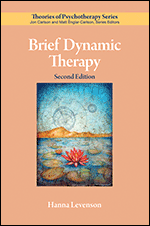
She has authored over 85 professional papers and three books (Time Limited Dynamic Psychotherapy, Brief Dynamic and Interpersonal Therapy, and Brief Dynamic Therapy, Second Edition) and has released five professional videos with APA illustrating her approach.
Dr. Levenson received the Distinguished Contribution to Psychology as a Profession Award given by the California Psychological Association.
Volney Gay, PhD, is professor emeritus at Vanderbilt University and a training and supervising analyst at the St. Louis Psychoanalytic Institute.
He has published nine books on religion, psychiatry, and anthropology. Dr. Volney has won teaching awards from McMaster University and Vanderbilt University School of Medicine; the Heinz Hartmann Award from the New York Psychoanalytic Institute; the Outstanding Service Award from the American Psychoanalytic Association; and was named Distinguished Psychoanalytic Educator, International Forum for Psychoanalytic Education.
His most recent book is American Slavery: Privileges and Pleasures (2021).
Jeffrey L. Binder, PhD, ABPP, is clinical professor of psychiatry and behavioral science at Vanderbilt University. He maintains a private practice of psychotherapy and clinical supervision.
Dr. Binder has authored or coauthored over 45 articles and book chapters on psychotherapy practice, research, and supervision, as well as three books on a form of time-limited therapy developed with Hans Strupp: Psychotherapy in a New Key: A Guide to Time-Limited Dynamic Psychotherapy, Key Competencies in Brief Dynamic Psychotherapy: Clinical Practice Beyond the Manual, and Core Competencies in Brief Dynamic Psychotherapy.
Dr. Binder is a Fellow of APA.
This book fills an essential need, one that has gone unaddressed for too long. The authors provide deceptively simple yet sophisticated exercises tailor-made for mastering skills that help beginning psychodynamic psychotherapists to settle into themselves and deepen their work with clients. These exercises elegantly complement the more usual—and indispensable—educational experiences of acquiring theoretical knowledge and participating in meaningful supervisory and personal therapy relationships, contributing to the development of creative, reflective, and skillful practitioners.
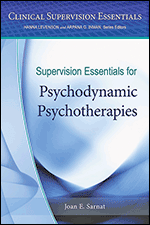
—Joan E. Sarnat, PhD, ABPP, Faculty and Supervising Analyst, Psychoanalytic Institute of Northern California, San Francisco, CA, United States, and author of "Supervision Essentials for Psychodynamic Psychotherapies"
Deliberate Practice in Psychodynamic Psychotherapy is a gift of clarity and focus to developing therapists. Too often, relational treatment approaches have been vague in helping trainees conceptualize and intervene within the therapeutic relationship. Many supervisees describe themselves as “imposters”—painfully unsure of what to say or do to help. This foundational text empowers therapists by providing experiential, multistep practices for each key concept. Kudos to the authors for bringing these comprehensive training practices to our field.
—Edward Teyber, PhD, Professor Emeritus, Psychology, California State University, San Bernardino, San Bernardino, CA, United States
This is a rare gem of a book that distills the essence of psychodynamic therapy from an art form to a science that can be deliberately taught with focused, practical guidance and exercises that are graded for the beginner, intermediate, and advanced clinician. It will make supervisors better able to teach specific skills and help trainees find their own voice and become more effective therapists. Invaluable!
—Mantosh Dewan, MD, President and SUNY Distinguished Service Professor of Psychiatry, Upstate Medical University, Syracuse, NY, United States
This work represents the leading edge of innovation in the training and practice of psychotherapy. The authors effectively combine the scientific principles of deliberate practice to build expertise with focused clinical exercises designed to develop specific therapy skill sets. The integration between evidence-based learning strategies and clinical practice makes this a seminal work in the field of psychotherapy training and supervision.
—Mark Hilsenroth, PhD, Adelphi University, Derner School of Psychology, Garden City, NY, United States
Psychodynamic psychotherapy teaching is typically conceptual or observational and is in competition with more skill-oriented modalities. The authors have identified some of the essential elements of psychodynamic psychotherapy and brilliantly created extremely effective exercises that enable trainees or experienced therapists to develop or hone specific relevant skills. These include traditional techniques that focus on process, defenses, and interpretation, as well as more affectively focused skills, such as deepening affect, use of metaphor, and the creation of corrective emotional experiences that facilitate achievement of effective outcomes in a time-sensitive and focused manner.
—Richard D. Lane, MD, PhD, Professor of Psychiatry, Psychology and Neuroscience, The University of Arizona, Tucson, AZ, United States
This book provides psychotherapy clinicians, supervisors, and trainers with a unique, practice-based guide for the development of therapeutic expertise in brief psychodynamic psychotherapy. In particular, the identification and thoughtful delineation of 12 core skills that underlay psychodynamic therapy approaches, along with the provision of tailored experiential exercises that enhance skill development, will make a singular contribution to psychotherapy training and the practice literature.
—Lynne Angus, PhD, CPsych, Professor Emerita, Senior Scholar, York University, Toronto, ON, Canada
This book is part of the Essentials of Deliberate Practice series by Tony Rousmaniere and Alexandre Vaz. The clinician and practitioner resources on this page include a Deliberate Practice Reaction Form and a Deliberate Practice Diary Form that can be used with every book in this series, as well as volume-specific content.
These documents are offered for your personal use in clinical training or teaching courses. If you reprint or adapt them for publication, permission is required from the publisher.
Deliberate Practice Reaction Form
The Deliberate Practice Reaction Form can be used with any of the deliberate practice exercises throughout the series to measure how challenging it was for the trainees and to adjust the difficulty as needed. Appendix A includes a black-and-white version of the form with instructions for assessing and modifying an exercise’s difficulty. A color version of the Deliberate Practice Reaction Form is also available for individual download.
- Appendix A: Difficulty Assessments and Adjustmentsopens in new window (PDF)
- Deliberate Practice Reaction Formopens in new window (PDF)
Deliberate Practice Diary Form
The Deliberate Practice Diary Form is an optional form that trainees can complete during a training session’s final evaluation or between sessions to process their experiences with the activity, including what was and was not helpful and what they learned. Appendix B, which is the same across all books in the series, presents this form.
Volume-specific materials
The following content is unique to Deliberate Practice in Psychodynamic Psychotherapy and includes a sample syllabus that integrates the deliberate practice exercises into a standard clinical course.
- Appendix C: Sample Psychodynamic Therapy Syllabus With Embedded Deliberate Practice Exercises (PDFopens in new window | Wordopens in new window)
Video demonstration
A YouTube series (Practice Time! with Amy DeSmidt and Jamie Manseropens in new window) highlights authentic deliberate practice sessions featuring exercises from this book and other volumes in the Essentials of Deliberate Practice series.
Supplemental resources for therapist training
Designed for faculty at graduate institutions, these supplemental resources provide a framework and clear examples for implementing deliberate practice within existing therapist training curricula. Sentio University is where we started to develop what would become the APA Essentials of Deliberate Practice series. We provide a comprehensive suite of free psychotherapy training resources based on the deliberate practice methodologyopens in new window. These materials are designed to supplement modern hybrid and online therapist training curricula and are used extensively within our own clinical programs.
- California MFT program integration: These materials are a core component of the Sentio hybrid MFT program in Californiaopens in new window, the first in the state to fully integrate DP into its entire curriculum and receive California Board of Behavioral Sciences approval for licensure.
- Free deliberate practice exercises: Access our library of therapist skill-building worksheetsopens in new window used to enhance the online California MFT degree through repetitive, feedback-informed practice.
- Deliberate practice video demonstrations: Visit our YouTube channel for free therapist training videosopens in new window to view clinical demonstrations from the APA Essentials of Deliberate Practice book series. These videos illustrate key skills used to enhance the online California MFT degree through repetitive, feedback-informed practice.
- AI and emerging therapy resources: Learn how deliberate practice can be used to safely and ethically integrate AI for therapist trainingopens in new window. Review our AI research programopens in new window and our clinical guidelines on using AIopens in new window to prepare for the modern landscape of digital mental health.