Becoming Better Psychotherapists
Available formats
Also available from
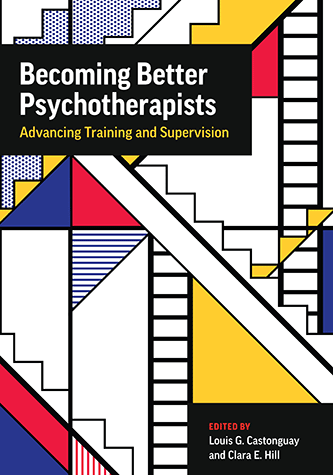
This book examines the training and supervision of psychotherapists, with a focus on psychotherapy efficacy and key issues facing psychotherapy training programs today.
While some therapists are more effective than others, good training and supervision can provide all clinicians with the skills and tools to become effective practitioners. Considerable research has shown the broad efficacy of psychotherapy, but there are still many clients who do not fully benefit from therapy, some who don't benefit at all, and even some who get worse as a consequence of therapy. The overall goal of training and supervision, and efforts to study these practices, should be to enhance the current degree of effectiveness that has been reached in psychotherapy.
This book offers innovative knowledge on how to better understand and improve training by relying on the reflections, research discoveries, and collaborative work of psychotherapy scholars who represent a diversity of theoretical orientations, methodological expertise, and levels of experience.
- Chapter 1. Introduction to Becoming Better Psychotherapists
Louis G. Castonguay and Clara E. Hill
- Chapter 2. What Competencies Should Therapists Acquire and How Should They Acquire Them?
Louis G. Castonguay, James F. Boswell, Franz Caspar, Myrna L. Friedlander, Beatriz Gómez, Adele M. Hayes, Martin grosse Holtforth, Stanley B. Messer, Michelle G. Newman, and Bernhard M. Strauss - Chapter 3. Psychotherapy Training and Supervision With Undergraduate and Graduate Students
Clara E. Hill and Sarah Knox - Chapter 4. Professional Training and Supervision After Graduation: Is it Worthwhile?
Katie Aafjes-van Doorn and Jacques P. Barber
Part II. Therapeutic Skills Training
- Chapter 5. Training on Context-Responsive Psychotherapy Integration: An Evidence-Informed Framework
Michael J. Constantino, Alice E. Coyne, James F. Boswell, Marvin R. Goldfried, and Louis G. Castonguay - Chapter 6. Alliance-Focused Training: Teaching Therapists to Navigate Alliance Ruptures
Catherine F. Eubanks, J. Christopher Muran, and Lisa Wallner Samstag - Chapter 7. Training Therapists to Manage Countertransference via Reflective Practice
Jeffrey A. Hayes, Claire C. Cartwright, and Fanghui Zhao - Chapter 8. Building a Theory of Therapist Responsiveness Training
Williams B. Stiles, Jordan Bate, and Timothy Anderson - Chapter 9. Deliberate Practice for Immediacy: Skill Use and Client Outcome
D. Martin Kivlighan III, and Dennis M. Kivlighan Jr.
Part III. Technology and Psychotherapy Training
- Chapter 10. Data-Informed Clinical Training and Practice
Wolfgang Lutz, Anne-Katharina Deisenhofer, Birgit Weinmann-Lutz, and Michael Barkham - Chapter 11. Technology and Psychotherapy Training
Matteo Bugatti, Zac E. Imel, and Jesse J. Owen
Part IV. Supervision and Consultation
- Chapter 12. Good Supervision, Better Therapy: Trainees' Accounts of How Supervisors Helped Them Manage Difficult Therapy Situations
Myrna L. Friedlander, Laurie Heatherington, Clara E. Hill, Sarah Knox, Catherine F. Eubanks, Lynne E. Angus, and Mengfei Xu - Chapter 13. Peer Consultation for Early Career Psychotherapists: A Preliminary Study
J. Ryan Kilcullen, Louis G. Castonguay, Dever M. Carney, Katherine A. Davis, Natalie R. Pottschmidt, Samuel J. Knapp, Corrie L. Jackson, Neil A. Hemmelstein, and Ann Marie Frakes - Chapter 14. Informal Supervision: A Significant and Overlooked Aspect of Therapists' Training
Barry A. Farber and Daisy Ort
Part V. Looking for the Best, Avoiding the Worst, and Exploring Lifelong Experiences in Training
- Chapter 15. Selecting Future Psychotherapists for Training: A Nationwide Study of Ideal Characteristics and Current Practices
Laurie Heatherington, Jacques P. Barber, J. Ryan Kilcullen, Louis G. Castonguay, Katherine A. Davis, Peter Barry, and Dennis M. Kivlighan Jr. - Chapter 16. Nil Nocere: How to Avoid Harm in Psychotherapy Training
Bernhard M. Strauss and Dominique Frenzl - Chapter 17. The Role of Faith and Doubt in the Development of Six Psychotherapy Scholars and Practitioners: Implications for Training and Supervision
Clara E. Hill, Sarah Knox, Heidi A. Zetzer, Barry A. Farber, Catherine F. Eubanks, and Timothy Anderson
Part VI. Conclusions
Chapter 18. Clinical, Research, and Policy Implications for Psychotherapy Training and Supervision in the 21stCentury
Clara E. Hill, Louis G. Castonguay, and the participants in the Penn State Conference
Louis Georges Castonguay, PhD, completed his doctorate in clinical psychology at Stony Brook University, a clinical internship at UC Berkeley, and a post-doctorate at Stanford University. He is currently liberal arts professor of psychology at The Pennsylvania State University.
His research focuses on factors related to the process, outcome, and training of psychotherapy. In recent years he has conducted practice-oriented research aimed at better understanding and improving psychotherapy as practice in natural settings.
He has more than 230 publications, including 12 coedited books. Among these books is the 7th edition of the Bergin and Garfield's Handbook of Psychotherapy and Behavior Change, which he coedited with Michael Barkham and Wolfgang Lutz.
Clara E. Hill, PhD, earned her doctorate at Southern Illinois University in 1974. She started her career in 1974 as an assistant professor in the Department of Psychology, University of Maryland, and is currently still there as a professor. She has been president of the Society for Psychotherapy Research, editor of the Journal of Counseling Psychology, co-editor of Psychotherapy Research, and is currently the president of the Society for the Advancement of Psychotherapy (APA Division 29).
Her major research interests are therapist skills, psychotherapy process and outcome, training and supervising therapists, dream work, meaning in life, and qualitative research. She has published 270+ journal articles, 75+ chapters in books, and 16 books (including Helping Skills, Dream Work in Therapy, Essentials of Consensual Qualitative Research, and Meaning in Life).
For decades, we have been bamboozled by research that indicates training, supervision, and practice do not discernibly impact psychotherapy outcome. This book dispels that myth, corrects the research record, highlights the value of clinical training and supervision, and offers innovative ways to enhance training and its scientific study. The best book on psychotherapy training and supervision you will read this year!
—John C. Norcross, PhD, ABPP, Distinguished Professor & Chair of Psychology, University of Scranton, Scranton, PA, and author of Supervision Essentials for Integrative Psychotherapy and Psychotherapy Relationships That Work
This book presents bold and innovative conceptual, clinical, and empirical ideas showing where we need to go. A must-read for anyone involved in helping clinicians become more effective practitioners.
—Hanna Levenson, PhD, Professor, Wright Institute, Berkeley, CA, and coeditor of the Clinical Supervision Essentials Series from APA Books and The Psychotherapy Supervision Video Series from APA Videos
Louis Castonguay and Clara Hill continue their long-standing collaboration in bringing the brightest minds together to advance the field of psychotherapy process and outcome. This time they focus their attention on the training and supervision that is essential for therapists to become the most effective professionals. Their book addresses the multifaceted components of training and supervision and sheds new light on how psychotherapists learn and thrive in their careers.
—Nick Ladany, PhD, President & Professor of Psychology, Oglethorpe University, Atlanta, GA
This book covers a wide variety of interesting and important topics in the clinical training and supervision of psychotherapy. It is thought-provoking and very relevant to psychotherapy researchers, trainers, and practitioners.
—Xu Li, PhD, Assistant Professor, Educational Psychology, University of Wisconsin–Milwaukee