Author
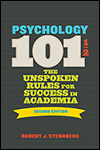
: Paul J. Sylvia, Peter F. Delaney, and Stuart Marcovitch
Publisher
: American Psychological Association
Copyright year
: 2016
ISBN
: 978-1-4338-2379-4
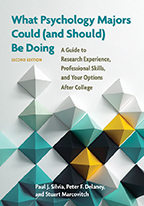 The second edition of this guide contains 14 chapters: Chapter 1, Choosing Your Research Focus; Chapter 2, Finding Research Opportunities; Chapter 3, Succeeding in Your Classes; Chapter 4, Getting More Out of Statistics; Chapter 5, Finding and Understanding Research Articles; Chapter 6, Writing Research Papers; Chapter 7, Getting Involved Outside the Lab and Classroom; Chapter 8, Attending Academic Conferences; Chapter 9, Presenting a Research Poster; Chapter 10, Presenting a Research Talk; Chapter 11, Making a CV; Chapter 12, Writing Personal Statements; Chapter 13, Thinking About the World of Work; Chapter 14, Understanding Graduate School; and Epilogue. Chapters 1, 3, 11, 12, 13 and 14 are new to the second edition. An Appendix lists references for Life After College, Statistics and Research Methods, Academic Writing and Public Speaking.
The chapters are short, clearly written, student friendly and provide sound information about conducting research. Several topics are similar to those taught in a research methods course but with additional practical advice. The authors’ thesis is that the best career preparation for psychology majors is to become highly immersed in research. The last six chapters stress the importance of preparing students for careers in graduate school and workplace environments.
About 45 percent of bachelor’s degree psychology majors attend graduate school, including psychology and other programs, and 55 percent enter the labor market (Carnevale, et al., 2015). Chapter 13, addresses the realities of a competitive labor market where an oversupply of psychology baccalaureates is associated with lower annual salaries compared to other academic majors. The authors also mention the importance of hard and soft skills, the Holland vocational categories and the immensely valuable Appleby on-line career exploration resource (Appleby, 2016). However, the authors could have expanded their discussion in Chapter 13, although in some instances the literature might not have been available. The 55 percent of graduates who enter the workplace would benefit from additional information about the work world. For example, only 3 percent of bachelor’s graduates identify research as their primary job; other graduates identified sales (20 percent), professional services (17 percent), management/supervision (16 percent), teaching (11 percent), accounting/finance/contracts (9 percent), employee relations (5 percent), or other work activities (19 percent) as their primary job (Stamm, et al., 2016). Research experience can certainly contribute to a successful entry in these careers, but is research the only or best form of preparation for all students? A survey of 400 employers identified applied learning experiences as preparation that 51 percent to 94 percent of companies favor in the hiring of recent college graduates. These experiences include (from higher to lower preference): Internships with a company or organization; senior thesis/projects demonstrating knowledge, research, problem solving and communication skills; multiple courses involving significant writing; research projects done collaboratively with peers; service learning projects with community organizations; field projects in diverse community with people from different backgrounds; and study abroad experiences.
The authors should address skills in detail because many hiring managers are more likely to explore a candidate’s skills than their coursework. Employers were asked what attributes or skills they seek on a candidate’s resume. Between 49 percent and 78 percent listed (from higher to lower): teamwork, problem-solving, written communication, strong work ethic, verbal communication, leadership, initiative, analytical/quantitative, flexibility/adaptability, detail oriented, interpersonal, technical and computer skills (NACE, 2016). Research experience can certainly develop most of these attributes but studies indicate such skills should be articulated clearly so students can connect to them during job interviews (Martini, et al., 2015; Martini et al., 2015, Strohmetz, et al., 2015).
Furthermore, “The majority of employers think that having both field-specific knowledge and skills and a broad range of skills and knowledge that apply to a variety of fields is important for recent college graduates to achieve long-term career success at their company” (Hart Research Associates, 2015, p. 2). Thus, students should be encouraged to explore options for career-specific minors or double majors. For example, an analysis of job postings open to recent liberal arts graduates identified eight diverse jobs that graduates can enter with higher than average pay if they complete a minor or internship in those areas (Burning Glass Technologies, 2013). Finally, students should know that “internships and employment during school were the two most important factors to employers in their hiring decisions” (Burning Glass Technologies, 2013, p. 6).
Given the modest length of this very fine text and the growing literature on workforce reports and empirical studies on skills, these and related topics could readily be included in a careers course that supports those psychology majors who seek a career with a bachelor’s degree in psychology as well as those who seek a career in psychology. What psychology teachers could (and should) be doing is to continue promoting research as career preparation but also become familiar with additional resources that benefit the 55 percent of students who enter the workplace upon graduation.
References
Appleby, D.C. (2016). An online career-exploration resource for psychology majors. Society for the Teaching of Psychology’s Office of Teaching Resources. Retrieved from https://teachpsych.org/resources/Documents/otrp/resources/appleby16students.docxopens in new window.
Burning Glass Technologies, (2013). The art of employment: How liberal arts graduates can improve their labor market prospects. Boston, MA: Burning Glass Technologies. Retrieved from https://burning-glass.com/wp-content/uploads/BGTReportLiberalArts.pdfopens in new window (PDF, 3.94MB).
Carnevale, A. P., Chea, B., & Hanson, A. R. (2015). The economic value of college majors. Washington, D.C.: Georgetown University, Center on Education and the Workforce.
Hart Research Associates. (2015). Falling short? College learning and career success. Retrieved from Association of American Colleges and Universities website: https://www.aacu.org/leap/public-opinion-researchopens in new window.
Martini, T.S., Judges, R., & Belicki, K. (2015). Psychology majors’ understanding of skills based learning outcomes. Scholarship of Teaching and Learning in Psychology, 1, 113-124.
Martini, T.S., Rail, A., & Norton, C. (2015). Psychology students’ understanding of the skills based learning fostered through university assignments. Teaching of Psychology, (42), 335-338.
National Association of Colleges and Employers (NACE). (2016). Job Outlook 2017. Bethlehem, Pennsylvania: National Association of Colleges and Employers.
Stamm, K., Lin, L., & Christidis, P. (2016, June). What do people do with their psychology degrees? Monitor on Psychology, 47(6), 12. Retrieved from https://www.apa.org/monitor/2016/06/datapoint.
Strohmetz, D.B., Dolinsky, B., Jhangiani, R.S., Posey, D.C., Hardin, E.E., & Shyu, V. (2015). The skillful major: Psychology curricula in the 21st century. Scholarship of Teaching and Learning in Psychology, 1, 200-207.
About the reviewer
 Paul Hettich, PhD, professor emeritus at DePaul University (Illinois), was an Army personnel psychologist, program evaluator in an education research and development lab, and corporate applied scientist — positions that created a “real world” foundation for a long career in college teaching and administration. He has completed numerous professional presentations and authored or coauthored several refereed publications including three books and three book chapters. He co-authored "Your Undergraduate Degree in Psychology from College to Career" with R.E. Landrum, and writes the column “Wisdom from the Workplace” for
Eye on Psi Chiopens in new window
. His interest in workplace transition derives from the frustrations of alumni and employers who complained of a major disconnect between university and workplace expectations, cultures and behaviors.
Paul Hettich, PhD, professor emeritus at DePaul University (Illinois), was an Army personnel psychologist, program evaluator in an education research and development lab, and corporate applied scientist — positions that created a “real world” foundation for a long career in college teaching and administration. He has completed numerous professional presentations and authored or coauthored several refereed publications including three books and three book chapters. He co-authored "Your Undergraduate Degree in Psychology from College to Career" with R.E. Landrum, and writes the column “Wisdom from the Workplace” for
Eye on Psi Chiopens in new window
. His interest in workplace transition derives from the frustrations of alumni and employers who complained of a major disconnect between university and workplace expectations, cultures and behaviors.