Why should high school psychology teachers (and community college teachers) seriously consider attending APA 2019, the convention of the American Psychological Association? Is the cost of the conference beyond a teacher’s financial resources? Would it be filled with complex research and theoretical presentations that would have no relevance to our students? These are common misconceptions that could not be farther from the truth. The event offers high school teachers the opportunity to gain greater content knowledge as well as new activities and demonstrations to enhance teaching.
APA's conventions offer a large number of sessions that are specifically geared for teachers of psychology as well as the opportunity to hear presentations by leaders in the discipline of psychological science. Sessions include lectures from world famous psychologists, addresses on cutting-edge research and its implications, panel discussions, film screenings and a myriad of other choices. In 2017, the last year that I attended, I was able to hear presentations by Philip Zimbardo, PhD, Noam Chomsky, PhD, Martin Seligman, PhD, Robert Sternberg, PhD, Robert Cialdini, PhD, and Aaron Beck, PhD.
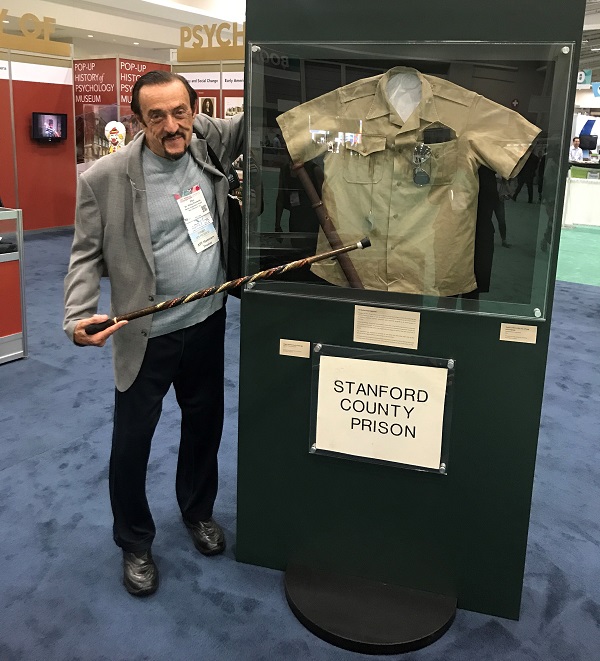
Philip Zimbardo, PhD, in the 2017 APA convention exhibit hall.
It is truly an amazing experience to hear the psychologists we teach about all year present their ideas in person. If you want to “nerd out,” most are willing to take photos or sign autographs for high school psychology teachers. Past speakers have included Scott O. Lilienfeld, PhD, co-author of "50 Great Myths of Popular Psychologyopens in new window," Martin Seligman, PhD (learned helplessness, positive psychology and more), Elizabeth Loftus, PhD (the misinformation effect and problems with eyewitness memory), and neuroscientist V.S. Ramachandran, PhD. Some of the exciting speakers at APA 2019 have already been announced, including Richard J. Davidson, PhD (“Well-being as a Skill”), Larry J. Young, PhD (“Neuroscience of Love and Attachment: Implications for Autism”), Lisa Damour, PhD (“Reframing Stress and Anxiety”), William D. Parham, PhD (“Invisible Tattoos: Unlikely Sources from which Elite Athletes Draw Strength”), Keith B. Maddox, PhD (“How Racial Typicality Biases Judgment (and Why You Should Care)”), and Helen Verdeli, PhD (“From Bogota to Beirut: Innovations in Global Mental Health Research”). Documentary film screenings followed by panel discussions with experts addressing a wide range of topics like positive psychology, prejudice, cell phone dependency, immigration, culture, anxiety disorders and individuals with disabilities are included each year. Several important feature films such as Get Out and Lady Bird in 2018 are also presented at each convention along with discussions.
Each year, the TOPSS Committee (APA Teachers of Psychology in Secondary Schools), CABE (APA Committee on Associate and Baccalaureate Education), BEA (APA Board of Educational Affairs), Psi Chi, Psi Beta, and the Society for the Teaching of Psychology (STP; APA Div. 2) offer numerous sessions specifically for teachers of psychology. In 2018, sessions included a presentation by Paul Ekman, PhD (emotions and microexpressions), sessions on the impact of violent video games, teaching critical thinking and scientific literacy, a hands-on workshop for teaching statistics and even a session with Phillip McGraw, PhD (Dr. Phil). The 2019 TOPSS speakers are: Cedar R. Riener, PhD; Randolph-Macon College, "Randal M. Ernst Lecture: Mythbusting with Care: Teaching Cognitive Psychology to Students Who’ve Made up their Minds"; Jeffrey R. Stowell, PhD, Eastern Illinois University, "Lee Gurel Lecture: Find out what students know before it’s too late! Assessment strategies for intro psychology"; and Uma Tauber, PhD, Texas Christian University, "Improving Student Learning with Principles from Cognitive Science." TOPSS and the APA Education Directorate are also sponsoring a full day workshop for high school teachers on Aug. 7, held with support from the American Psychological Foundation.
In addition to all of the exciting sessions, make sure to check out the Solution Center (exhibit hall) where you can meet authors and see the latest books and technology. The National Museum of Psychology in Akron, Ohio, brings several exhibits each year so you can take your photo with some of the museum's important pieces such as the real Bobo doll, Milgram’s original “shock” machine or the Stanford Prison experiment guard uniform. During the evening, receptions and social events provide opportunities to meet with other high school and college psychology teachers. Honestly, there are always more sessions that apply to teacher interests and pedagogy than could be attended.
Truly one of the highlights of the event is the keynote speakers of the opening night. Previous keynote speakers have included Bryan Stevenson, JD, author of "Just Mercyopens in new window" and founder of the Equal Justice Initiative; Daniel Kahneman, PhD, Nobel prize-winning author of "Thinking, Fast and Slowopens in new window;" Claude Steele, PhD, author of "Whistling Vivaldiopens in new window" known for research on stereotype threat; Malcolm Gladwell, author of the bestselling books "Blinkopens in new window," "The Tipping Pointopens in new window" and "Outliersopens in new window;" and Daniel Gilbert, PhD, noted Harvard psychologist and author of bestselling book "Stumbling on Happinessopens in new window." Speakers are often available after their presentations for book signing events. The 2019 keynote speaker will be Wes Moore, a bestselling author, decorated Army veteran and founder of one of the largest organizations to combat poverty in the United States. Watch the APA’s website and follow the APA 2019 blog for announcements regarding this year's speakers and program.
The American Psychological Association encourages high school psychology teachers to participate in APA 2019 and offers a discount for this four-day conference. The conference is held in a different exciting city each year. APA 2019 is in my hometown Chicago, APA 2020 it will be in Washington, D.C., and APA 2021 will be in San Diego. For individuals who choose to attend the conference when it is held at a distant location, hotel accommodations and transportation costs can be reduced through booking hotels that are a further distance from the event site and using public transportation. The APA 2019 website also includes details about how to sign up for a roommate to share a hotel room, which can be a real money saver.
Should high school teachers of psychology attend APA 2019 on Aug. 8-11 in Chicago? Absolutely, yes. This is an incredible professional development opportunity to learn about current trends and research in psychology, to gain strategies and activities to enhance curriculum, to network with other psychology teachers and college professors, and to acquire a plethora of knowledge in this ever-changing field. You will leave the event re-energized and armed with countless new ideas to improve your classroom instruction. No doubt about it, you’ll describe it as the greatest professional development opportunity of the year. I hope to see you this summer in Chicago for psychology and deep-dish pizza.
This article originally ran in the Spring 2012 issue of the Psychology Teacher Network. It was recently updated.
About the author
 Nancy Fenton, MA, teaches AP psychology at Adlai E. Stevenson High School in Lincolnshire, Illinois, and online for the Center for Talent Development at Northwestern University. She has taught AP psychology since 2006 and has served as a reader for the AP psychology exam since 2008, a table leader since 2017, and a College Board consultant since 2014. She earned her BA in history and secondary education at Northeastern Illinois University and her MA in psychology at National Louis University. Fenton was awarded the 2013 American Psychological Association Teachers of Psychology in Secondary Schools (TOPSS) Excellence in Teaching Award. She has previously served as a member of the TOPSS committee and served as the TOPSS representative to the APA Coalition for Psychology in Schools and Education. She has worked on numerous APA initiatives including the performance indicators for the National Standards for High School Psychology Curricula, and several TOPSS Psychology Unit Lesson Plans. Nancy Fenton is the co-author of the review book "AP Psychology All Access" and writes for the blog Books for Psychology Classopens in new window.