skip to main content

This page has been archived and is no longer being updated regularly.

Susan Clayton, PhD

Conservation Psychologist
Susan Clayton, PhD
“One of the areas of research that’s really booming … is research demonstrating that feeling connected to nature, being outside in nature, has a positive impact on people.”

The Human Zoo

Psychologist Susan Clayton, PhD, spends a lot of her time at zoos—not merely for fun but to observe how people connect with animals and nature and, as a consequence, how this might lead them to conserve our natural resources.

“People go to the zoo, they’re experiencing wild animals, they’re experiencing lush vegetation, and for them, it really is nature,” she says. “So I like to look at the ways in which they respond to those natural elements, and I do that by watching them and coding their behavior, by listening to them, and also by … asking them direct questions.” Based on her observations, she has learned that zoos make people happy and “that people are trying to connect with the animals in some way.” When people connect to nature, Clayton argues, environmental conservation becomes personally relevant.

Additionally, she has found that the signs that describe the exhibits can affect the way people respond to the animals, often in a way that makes them more receptive to conservation messages, she says. For example, an exhibit on the wildlife trade was designed at a zoo in Chengdu, China, partly on the basis of Clayton’s research. “And the hope is that this exhibit will actually change people’s attitudes, lead them to be more active against the wildlife trade, and therefore protect the animals.”
Dr. Clayton in Action

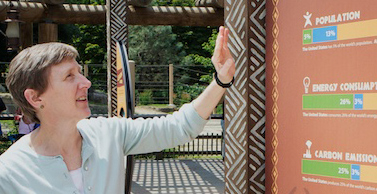
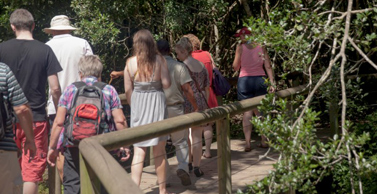
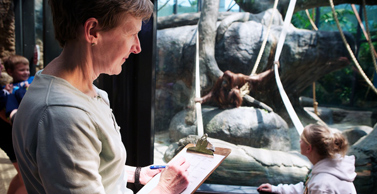
Dr. Clayton observes how people relate to animals in the zoo.

Human-Animal Interaction

Dr. Clayton observes how people relate to animals in the zoo.
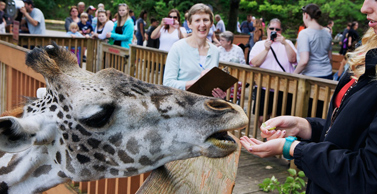
Children are a receptive audience because they are naturally curious about animals.

Innate Interest

Children are a receptive audience because they are naturally curious about animals.
Dr. Clayton has found particular messaging within a zoo's informational signs can help connect people with nature.

Messages Matter

Dr. Clayton has found particular messaging within a zoo's informational signs can help connect people with nature.
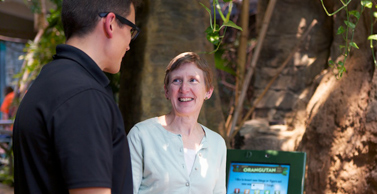
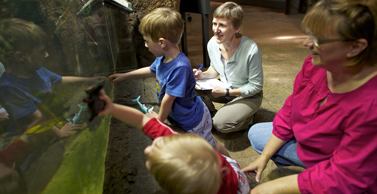
Dr. Clayton explains that she is researching how people interact with and are affected by animal exhibits.

Human-Human Interaction

Dr. Clayton explains that she is researching how people interact with and are affected by animal exhibits.
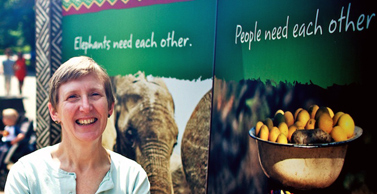
Hopeful messages are more effective in getting people to conserve, Dr. Clayton has found.

Go Positive

Hopeful messages are more effective in getting people to conserve, Dr. Clayton has found.
Research has shown that spending time in nature helps to reduce stress and increase a sense of wellness.

Natural Connection

Research has shown that spending time in nature helps to reduce stress and increase a sense of wellness.
People who perceive animals as similar to humans are more concerned about their well-being and long-term survival.

Seeing Ourselves

People who perceive animals as similar to humans are more concerned about their well-being and long-term survival.

Our Psychological Nature

Clayton has always been drawn to nature, but she didn't at first associate that interest with psychology as she was studying it in college and grad school. Eventually, however, the connections emerged. “I began to realize there was a real psychological significance to nature that I hadn't appreciated beforehand,” she says. “So from a theoretical point of view, I wanted to explore that.”

And, she says, “Science is why I wanted to become a psychologist, because I really love data. I love the idea that you can ask questions and then you can get data to answer them, or you can formulate hypotheses and then you can test the hypotheses.”

Research has shown that human behavior has contributed to global climate change and that human behavior will have to help us mitigate and adapt to its effects. Some have suggested that people aren't sufficiently invested in nature and therefore don’t engage in behaviors that would help alleviate climate change, pollution and other environmental damage. But Clayton thinks people really do care. “One of the areas of research that’s really booming in the past 10 to 15 years is research demonstrating that feeling connected to nature, being outside in nature, has a positive impact on people,” she says. “It reduces their stress, it makes them happier, perhaps more productive, even more physically healthy … that’s part of the message that people need to have.”

Protecting the Planet Through Conservation Psychology

Connecting People to Nature

Studying people's relationship with nature has helped Dr. Susan Clayton create messages that encourage people to protect the environment.

Saving the World

In a paper she wrote in 2005, Clayton asked, “Can psychology help save the world?” Since the science of psychology is the study of human behavior, it has a crucial role to play. “Recognizing the interdependence of social and environmental ties suggests that we should encourage social policies and institutions that include interactions with the natural world as a fundamental part of a society,” she wrote. ‘[W]hile the natural environment provides psychology with a deeper understanding of human nature, psychologists should provide educators, environmental policymakers and conservationists with the information to support their work in sustaining the human experience of nature.”

For her part, she enjoys being what she hopes is part of the solution. “What I love the most about my work has to be the potential to make a difference,” she says. “It’s just so satisfying to think that the things I learn can be applied to actually change people’s behavior, that my research might actually help in a small way to protect the environment, and therefore to provide healthy environments for people and wildlife into the future.”

Climate and Environmental Psychology

Psychologists working on issues affecting our climate use psychological science to help promote human behaviors that can protect and restore our environment.

Date created: 2014
The content I just read: