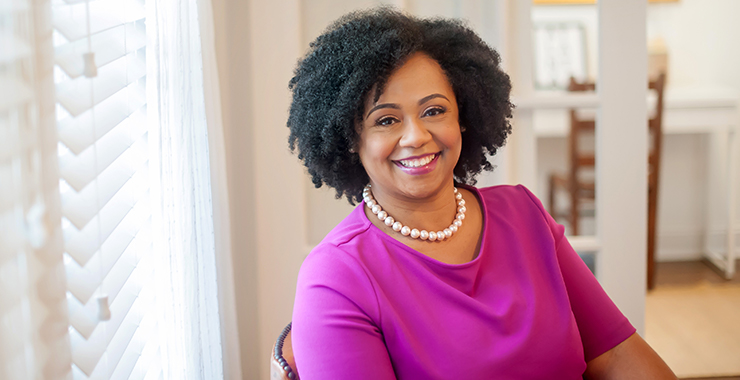
Joy Harden Bradford, PhD, an Atlanta, Georgia, clinical psychologist, specializes in working with African-American women in her practice, especially around relationships, breakups, divorce and work-life balance, but she goes well beyond merely making herself available to her own clients.
The creator of the website Therapy for Black Girls,opens in new window Bradford provides an array of resources to introduce psychology to African-American women, who have typically been raised to handle their problems in the context of family, church and friends.
"A lot of black families have had this idea that what goes on in the house stays in the house. Talking to a stranger about some very personal things has been taboo," says Bradford, an APA member.
Black women are often seen as strong and resilient, and Bradford says, as a general rule, that is true, but only part of the story. Black women have all the stressors other women have, as well as the additional effects of systemic racism to deal with. For example, black women are more likely to experience post-partum depressionopens in new window, a condition often linked to socioeconomic status, yet they are far less likelyopens in new window to get help in dealing with it.
Bradford's outreach to black women dates back to her days as a college counselor, when she first noticed that African-Americans sought mental health services from the campus centers much less often than other students. She aims to make a discussion of mental health issues "accessible and relevant" for black women.
Her project, Therapy for Black Girls, is part of that effort, and it seems to be working. The website has 100,000 followers, and Bradford's weekly podcast has had more than 2.5 million downloads since it began in April of 2017. The podcasts are designed to help black women become familiar with the objectives, terminology, possible topics and some of the processes of therapy. She enlists other therapists, all black women so far, to analyze the issues that, say, characters from popular culture might discuss in therapy, like Mollyopens in new window from the HBO series Insecure, or Olivia Popeopens in new window from ABC's Scandal. Bradford lists books and other resources on the website as well. A new subscription service, the Yellow Couch Collective, has 65 members so far.
"I want every black woman to be able to have a great therapist," she says.
The road to that objective is strewn with obstacles, though, Bradford says. For one thing, in her experience, most black women who are open to therapy say that another black woman is their ideal mental health professional. But while more than two-thirds of psychologists are women, only 5.3 percent were African-American in 2013. And those are not spread evenly across the country.
Two years ago, Bradford began assembling a national directoryopens in new window of mental health professionals who are licensed and ostensibly culturally competent to work with black women. The directory has grown to more than 1,000 therapists. Some nominate themselves; other names come from current or former clients who report good experiences. Most therapists in the directory are African-American women themselves. Bradford doesn't endorse the therapists on the list she's created, but she is proud that it gives women a start on getting help.
Trust-building is an important aspect of any therapeutic relationship, but especially when client and therapist come from different backgrounds. The importance of cultural competence may be on white psychologists' radar these days, and therapists are almost by definition well-intentioned people, Bradford says, but good intentions are just a start.
"White therapists need to do the work to allow black women to have the best therapy experience possible," she says.
Black women may feel traumatized by a bad experience with a therapist who, for example, questions the legitimacy of something the client is reporting that the client knows to be true, Bradford says. Or, black women may talk with fervor when they have strong feelings about something, but that doesn't mean they are habitually angry, as one stereotype has it.
On the other hand, white therapists absolutely do need to talk about racial issues with their black clients. "Our training tries to take this color-blind approach, but if you see me as just another woman, then you're missing a whole lot of what's bringing me into therapy. You're not seeing all of who I am," Bradford says.
Affordability is another roadblock. Black women are less likely to have health insurance than white women and, even when they do have it, therapists may not take insurance — Bradford herself doesn't.
"Insurance companies need to do a better job. There has been so much information about how mental health professionals are not reimbursed at the same rate as physicians," even though psychologists also go through several years of postgraduate training. "And physicians can see four to six people in an hour, where we see only one. The reimbursement rates are not up to par," she says.
In rural areas, "there might not be a therapist within 20 or 30 miles, and sadly, a lot of community mental health facilities have closed," Bradford says. Telehealth options might be at least one answer in those areas.
Growing up in Paincourtville, Louisiana, Bradford says she was the girl her friends would come to with all their problems. "I always knew I would do something in the helping professions," she says.
Bradford did her undergraduate work at Xavier University of Louisiana in New Orleans. She has a master’s degree in vocational rehabilitation counseling from Arkansas State University in Jonesboro, and a PhD in counseling psychology from the University of Georgia in Athens.
Bradford has worked for the Wisconsin Division of Vocational Rehabilitation and in the counseling centers of Virginia Commonwealth University in Richmond; Georgia Southern University in Statesboro; the University of Georgia in Athens; Emory University Oxford College in Oxford, Georgia; and Clark Atlanta University in Atlanta, Georgia.
It wasn't easy, as an African-American woman, getting all the way through psychology training, she says. "The programs are still very white, and not the most welcoming. In fact, they can be downright hostile." She wrote her dissertation on depression and anxiety among black people attending predominantly white academic institutions.
"Even if you figured out the money piece, you also had to deal with the assault to your mental health," she says.
Luckily, Bradford was one of two black female students in her cohort, and a scattering of other black grad students were in the program as well.
"We did a good job supporting one another. There were also a couple of faculty members who got it, who understood we weren't making things up. Support is the only way you can make it through," she says.
Now, she's gratified to find herself at the center of an "active and strong community" through Therapy for Black Girls. She's thinking about offering live events starting in 2019, perhaps some half-day or full-day intensives.
"I'm always in conversation with the community," Bradford says. "I don't want to just say what I think they should hear. I want to make sure that I'm giving them content they feel is useful, and helpful to their lives."