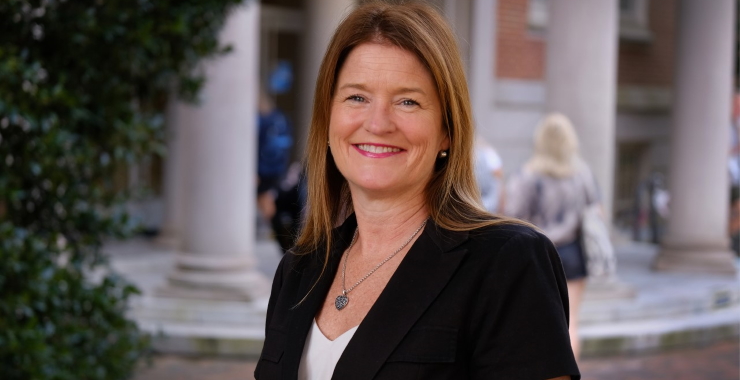
Photo credit: Mike Hobbs of UNC at Chapel Hill School of Education


Dorothy Espelage, PhDopens in new window , a pioneering researcher of aggression among schoolchildren, has done foundational studies on “bullying”—distress or injury one individual or group repeatedly inflicts on others who are less powerful.
Espelage has packed a great deal into her quarter-century career. The William C. Friday distinguished professor of education at the University of North Carolina in Chapel Hill, Espelage has co-authored a number of books, including Bullying in American Schools, dozens of additional chapters, and 300 scholarly papers, including 40 that her teams produced last year alone. She is a Division 15opens in new window (Educational Psychology) fellow, and has received both an APA Lifetime Achievement Award in Prevention Science and the 2016 APA Award for Distinguished Contributions to research in public policy. She teaches both graduate and undergraduate students, has mentored 50 doctoral students, and has traveled 200,000 miles in a normal year before the pandemic, she says, often to testify or speak at conferences.
Not surprisingly, she has had a significant impact. Every state in the union now has some type of legislation on the books recognizing that bullying in schools is harmful and should be prevented, she says. "My work has informed a lot of policy and legislation."
Bullying, as separate from aggression, came to the public’s attention in the early 1980s after three boys in northern Norwayopens in new window, aged 10 to 14, committed suicide in the space of a few months, and Norway became the first country to develop a national program to address the bullying behavior it was thought had led to the boys’ deaths. But the Norwegian remedy didn’t translate well to the United States, Espelage says, and many questions remained.
One of Espelage's surprising early discoveries was that bullies are often popular students (PDF, 51KB)opens in new window. Sometimes, "they're not only popular, they're likable," she says. Work she has done has helped establish (PDF, 224kB)opens in new window that gay, lesbian, bisexual, transgender, and queer (LGBTQ) youth are bullied and physically assaulted far more commonly than others, and that those victimized LGBTQ individuals have high rates of suicide attempts and suicidal thoughts, she says.
She has shown that bullying can diminish the academic performanceopens in new window of children who are victimized, in part because bullying weakens their sense of belonging at school.
Espelage and her colleagues have also discovered
a strong element of homophobiaopens in new window
in the bullying of both boys and girls do—and, among boys as they mature,
an association between bullying and sexual violence against womenopens in new window
.
"That relationship between bullying and sexual violence is highest for those kids who adopt a traditional masculinity," she says.
Not all bullying occurs in person. The Pew Research Center has found that nearly 60% of American teenagersopens in new window have been bullied or harassed online, mostly on social mediaopens in new window. Espelage has studied this “cyberbullyingopens in new window” phenomenon as well, and has assessed interventionsopens in new window developed to combat it.
With all kinds of bullying, information is the first defense, and reliable websites like StopBullying.govopens in new window are a good place for students, parents, teachers, and healthcare providers to start.
Espelage has developed online training programs for school police and other security personnelopens in new window to help them respond to bullying, a “fascinating” project that gave her new understanding for how complex those jobs are, and for how typically undertrained school police are in even the basics of child development.
Suicide, which is associated with bullying, has surged in recent years to become the second leading cause of deathopens in new window for children ages 10 to 14, and the third leading cause of death for young people ages 15 to 24. Espelage has found that both bullies and their victimsopens in new window are much more likely to think about and attempt suicide than are individuals who are not involved in bullying, and that bullied individuals are at greater risk for depression.
One important aspect of her overall project, Espelage says, is to identify influences that protect against bullyingopens in new window—in individuals, classrooms, and schools—and to bolster those. In order to stop bullying, it’s important to change the culture to one that is less toxic, she says. She has supported peer-led programs in middle school and high school that give the students “agency and voice to change the climate” to one that is more respectful of everyone.
One of the remedies she has helped assess and shape is social emotional learningopens in new window (SEL), a skill set that can be taught that includes self-awareness, self-control, and an understanding of how to communicate well with others. Faithfully implemented, SEL can lower sexual harassment, homophobia, and aggression, Espelage says; correct implementation is a critical ingredient in the effectiveness of such campaigns.
Now, though, SEL is under fire. Some conservativesopens in new window characterize it as brainwashing, a Trojan horse for progressive ideology. Espelage says semantic tweaks can help counter those perceptions. In conservative settings, "I call it executive function or workforce-development skills," she says. She finds that if she breaks down the individual skills, conservative critics are more accepting. On the other hand, some people of coloropens in new window see SEL as diminishing to their children—"white supremacy with a hug," in the words of educator Dena Simmonsopens in new window, if it isn't seated in an appropriate cultural and historical context.
"We have to answer this with science," says Espelage. She has a grant to assess how well SEL works for Black and other minority children. The broad opposition puzzles her. "I've always thought about social emotional learning as a way to level the playing field a little bit to give kids skills they may not be getting at home," she says.
Espelage is also a member of the APA Task Force on Violence Against Educators and School Personne1 (PDF, 206KB)opens in new window, a follow-up to the Task Force on Classroom Violence Directed Against Teachers she chaired in 2011, when 80% of teachers reported at least one abusive interaction in the past year, mostly with students. The new task force found itself gathering data between July 2020 and June 2021, when COVID-19 forced many (though not all) children to attend school online or in hybrid mode (in school only part-time). Even so, one-third of teachers said they experienced verbal harassment or threatening behavior from students at least once during the pandemic.
"It was even happening online," Espelage says.
In the new study, about 14% of teachers reported an incident of physical violence from a student. Nearly 30% said they had been harassed or threatened by their students' parents. This abuse has taken a toll. Of the 9,370 teachers surveyed, 43% said they planned or wanted to quit their jobs. Harassment, and the desire to get out, were most common among middle school teachers.
About 5,000 school administrators and other support staff were included in the 2022 study as well. More than 40% of administrators reported that parents had harassed or threatened them. About 15% of administrators, 18% of school psychologists and social workers, and 22% of other school staff said they had experienced at least one violent interaction with a student during the pandemic.
Add to this the learning and mental health crises among students whose lives were disrupted by COVID-19, and the challenges the pandemic dumped on the nation's school systems in general, and it becomes evident that education has become "just this perfect pressure cooker," Espelage says.
As for Espelage herself, the pandemic has had some silver linings. She did much less traveling, and her research was restricted, though she still went into schools. So she got more sleep, substituted long walks for her habit of running, and took time to reflect on her fruitful career.
"I fell in love with teaching again,” she says. “I remembered that I really like teaching undergrads and publishing with them.”

Connecting with peers
Find Your Perfect Gym
Active&Fit Directopens in new window
New products available
APA Merch Storeopens in new window
Competitive low rates