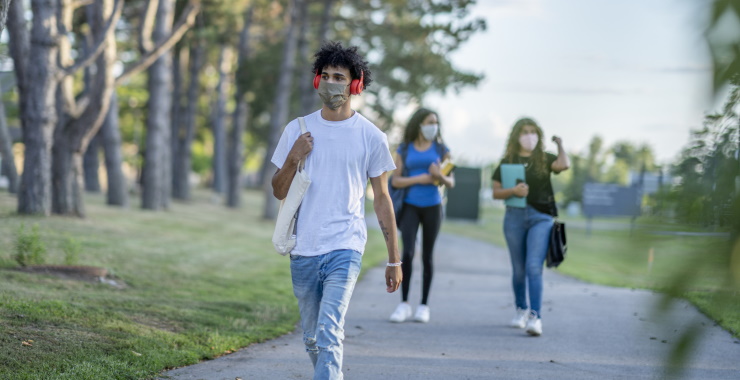
It's a fall like no other at colleges and universities across the country, with a patchwork of online and in-person classes, extracurricular activities cancelled or downsized, even meetups with friends severely restricted—but in spite of it all, some institutions have become COVID-19 hotspotsopens in new window. Emotions are running high among students, faculty, and staff; counseling services are mostly being offered online; and therapists are scrambling to keep up with young clients tucked up in dorms, off-campus apartments, and far-flung family homes.
“One of my counselors said we're like the band on the Titanicopens in new window,” says Barry Schreieropens in new window, PhD , head of the counseling center at the University of Iowaopens in new window in Iowa City. “We're clearly on the same ship as everybody else, but we're trying to be creative and proactive, and in the end, we're helping students with a situation we're having to manage ourselves.”
By the end of September, about 2,000 Iowa students, of about 32,000 total, and 45 employees, had reported testing positive for COVID-19. Many classes, which began late in August, are totally or partially online. Iowa's students will leave before Thanksgiving, resume classes online November 30, and take exams online. For the spring session, the plan is for the campus to re-open January 25.
Nearly all American college students, graduate and undergraduate both, have lost something significant as a result of the pandemic—participation in sports (or the fun of supporting teams in person), theater practice, research opportunities, dorm life, Greek life, or signature social events.
At Iowa, anecdotally, Schreier says, there is a considerable range in how students are handling the losses, from quite a few who report they are managing all right, to others who struggle with isolation, boredom, and staying motivated with online classes.
However, Iowa's counselors are seeing basically the same number of students they saw last year; worrisome problems like depression and suicidal thoughts are no more pronounced in the waning months of 2020 than they were in 2019, Schreier says.
Some reassuring findings
Iowa's numbers are consistent with a studyopens in new window by the Center for Collegiate Mental Health (CCMH) at Pennsylvania State University, which has been gathering data about students seeking mental health services at college counseling centers all over the country for nearly 20 years for its Counseling Center Assessment of Psychological Symptoms (CCAPS)opens in new window. Fewer students sought services in the first months of the pandemic, March to May, and reports of depression, social anxiety, and eating concerns were about the same as for 2019. Reports of struggles with alcohol use and suicidal ideation were also slightly lower. However, more students sought counseling for family distress and academic distress. (Other surveysopens in new window have shown greater distress in more areas among college students.)
This strange year is “a heavier lift” for some students with “marginalized identities,” Schreier says—students of color, LGBTQ students (lesbian, gay, bisexual, transgender, queer), differently abled students, the first in their families to go to college. For LGBTQ students in particular, home may not have been “an easy or safe place” to be last spring. If they felt connected to the LGBTQ community at Iowa, it may be hard for them now to fully reconnect virtually, he says.
The university counseling center at Iowa is presently serving students entirely by telehealth, Schreier says. Counselors have become flexible about when they see students via Zoom, working into the evenings at times, and also proficient at staying connected with each other, he says, adding that most like the flexibility, as well as the extra time they have because they are not commuting to and from work.
Iowa has taken its student outreach online this year more than ever before, to Instagram, Facebook, and Twitter, and has a number of online resources for students at Mental Health at Iowaopens in new window, Schreier says.
Reaching out with telecounseling
At the University of Oregon (UO), in Eugene, the counseling staff has gone all out to ensure that students who want mental health services can get them, says Shelly Kerr PhD, director of the UO counseling center. Most classes this quarter, which began September 29, are online. Many first-year students have chosen to live in the dorms, but many upper-class students are off-campus, at home or in Eugene.
In-person spaces at the counseling center have been refigured for socially distanced therapyopens in new window that runs no longer than 30 minutes, though sessions can be extended via teletherapy. Those meetings must be set up in advance, and aren't expected to be common, Kerr says. Zoom rooms—private rooms in the center with secure internet connection—are also available for students who don't have a private space at home, for teletherapy with a campus counselor or a therapist back home.
But telecounseling is the main focus. More than three-fourths of UO students are from Oregon or California, but Kerr reached out to state licensing boards across the country to confirm her staff's ability to counsel students who are at home in 17 statesopens in new window during this emergency.
UO therapists are trained to treat their college students, who may not be able to afford or even find off-campus mental health services, Kerr says. And student-clients her staff worked with via teletherapy over the summer have said that “talking with someone from the counseling center helps them feel supported by the University of Oregon in general,” she says.
At UO, student health fees cover mental health services, and even in normal times, students who are not enrolled in summer school can pay the health fee and meet with a counselor during the summer session. Those numbers were noticeably higher this year, with teletherapy in place, Kerr says.
“It's a way for us to maintain a therapeutic relationship with students even when they're not right here in Eugene,” she says.
UO students who meet with Kerr's counselors have reported struggling with depression, anxiety, and academic stress, Kerr says, along with health concerns about the virus and “what will my world look like after the pandemic?”
A safe space for students of color
Ashlee Davisopens in new window, PhD, coordinator for Diversity, Inclusion and Social Justice Initiatives at Fordham University'sopens in new window counseling center in the Bronx, works with a vulnerable group of students at her school that includes students of color, international students, and those who hold intersecting marginalized identities. Davis leads groups, counsels individuals, and does outreach.
Fordham, a Catholic Jesuit university with about 17,000 students, including about 10,000 undergraduates, is offering instructionopens in new window this year in person, remotely, or in a hybrid of both. Counselorsopens in new window are seeing students primarily via telehealth.
The disruption from COVID-19 has created another difficult layer for the students of color Davis works with, many of whom were already stressed. “It's not easy being at a PWI (predominantly white institution), nationwide,” Davis says. “Feelings of being othered, of experiencing microaggressions and persistent racism on campus—those students don't really feel safe,” she says.
Confronting the deaths of George Floyd, Breonna Taylor, and other Black victims of police brutality, which brought the Black Lives Matteropens in new window movement to the fore this year, has been hard for Black students, too. “Vicarious racial trauma is real,” Davis says. Some students have engaged with activism; others are uncertain about the stance they want to take. Davis says she is proud of Fordham's administrationopens in new window for its openness to listening to its students of color, and for moving toward anti-racism.
New York had a severe coronavirus outbreakopens in new window in the spring. “A number of students had relatives who died, and now they are navigating grief,” she says. Some students are afraid of contracting the virus themselves; others have to worry about vulnerable relatives at home. Davis says, “I'm glad to be able to co-create a space of safety for them.”
Some stressors in these students' lives may be financial—parents who have lost jobs, difficulty finding work themselves, home obligations like looking after siblings, which can pull students living at home away from concentrating on school.
As for Davis's international students, they are far from home, concerned about their own and their families' health, and targeted in some cases for xenophobic abuseopens in new window or scrutinyopens in new window from the federal governmentopens in new window. Students from these communities may be feeling isolated and anxious, she says.
Davis often reminds her clients of the value of self-care. “It's easy to find ourselves depleted,” she says. “Don't spend hours with media and social media. Find other ways to establish community.”
Weighing the college experience against public health concerns
At Auburn University, a state land-grant school of 30,000 students in Auburn, Alabama, the new normal has more in common with the old normal than at some other colleges.
“A really conservative school overall” in a conservative state, according to Doug Hankes PhD, director of Auburn's counseling center, Auburn “waited and waited” to approve in-person classes this fall, but has held them to an extent since mid-August, and permits pre-approved gatherings of up to 100 people. The football season is on, if cautiously, with students getting most of the 17,500 tickets made available for the first home game in the 90,000-seat stadium. Auburn requires masks indoors; social distancing, with classrooms at 50% capacity for in-person classes; and self-screeningopens in new window. Cases of the virusopens in new window have dropped dramatically since August.
“The students have done a good job” of weighing public health concernsopens in new window against their desire to have as full a college experience as possible, Hankes says.
After students left mid-Marchopens in new window, many of them going to “healthy home environments” to finish the term online, Hankes says, demand for mental health services declined precipitously. Now, although two of 19 total licensed professionals in the department are on hand to handle emergencies at each of Auburn's two counseling centers, basically the entire operation has moved online, he says.
Like Schreier at Iowa, Hankes reports that student demand for services “is almost exactly the same as last year.”
He's surprised at how well telehealth has been working; he was not previously a proponent, and “I still think you miss a lot” compared with in-person therapy, Hankes says. But he agrees with other counselors interviewed here that telecounseling's flexibility in terms of time and place can make mental health help available to more students. Going forward, “it will be another option we give our students,” he says.
Auburn freshmen, transfers, and grad students “have struggled the most—anybody who didn't have that friend network in place,” Hankes says. Graduate students make up about 20% of the student body but roughly 25% of the clientele at the center.
One silver lining of the limitations forced on students by the pandemic is that they have gotten bored with the activities they can do online, Hankes says. “They're being forced to think, ‘What else do I want to do? What am I passionate about?' For some students, that's a good thing.”