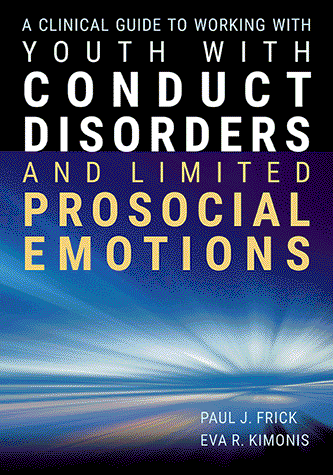
A Clinical Guide to Working With Youth With Conduct Disorders and Limited Prosocial Emotions
ISBN: 978-1-4338-4380-8Available formats
Also available from
This practical guide provides clinicians with evidence-based tools and strategies to assess and treat children and adolescents with serious behavior problems who exhibit limited prosocial emotions (LPEs).
Extreme behavior problems in youth, while rare overall, have an outsized impact. These youth can cause tremendous harm to themselves, their peers, and even adults while also presenting as callous, unemotional, unremorseful, and unconcerned about the consequences of their actions. Without intervention, these children face increased risks of justice system involvement, school dropout, and serious mental health issues such as depression, suicidal ideation, and substance abuse that can continue into adulthood.
Youth with serious conduct problems pose distinct challenges for mental health professionals, particularly when accompanied by LPEs. To support clinicians, the authors offer a comprehensive framework for engaging families, conducting specialized assessments, and delivering targeted treatment. Readers will learn how to use tools such as the Inventory of Callous–Unemotional Traits and the Clinical Assessment of Prosocial Emotions to evaluate the presence of LPE specifier, as defined by the DSM and the ICD. The book also presents multiple promising treatment methods, with a particular focus on an adapted version of parent–child interaction therapy (PCIT) designed specifically for young children with callous–unemotional traits.
A detailed case example follows a 5-year-old Aboriginal boy and his mother, illustrating the full course of assessment, parent engagement, and intervention in the treatment of severe conduct problems with limited prosocial emotions.
Dedications
An Introduction to Assessing and Treating Children and Adolescents With Disruptive Behavior Disorders Who Lack Empathy and Guilt
Part I. Overview of the Limited Prosocial Emotions Specifier and Its Significance
- Chapter 1. An Overview of Research on Diagnosing Limited Prosocial Emotions in Children and Adolescents
- Chapter 2. Clinically Important Differences Between Children with Limited Prosocial Emotions and Other Children with Conduct Problems
- Chapter 3. Distinct Emotional, Cognitive, and Social Characteristics of Children and Adolescents With Limited Prosocial Emotions
Part II. Clinical Assessment and Diagnosis of Children and Adolescents With Limited Prosocial Emotions
- Chapter 4. General Considerations in the Assessment of Children and Adolescents With Limited Prosocial Emotions
- Chapter 5. Using the Inventory of Callous-Unemotional Traits in Clinical Assessments of the Limited Prosocial Emotions Specifier
- Chapter 6. Using the Clinical Assessment of Prosocial Emotions (CAPE) in Clinical Assessments of the Limited Prosocial Emotions Specifier
Part III. Treating Children and Adolescents With Limited Prosocial Emotions
- Chapter 7. An Overview of Treatments That Work for Children and Adolescents With Limited Prosocial Emotions
- Chapter 8. Parent–Child Interaction Therapy for Callous–Unemotional Traits (PCIT-CU)
- Chapter 9. Illustrative Clinical Case Study Involving Parent–Child Interaction Therapy for Callous–Unemotional Traits (PCIT-CU)
- Chapter 10. Expanding the Reach of Treatments for Children and Adolescents with Limited Prosocial Emotions
Part VI. Future Directions for Research and Practice
- Chapter 11. A Roadmap for the Future of Assessing and Treating Children and Adolescents With Limited Prosocial Emotions
Appendix A. QR Codes for Accessing Various Assessment Tools, Treatment Manuals, and References
Index
About the Authors
Paul J. Frick, PhD, is a licensed psychologist and the Roy Crumpler memorial chair in Louisiana State University’s Department of Psychology. His research on how children develop disruptive behaviors has been widely cited and has influenced how behavior problems are diagnosed worldwide. Dr. Frick has also developed several measures to aid in the assessment and diagnosis of children and adolescents with emotional and behavioral problems, which are used internationally in both research and practice and led him to receive the Bob Smith Excellence in Psychological Assessment Award from Division 53 of APA. Visit his websiteopens in new window.
Eva R. Kimonis, MS, PhD, is a clinical psychologist and professor of psychology at the University of New South Wales where she directs the Parent-Child Research Clinic that provides state-of-the-art assessment and treatment for children with conduct problems. Dr. Kimonis has published widely on the development, assessment, and treatment of childhood conduct disorders and psychopathic traits. She received the Eric Taylor Translational Research Into Practice Award from the Association for Child and Adolescent Mental Health and a prestigious Fulbright Award from the J. William Fulbright Foreign Scholarship Board. dVisit her website and follow her on Facebook and Xopens in new window.
Bringing together decades of theoretically driven research with a wealth of clinical experience, this book will be a valuable tool for practitioners working with children and adolescents with early onset conduct disorders. Highly recommended.
—Mark Dadds, PhD, Professor of Child Psychology, University of Sydney, Sydney, Australia; Director, Growing Minds Australia
This will be the book for clinicians and other practitioners caring for children and adolescents with conduct problems and limited prosocial emotions.
—Robert James Blair, PhD, Professor and Director of Child and Adolescent Psychiatry Research, Department of Psychiatry, Virginia Commonwealth University, Richmond, VA, United States
Drs. Paul Frick and Eva Kimonis, pioneering leaders in the study of youth conduct disorders and limited prosocial emotions, have produced an indispensable book that offers a clear, integrative framework for understanding these complex conditions. Importantly, they also provide concrete, practice-ready guidance for diagnosis, treatment, and future policy. This book will be essential reading for researchers, clinicians, and trainees alike, filling a critical gap in the child mental health literature.
—Rebecca Waller, PhD, Associate Professor of Psychology; Director, Emotion Development Environment & Neurogenetics EDEN Lab, Department of Psychology, University of Pennsylvania, Philadelphia, PA, United States
This book is a real game changer and will ensure that limited prosocial emotions will be appropriately assessed and considered in interventions for disruptive behavior disorders. I have lost count of the number of parents, teachers, and clinicians who have reached out to me, asking what to do with a child whose behavior is aggressive and dangerous but appears to have limited capacity for empathy and guilt. It has been heartbreaking to tell them that much of what we know is in academic journals and has not yet reached clinical and educational services. This book by Drs. Frick and Kimonis will change that—for the benefit of children, young people, and their families.
—Essi Viding, PhD, FBA, FMedSci, Professor of Developmental Psychopathology, University College London, London, United Kingdom
This is an essential book for those assessing and treating youth and families with mental illness, particularly young people with behavior problems and antisocial and aggressive behavior. The book is written by two of the foremost leaders in the field—Paul Frick, who essentially founded this area of research, and Eva Kimonis, who has done the most extensive and cutting-edge research in the treatment of limited prosocial emotions. The book is easy to follow and provides an expert, pioneering description of research in the field, along with practical advice and guidance on assessing and treating youth with limited prosocial emotions. This book should be compulsory in courses on child interventions, in clinical and forensic graduate programs, and is an ideal guide for practicing clinicians looking to become more adept in this challenging practice area.
—Luke W. Hyde, PhD, Professor, Department of Psychology, University of Michigan, Ann Arbor, MI, United States
Our current understanding of children with disruptive behavior disorders owes much to the work of these authors, whose influential research has shown us that disorders of child behavior are also disorders of emotional development. In this landmark publication, they unpack what practitioners need to know about the science of prosocial emotions and callous–unemotional traits. No practitioner should be without the evidence-based knowledge and tools now available to help recognize children with limited prosocial emotions and respond to their unique needs.
—David J. Hawes, PhD, Professor of Clinical Psychology, School of Psychology, University of Sydney, Sydney, Australia