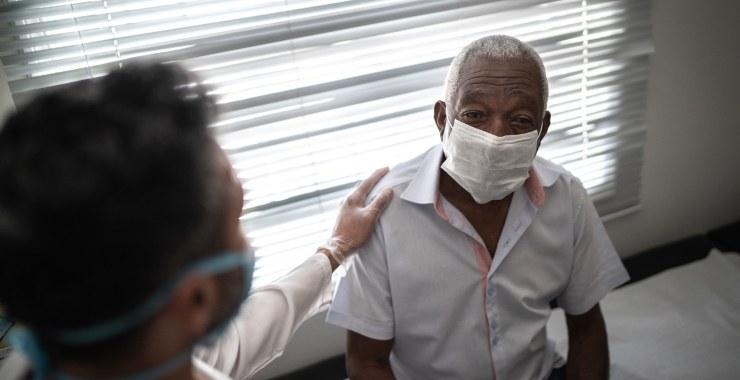
People of color and disadvantaged families have been disproportionately impactedopens in new window by COVID-19. More than a year after the World Health Organization declared COVID-19 a pandemic, our understanding of its disproportionate effects and underlying causes is only just beginning. Among them, is access to quality mental health care.
In September 2020, the Centers for Disease Control and Prevention’s National Center for Health Statistics (NCHS) reported survey resultsopens in new window showing that in 2019, over 19% of adults in the U.S. received mental health treatment in the previous year, including prescription medication, counseling, or therapy from a mental health professional. Of those adults, White people were more likely to receive mental health treatment than people of other races. The survey also revealed that people living in the more rural areas were more likely to receive mental health treatment than those living in more urban areas. “These reports are meant to be a starting point on researching mental health treatment and discussions about mental wellness. This data is the first step,” says Emily Terlizzi, MPH, a health statistician for NCHS.
The next step is for researchers to explore the underlying causes of inequity. “At NCHS, our job is to present timely and nationally representative data,” Terlizzi says. “We leave it to other researchers to discuss the implications of that data.” One huge implication involves the many cultural differences that have created barriers to accessing mental health care among people of color, says Ysabel Duron, president and executive director of the Latino Cancer Institute.
These inequalities highlight the need for deeper research into why they exist in the first place. The disparities in mental health services often result from lack of insurance coverage, lack of access to good providers, or bias and discriminationopens in new window—all of which are more likely to be experienced by people of color and disenfranchised groups. Duron adds that high co-pays also contribute to mental health care disparities among people of color. Within black and brown communities, “traditionally, you couldn’t get sick because you couldn’t afford to, and that translates to mental health care as well,” says Duron.
Also, people of color are less likely to find employmentopens in new window under normal circumstances than people who are not of color. Now, in the middle of a pandemic that has caused 25% of adults in the U.S to lose their jobsopens in new window, finding employment is even more difficult for many. “These issues exacerbate mental health problems in people that are already quite ill,” says Duron. “They are dealing with potential evictions from their homes, risking safety concerns with children and family members, and the inability to find resources to deal with those things.”
People living with these disparities include residents of low-income housing located in neighborhoods too far away from mental health care providers for convenient travel. “COVID makes all of those things worse,” says Wilma Batiste, chair of the University of California San Francisco’s Abundant Life Health Ministries Network. A former clinical research coordinator, Batise is currently a community advocate and reviews health-related research grants. In her work, she has seen previous researchopens in new window indicating that underrepresented populations have difficulty accessing health care because of low outreach and community engagement efforts. Batiste believes it is important to explore how future research can be used to correct these inequities.
Community research
While scientific and anecdotal data have shown clear racial disparities in mental healthopens in new window, they have worsened in the wake of COVID-19. “This is why we need to have some research on the populations more heavily impacted by the virus,” Batiste says. She hopes that looking into the COVID-19 situation can also address “housing insecurity, food deserts, and all of those other things that compound COVID.”
“These are disparities that we already had in communities of color and lower economic communities that have been dealt with in the past, and it reflects on our inability or unwillingness to have done work in these populations before,” says Duron. To be able to discuss the implications of research findings that uncover these disparities, researchers must identify the people who are at risk within the community, says Duron.
Community-based researchopens in new window involves members of the community in the research, allowing them to participate in the exploration of their own situations. Community involvement helps to remove cultural barriers that prevent health-related research from being easily carried out, such as a lack of trust in the researchers. For example, Batiste shares that very few members of immigrant communities were willing to participate in COVID-19 testing at the beginning of the pandemic because they thought the testers were only coming to their community to find out their immigration status. “They wouldn’t even let us get close to them,” she says. This lack of trust discourages people from participating in testing and ends up making it difficult to capture important data – for example, data on how the virus affects people of color, she says.
The key to getting people to trust researchers is using community health workers that are part of the community you are researching, says Duron.
She has used community health workers to research gaps in health care systems that also lead to inequity and disparities as well as to address health risks among people of color that need immediate attention. “While you are taking months to figure out how a study should be validated, people have died,” she says. “We can go into the community and get some data—it may not be with a valid instrument, but we are in the trenches doing the work,” she says.
This kind of research can lead to data that will inform future evidence-based programs to improve community mental health.
Future research
Van Ta Park, PhD, MPH, is an associate professor at University of California, San Francisco. Her research proposal to study the effects of COVID-19 on the mental and physical health of Asian Americans and Pacific Islanders (AAPI) has been funded by the National Institutes of Health.
Dr. Park will survey members of the AAPI community on how COVID-19 has impacted their health, access to healthcare, experiences with discrimination, employment, income, and many other factors. She expects to find a connection between physical and mental health levels and the severity of the effects of the virus. She also expects to find that experiences with discrimination will have a negative effect on mental health–related issues of COVID-19.
Because community-based research can help reduce health disparitiesopens in new window, Dr. Park wants research on the disparate effects of COVID-19 to be more than a one-time survey and to lead to the development of programs and interventions for communities adversely affected by the pandemic. She hopes her research will inform future policies, programs, and follow-up research that can help to minimize the adverse effects of COVID-19 on members of the AAPI community.
“We found that 60% of AAPI experienced discrimination in the past 6 months and 59% believed that the country has become more dangerous for their ethnic group. These data emphasize that there’s much work needed to be done for AAPI to feel safe, heard, and supported,” shares Dr. Park.
According to Batiste, “Because of the racial injustice and social injustice, we know that people of color have always been mistreated, that is nothing new. But now that everybody sees it, they don’t have a cover for all of those things that contribute to the virus and mental wellness disparities.”
“Covid has forced us to come to these reckonings about disparities,” Duron says.
One of Dr. Park’s COVID-19 papers has been published, and is available hereopens in new window.
The APA has issued a call for papers for a special journal issue, Translational Issues in Psychological Science, for researchers to bring awareness to, and promote understanding of, complex personal and societal issues arising from pandemics.