Practical Ethics for Psychologists
Available formats
Also available from
- Doody's Core Title
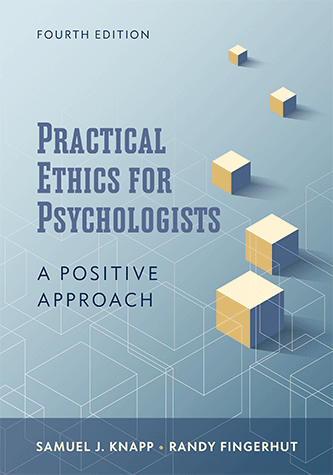
The fourth edition of this seminal book, guided by the APA Ethics Code and a social justice perspective, shows psychologists how to achieve higher standards of ethical practice in their everyday work.
Advocating a positive, proactive approach to ethics, Samuel Knapp and Randy Fingerhut go beyond the minimal ethical requirements in clinical practice, research, education, forensic psychology, consultation, and other areas. Through vivid case examples, they explore ethical dilemmas that psychologists must face regarding issues including informed consent, confidentiality, maintaining competence, and protecting the welfare of clients and society at large.
The authors present three models to guide psychologists:
- the ethics acculturation model for balancing personal and professional ethics;
- the five-step decision-making model for navigating complex ethical quandaries; and
- the quality enhancement model for managing risk, particularly with patients who may cause harm to themselves or others.
Preface to the Fourth Edition
Acknowledgments
- Chapter 1. The Legal Floor and Positive Ethics
- Chapter 2. Foundations of Ethical Behavior
- Chapter 3. Social Justice
- Chapter 4. Applying Ethical Theories to Ethics Codes and Ethical Decision-Making
- Chapter 5. Competence
- Chapter 6. Informed Consent or Empowered Collaboration
- Chapter 7. Multiple Relationships and Professional Boundaries
- Chapter 8. Confidentiality, Privileged Communications, and Record Keeping
- Chapter 9. Life-Endangering Patients
- Chapter 10. Psychological Testing and Assessment
- Chapter 11. Forensic Psychology
- Chapter 12. Special Topics in Psychotherapy
- Chapter 13. Business Issues
- Chapter 14. Psychologists as Educators
- Chapter 15. Consultation and Clinical Supervision
- Chapter 16. Research and Scholarship
Afterword: Fulfilling Psychology’s Ethical Ideals
References
Index
About the Authors
Samuel Knapp, EdD, ABPP, is a retired psychologist and was director of professional affairs for the Pennsylvania Psychological Association. He has written or edited 16 books and more than 100 peer reviewed articles and made almost 500 professional presentations on ethics, suicide prevention, and other professional issues. He authored Suicide Prevention, was editor-in-chief of the APA Handbook of Ethics in Psychology, and coauthored Ethical Dilemmas in Psychotherapy. He holds a diplomate in counseling psychology from the American Board of Professional Psychology. Dr. Knapp received the APF Gold Medal Award for Lifetime Achievement in the Practice of Psychology in 2021.
Randy Fingerhut, PhD, is a professor of psychology at La Salle University. He teaches ethics and psychotherapy courses and supervises graduate students within their doctoral program. Dr. Fingerhut’s research interests include perinatal mood and anxiety disorders and self-care for graduate students. Dr. Fingerhut is a fellow of the Academy of Cognitive Therapy, an adjunct faculty member of The Beck Institute of Cognitive Behavioral Therapy, and has been practicing and training others in cognitive behavior therapy for over 20 years. He is a fellow of the Pennsylvania Psychological Association, serving on their Ethics and Legislative and Governmental Affairs committees.
To all those who want to practice ethically and to have a framework for addressing the many complex ethics issues and dilemmas that arise in the practice of psychology, this book is for you. Practical Ethics for Psychologists lives up to the promise of its title and really does provide very practical and user-friendly guidance for addressing and responding to the ethics issues common to the practice of psychology today, with each issue illustrated by realistic and relatable case examples. Every psychologist and psychologist-in-training should purchase and regularly read and use this book.
—Jeffrey E. Barnett, PsyD, ABPP, Professor of Psychology, Loyola University, Maryland
To keep psychologists current with the changes and challenges in the field, the fourth edition of this valuable book includes a focus on culture and diversity, ethical issues regarding new health care technologies, and the necessity of self-care. The authors encourage psychologists to go beyond just following the rules to avoid punishment and strive to achieve their highest ethical aspirations. Through vignettes the reader can see how ethical principles apply to everyday situations and can expand their ethical decision-making skills. Students as well as professionals will benefit from the many practical examples of situations often faced by psychologists.
—Linda K. Knauss, PhD, ABPP, Professor of Psychology, Widener University, Institute for Graduate Clinical Psychology
“Practical” and “positive” are but two of the adjectives that apply to the newly published fourth edition. “Insightful,” “in-depth,” and indeed “indispensable” further describe this critically important resource.
—Eric Y. Drogin, JD, PhD, ABPP, Harvard Medical School; Past Chair, Committee on Professional Practice and Standards, American Psychological Association
This book should be on the bookshelf of every practicing psychologist. It is chockful of timely, current, practical, and common sense advice on how to practice psychology consistently with both the law and ethics. It is truly, once again, a winner!
—Jeffrey N. Younggren, PhD, ABPP, Clinical Professor, Department of Psychiatry and Behavioral Sciences, University of New Mexico, Albuquerque; Associate Editor, Professional Psychology: Research and Practice; COL(r), MS; Risk Management Consultant, The Trust
Supplemental resources require an APA account and approval from APA to access. Please create or log inlogin required to your account and return to this page to download materials. Please note: After logging in, you may still need to be approved by APA staff to access secure content.