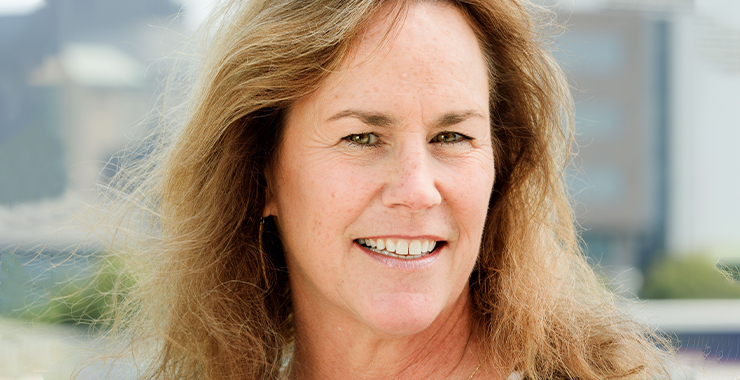
Photo courtesy of Trevr Merchant for the University of Colorado Denver.
Young people should be safe in their schools, but what is the best way to achieve that? APA member Franci Crepeau-Hobson, PhD, associate professor and director of clinical training in the School Psychology Program at the University of Colorado Denver (CU Denver), is working on several fronts to find answers to that compelling question.
But Crepeau-Hobson, a member of APA Div. 16, notes that suicide is the leading cause of death for teenagersopens in new window in Colorado, and second nationwideopens in new window. "Every day, folks in our schools are dealing with suicide" and other serious issues, she says, and for her, getting procedures in place to identify children at risk of taking their own lives, and to intervene with them, is more pressing than addressing the more popularly discussed issue of school safety.
Gun violence at school is "not that common," says Crepeau-Hobson, who has done research on these issues. "School is actually one of the safest places for kids." When gun violence does happen at school, however, "it's devastating." Even if a shooting occurs at another school in another city, and children hear about it, they can feel unsafe, and that can impact their learning and performance.
The infamous 1999 Columbine school shooting in the Denver suburb of Littleton, in which 15 students and teachers died and 21 were injured, was a real watershed, says Crepeau-Hobson. Even though Columbine was by no means the first mass violence event at a school, the toll and the narrative were so horrific that professionals, including school psychologists, began to organize in order to respond more effectively in the future.
"We didn't know what the heck we were doing" at the time, Crepeau-Hobson recalls. A young school psychologist herself in a different Denver suburb, she was so affected by the incident that "when I went into academia, one of the first things I did was develop a crisis intervention class for school psychology students. Now we have some really good research-informed models of response, and people have gotten trained."
She particularly likes the PREPaRE curriculumopens in new window developed by the National Association of School Psychologists (NASP), which she says "covers the gamut from planning and preparedness to response and recovery."
After Columbine, Colorado created a statewide crisis-response team,opens in new window of which Crepeau-Hobson is a member, that has subsequently gone into three schools after shootings to help the community deal with the aftermath. The Colorado team typically focuses on children who witnessed the violence or loss of a friend, or have pre-existing risk factors. When schools support children who have been impacted by school violence, "it works," she says. "Recovery is the norm."
Encouragingly, intervening with children at risk in other settings appears to have good outcomes as well. A 2013 studyopens in new window Crepeau-Hobson conducted in three large Denver-area school districts, of 3,400 children who came to the attention of school authorities as being at risk for suicide and who received support and follow-up, "not one has gone on to take his own life," says Crepeau-Hobson. "If we can find them, we can save them."
It's also possible to find and help children who have the potential to be violent at school. Nearly every school shooter to date has telegraphed those intentions, if not by directly divulging their plans, then with hints in essays, art work or postings on social media.
"We know that if we pick up on that, and engage in really good threat assessment, if we provide that child with mental health support, we can prevent violence," Crepeau-Hobson says.
School culture is key. A positive school culture, one that is "really walking the walk," will demonstrate to all students that they are cared for, and will insist that children treat each other with respect, she says.
Do the best plans for curbing gun violence in schools include arming teachers? No way, says Crepeau-Hobson. "We know that there are some really common-sense, effective ways to prevent school violence, but arming adults, particularly adults who are not well trained, is not one of them."
Crepeau-Hobson grew up in Denver and did her undergraduate work in psychology at Metropolitan State College there. "I always wanted to go into psychology and work with kids," she says. She worked with emotionally disturbed young people as a counselor for several years, but eventually realized that "to really make a difference, I had to pursue graduate education." She got her master's degree in counseling and psychometrics from CU Denver, and her PhD in school psychology from the University of Northern Colorado in Greeley.
At one time, a school psychologist's job consisted exclusively of working with the special education population in a school, assessing and identifying those students, and helping them succeed, says Crepeau-Hobson.
That has changed. Depending on the model of service delivery in place in a district, Crepeau-Hobson says, a school psychologist may be called on to provide direct services, lead groups, prepare behavior intervention plans for challenging children, handle crisis intervention, consult with teachers and parents, work with other mental health professionals like social workers, and intervene at the systems level to address a particular problem — bullying, for example — in a classroom, a grade or even an entire school.
Schools are now expected to flag and deal with mental health problems — not only suicide and the fallout from gun violence, but also child abuse, other kinds of trauma, and bullying — and psychologists are being tasked with bringing their expertise to bear. As a result, districts can't keep up with the increased demand for school psychologists, says Crepeau-Hobson.
Her own program at CU Denver graduates only 15 school psychologists every year, and she figures Colorado's psychology programs altogether probably produce no more than 50 PhDs in the niche. Meanwhile, school psychologists are retiring at a rate that, in many places, ensures that school districts will lose psychologists faster than they can replace themopens in new window, she says.
The CU Denver PhD program equips its school psychologists to "support all kids, no matter what they need," says Crepeau-Hobson. One of the things she likes about school psychology is that "your clientele is right there," that a system is in place for working with them, and that it's easy to identify who needs help: In one arena or another, they're the kids who are struggling in school.