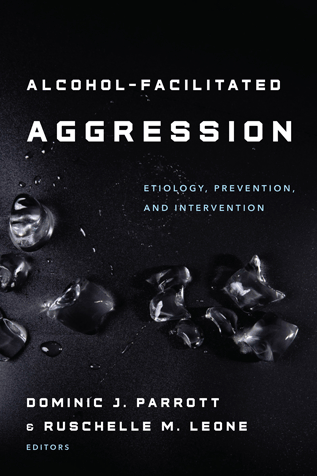
Alcohol-Facilitated Aggression
This book synthesizes interdisciplinary research on alcohol-facilitated aggression and violence. Chapters review key theories and empirical studies, etiology across multiple populations and settings, and evidence-based prevention and intervention efforts.
Bringing together contributors from clinical psychology, public health, criminology, and related disciplines, the volume unites a historically siloed field so experts can better understand the relationship between alcohol use and the perpetration of interpersonal aggression and violence. It bridges the gap between research and implementation, recognizing that meaningful progress requires understanding the behaviors of those who cause harm while attending to the diverse relationships, populations, and contexts in which harm occurs.
Organized into three parts, the first set of chapters establish the historical, theoretical, methodological, analytic, and epidemiological foundations of the field. Then, chapters examine etiological models across perpetratorvictim relationships, including intimate partner aggression and sexual assault in heterosexual and sexual/gender minoritized couples; the role of parental drinking role in child maltreatment and abuse; and social, cultural, and environmental factors that predispose people to drink heavily and engage in aggressive behaviors. Finally, contributors highlight prevention and intervention programs at the individual, community, and policy levels that have shown the most promise in reducing alcohol-facilitated aggression. Integrative chapters identify persistent gaps, such as the relationship between alcohol use and gun violence, and chart future directions.
Contributors
Foreword: Pathways Toward Integrating Alcohol and Aggression Prevention
Sarah DeGue
Introduction to Alcohol-Facilitated Aggression Theory, Research, Etiology, Prevention, and Intervention
Dominic J. Parrott and Ruschelle M. Leone
Part I. Foundations
- Chapter 1. A Historical View of Alcohol and Aggression: Historical Context, Empirical Evidence, and Changing Perspectives
Kenneth Leonard - Chapter 2. Theories of Alcohol-Facilitated Interpersonal Aggression
Christopher I. Eckhardt and Thomas F. Denson - Chapter 3. Methodological Approaches to Studying Alcohol-Facilitated Aggression
David S. Chester and Wyatt T. Brown - Chapter 4. Analytic Methods Used in the Study of Alcohol-Facilitated Aggression
Jaye L. Derrick - Chapter 5. Epidemiological Research on Alcohol-Related Aggression: Prevalence, Patterns, and Contexts
Monica H. Swahn - Chapter 6. An Introduction to Implementation Science Frameworks to Support Alcohol-Facilitated Aggression Research: A Roadmap
Anne Marie Schipani-McLaughlin, Caitlin Thompson, Shannon Self-Brown, Lindsay M. Orchowski, and Elizabeth Perry
Part II. Etiology
- Chapter 7. Alcohol-Facilitated Intimate Partner Aggression Within Heterosexual Couples
Meagan J. Brem and Allison Tobar-Santamaria - Chapter 8. Alcohol-Facilitated Intimate Partner Aggression Within Sexual and Gender Minoritized Couples
Katie M. Edwards, Katherine W. Bogen, David DiLillo, and Joseph Gardella - Chapter 9. Parental Alcohol Use and Child Maltreatment
Daniel Whitaker, Danielle Rivers, and David DiLillo - Chapter 10. A Sociocultural Etiological Analysis of How Alcohol Relates to Both Consensual and Nonconsensual Sexual Experiences
Tiffany L. Marcantonio, Geoffrey Hunt, Mitchell Kirwan, Susan Lagdon, and Melissa Meadows - Chapter 11. Environmental Factors and Alcohol-Facilitated Aggression
Peter Miller, Steven Litherland, Dominique de Andrade, Zara Quigg, and Christopher I. Eckhardt - Chapter 12. Relationships Among Perpetrators and Victims: An Integrative Discussion
William H. George
Part III. Prevention and Intervention
- Chapter 13. Individual-Level Prevention Programs for Alcohol-Facilitated Aggression
Lindsay M. Orchowski and Molly A. Maloney - Chapter 14. Individual-Level Intervention Programs for Intimate Partner Violence and Community Violence in the Context of Alcohol Use
Gail Gilchrist, Mary McMurran, Marisol Lila, and Liz Gilchrist - Chapter 15. Just-in-Time Interventions for Alcohol-Facilitated Interpersonal Aggression
Cynthia A. Stappenbeck, Anna E. Jaffe, Zoe Y. Zong, and Julia F. Hammett - Chapter 16. Interventions for Alcohol-Facilitated Intimate Partner Violence
Brandi C. Fink and Judith N. Biesen - Chapter 17. Community-Level Prevention and Intervention Programs for Alcohol-Facilitated Aggression
Kelly Cue Davis, Kayla Ortiz, Elizabeth A. Walker, and Elizabeth Miller - Chapter 18. A Comprehensive Policy Approach to Preventing Alcohol-Facilitated Aggression
Pamela A. Trangenstein, Ziming Xuan, Daniel Webster, and Richard Matzopoulos - Chapter 19. Preventing and Intervening in Alcohol-Facilitated Interpersonal Aggression: An Integrative Discussion
Andra Teten Tharp, Elizabeth Gray, Nicholas Buhr, Elizabeth Walther, and Laura Neely
Index
About the Editors
Dominic J. Parrott, PhD, is a professor of psychology and the director of the Center for Research on Interpersonal Violence at Georgia State University. He completed his PhD in clinical psychology at the University of Georgia, his clinical internship at the Medical University of South Carolina, and a postdoctoral fellowship at the University of Kentucky funded by the National Institute on Drug Abuse. A nationally recognized expert on the intersection of alcohol and violence, Dr. Parrott has authored more than 130 scientific articles and has received continuous funding from the National Institute on Alcohol Abuse and Alcoholism (NIAAA) since 2006, including seven R01 awards aimed at elucidating the etiology of alcohol-facilitated violence and developing interventions to reduce it.
Ruschelle M. Leone, PhD, earned her PhD in Clinical Psychology from Georgia State University. She is an associate professor in the Division of Addiction Science, Prevention, and Treatment within the Department of Psychiatry at the University of Colorado Anschutz. Dr. Leone's research focuses broadly on identifying risk and protective factors related to alcohol-facilitated intimate partner and sexual violence and translating these findings into prevention programs. Her work has been funded by the National Institute on Alcohol Abuse and Alcoholism, the Department of Defense, and the Substance Abuse and Mental Health Services Administration.