Substance Use Disorders in Underserved Ethnic and Racial Groups
This book examines substance use disorders among individuals and communities of color and offers assessment, treatment, and prevention strategies for supporting and empowering individuals within their cultural contexts.
It explores the unique histories and substance use trends within Black/African American, Latino/Latina/Latinx/Hispanic, Asian American/Pacific Islander, and American Indian/Alaska Native communities. This includes the role of intergenerational trauma and the enduring impacts of colonialism, slavery, and systemic oppression, as well modern injustices and inequities in mental health and medical treatment, criminal justice, and other institutions.
Expert contributors draw upon their extensive experiences working in these communities to establish evidence-based recommendations for culturally competent care. They explore common challenges with assessment and treatment, including the limitations of established models that fail to properly account for cultural factors. They offer culturally bound solutions that enable mental health professionals to better help individuals and communities while respecting their unique intersectional identities and values.
Contributors
Introduction to Substance Use Disorders in Diverse Ethnoracial Groups: Understanding How We Got Here
Edward C. Chang and Christina A. Downey
Part I. Overview of Cultural Competence
- Chapter 1. The Need for Cultural Competence in Understanding and Intervening With Substance Use Disorders
Christina A. Downey
Part II. Substance Use in Black/African American Communities
- Chapter 2. Scope and Historical Origins of Substance Use Disorders Among Black American Communities
Tamika C. B. Zapolski, Alia Rowe, Rieanna S. McPhie, and Maney Darby - Chapter 3. Culturally Competent Substance Abuse Treatment for Black American Communities
Michelle L. Redmond, Rhonda K. Lewis, Tasha Parker, Rosalind Canare, Dyan Dickens, and Stormy Malone - Chapter 4. Preventing Substance Use in Black Youth: What's Available and What's Missing?
A. Kathleen Burlew, Brittany D. Miller-Roenigk, Caravella McCuistian, Randi D. Burlew, and Bridgette J. Peteet
Part III. Substance Use in Asian American/Pacific Islander Communities
- Chapter 5. Substance Use Trends and Patterns Among Asian American and Pacific Islander Communities
Athena Park, Aylin Kaya, Jennifer Brady, Lauren Pandes-Carter, and Derek Kenji Iwamoto - Chapter 6. Culturally Competent Assessment and Treatment of Substance Use Disorders for Asian American Communities
Gloria Wong-Padoongpatt, Anthony King, and Nolan Zane - Chapter 7. Prevention of Substance Use Disorders in Asian American Adolescents: A Review of Family-Based Interventions
Yoonsun Choi, Michael Park, Dina Drankus Pekelnicky, Mina Lee, and Tae Yeun Kim
Part IV. Substance Use in Latino/Latina/Latinx/Hispanic Communities
- Chapter 8. Culturally Competent Assessment and Treatment of Substance Use Disorders in Latino American Communities
Luz M. López and Jocelyn Melian - Chapter 9. Prevention of Substance Use Disorders in Latino/Latina American Communities
Alyssa Lozano, Alejandra Fernandez, Yannine Estrada, and Guillermo Prado
Part V. Substance Use in Native American/Alaska Native Communities
- Chapter 10. Scope and Historical Origins of Substance Use Disorders Among Native American Communities
Tessa Evans-Campbell and Karina Walters - Chapter 11. Assessment and Treatment of Substance Use Disorders in American Indian/Alaska Native Communities: A Cultural and Practice Review and Call for Development
Laurence Armand French and Christina A. Downey - Chapter 12. Interventions for Substance Use Disorders in American Indian/Alaska Native Communities
Eric F. Wagner, John Lowe, and Julie Ann Baldwin
Part VI. Our Multicultural, Multiethnic Future and Substance Use Disorder
- Chapter 13. Integrating a Multicultural, Multiethnic Perspective Into Substance Use Training: Preparing Clinicians for the Future
Christina A. Downey and Edward C. Chang
Index
About the Editors
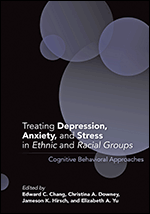
Christina A. Downey, PhD, is assistant vice-chancellor for academic affairs and student success and associate professor of psychology at Indiana University Kokomo. She has published articles on various topics in journals like Eating Behaviors, Psychology & Health, the Scandinavian Journal of Psychology, and The Journal of Effective Teaching and has published several chapters on positive psychology. She also serves on the editorial board of Cognitive Therapy and Research. Dr. Downey was coeditor of the Handbook of Race and Development in Mental Health, Positive Psychology in Racial and Ethnic Groups, and Treating Depression, Anxiety, and Stress in Ethnic and Racial Groups.
Edward C. Chang, PhD, is a professor of psychology and social work and a faculty associate in Asian/Pacific Islander American Studies at the University of Michigan, Ann Arbor. He served as a program evaluator for the Michigan Department of Community Health–Social Determinants of Health, working with the Asian Center of Southeast Michigan. Dr. Chang also serves as an associate editor of Cognitive Therapy and Research. He has published nearly 200 empirical and scholarly works focusing on optimism and pessimism, perfectionism, loneliness, social problem solving, and cultural influences on behavior, including the coedited book Motivation and Morality: A Multidisciplinary Approach.
Downey and Chang’s Substance Use Disorders in Underserved Ethnic and Racial Groups represents a fundamental and essential undertaking that rarely gets the attention it deserves. This volume successfully and remarkably gathers critical information and practical guidance among a diversity of ethnoracial groups. Social and historical events are deftly discussed and placed in essential contexts for psychologists, psychiatrists, and other readers interested in substance use and misuse. The editors recognize, integrate, and discuss the fundamental centrality of ideas that are essential to the successful treatment of substance use disorders. Downey and Chang have gathered luminaries who present, discuss, and clarify key considerations of contemporary cultural competence, and matching treatments to ethnoracial groups (e.g., African Americans, Asian Americans, Hispanic/Latino Americans, and Native Americans). Substance Use Disorders in Underserved Ethnic and Racial Groups represents an integrated public health view that is fundamental to understanding the influence of social setting and cultural set on the process of substance abuse treatment. This volume is so very important: It deserves to be on the shelf of every clinician, policy maker, researcher, and student of substance use and misuse. As I reviewed this text, I kept wondering what took the field so long to prepare a book of this focus and importance.
—Howard J. Shaffer, PhD, Morris E. Chafetz Associate Professor of Psychiatry in the Field of Behavioral Sciences, Harvard Medical School, Boston, MA; distinguished faculty, division on addiction, The Cambridge Health Alliance
This manuscript provides a thoughtful and compelling review of the multitude of ways to provide culturally responsive support to marginalized people of color to improve substance use disorder and mental health outcomes.
—Hendrée E. Jones, PhD, LP, Professor, Department of Obstetrics and Gynecology; Senior Advisor, UNC Horizons, School of Medicine, The University of North Carolina at Chapel Hill, and fellow of Division 28 of the American Psychological Association